

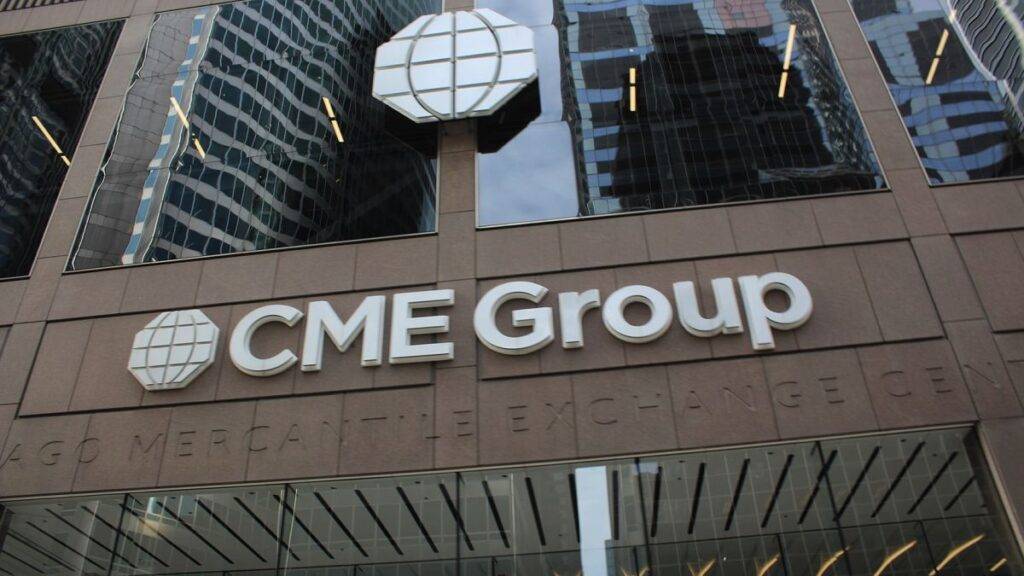
CME Group — the world’s largest derivatives exchange — has, for the first time, publicly confirmed that it is researching the issuance of its own proprietary token, tentatively referred to as “CME Coin.” This information was disclosed by CEO Terry Duffy during an earnings call and immediately drew attention from both the traditional finance world and the crypto community.
This move comes as CME prepares to launch 24/7 crypto futures trading and expand its digital asset offerings, signaling that the boundary between traditional finance (TradFi) and crypto is becoming more blurred than ever.
Key Takeaways – What You Need to Know
- CME Group is considering issuing its own token, but no official decision has been made yet.
- The token is intended for use as digital collateral, not a token sold to retail investors.
- CME is partnering with Google Cloud to develop a “tokenized cash” solution.
- This is a strategic move to support financial market infrastructure, not a direct attempt to compete with stablecoins like USDT or USDC.
I. What is CME Coin?
CME Coin is a temporary name used by the media to refer to an internal token that CME Group is researching, based on direct statements from CEO Terry Duffy. At this stage, it is not an official product, but rather an initiative in the phase of strategic and technological evaluation.
An important point to emphasize: CME Coin is not designed as a cryptocurrency for the retail market, but as a piece of financial infrastructure serving the operations of large institutions within the CME ecosystem.
Is CME Coin a crypto asset for retail investors?
No. Based on all publicly disclosed information, CME Coin (if launched) would have the following characteristics:
1. An internal token for institutions
CME Coin would most likely:
- Be used only by CME members, banks, investment funds, and financial institutions
- Not be open to free trading by retail investors
- Not be listed on public crypto exchanges
This indicates that CME Coin is not aimed at speculation or value storage, but instead functions as an operational financial tool.
2. The main use cases of CME Coin within the CME ecosystem
Based on statements from the CEO and CME’s operating context, the token could be used for:
Margin / Collateral
- Tokenization of collateral assets
- Helping institutions to:
- Post margin more quickly
- Reduce dependence on traditional banking systems
- Process margin almost in real time
Payments & clearing
- Optimizing settlement processes between market participants
- Reducing T+1 and T+2 settlement cycles in traditional finance
- Minimizing settlement risk
Tokenized collateral management
- Enabling:
- More transparent collateral tracking
- Automation of risk management processes
- Integration with CME’s 24/7 crypto futures trading system
In other words, CME Coin acts like “lubricating oil” for the financial engine, not “speculative fuel.”
3. Comparing CME Coin with JPM Coin
A very close and easy-to-understand comparison is JPM Coin from JPMorgan:
| Criteria | CME Coin (expected) | JPM Coin |
| Users | Institutions, CME members | JPM institutional clients |
| Purpose | Margin, payments, collateral | Internal payments |
| Listed on exchanges | No | No |
| Price speculation | No | No |
This shows that CME Coin belongs to the category of institutional blockchain tokens, not crypto in the commonly understood retail sense.
Which blockchain would CME Coin operate on?
What has CME officially said?
CEO Terry Duffy stated that CME is:
- Researching the use of tokens on a decentralized network
- But has not disclosed a specific blockchain
At present, CME has not confirmed:
- Which blockchain the token would run on
- Whether it would use a public blockchain
- Whether it would combine multiple chains or operate on a single proprietary system
Possible blockchain scenarios
Based on CME’s characteristics, there are three main scenarios:
Scenario 1: Permissioned blockchain (most likely)
- Only authorized parties can participate
- Suitable for:
- Regulatory compliance
- Risk management
- The needs of financial institutions
This is the model preferred by many banks and traditional exchanges.
Scenario 2: Controlled public blockchain
CME could:
- Use public blockchain infrastructure
- But restrict access rights and functionality
Advantages:
- Leverages the security and transparency of public blockchains
Disadvantages:
- Difficult to meet regulatory and control requirements
Scenario 3: Hybrid model
- Combines:
- A private blockchain for internal transactions
- Selective connections to public blockchains
This is a trend that many large financial institutions are currently experimenting with.
Important notes
- CME has not committed to issuing CME Coin
- The name “CME Coin” is purely a media label
- The entire project is still in the stages of:
- Research
- Experimentation
- Feasibility assessment
II. CME’s partnership with Google and what “tokenized cash” means
In a recent statement, CEO Terry Duffy confirmed that CME Group is working with Google Cloud to develop a “tokenized cash” solution, which is expected to be rolled out in the near future as part of CME’s strategy to modernize financial market infrastructure.
This is not a retail crypto product, but rather a payment and clearing infrastructure for financial institutions, designed to support large-scale derivatives and digital asset trading.
What is tokenized cash?
Tokenized cash can be understood as:
- Fiat currency (USD, EUR, etc.) that is digitized and represented as tokens on a blockchain
- Circulating only within a controlled environment operated by financial institutions
These tokens are:
- Backed 1:1 by real fiat money
- Issued and managed by licensed institutions
- Not freely transferable on open markets
The core objectives of tokenized cash
Tokenized cash is not created for speculation, but to:
- Speed up settlement
- Reduce counterparty risk
- Enable real-time margining and clearing
This becomes especially critical as CME prepares to offer 24/7 crypto futures trading, where traditional banking systems cannot operate continuously.
How is tokenized cash different from stablecoins?
Although both put “money on the blockchain,” tokenized cash and stablecoins serve very different ecosystems.
Detailed comparison: Tokenized cash vs. stablecoins
| Criteria | Tokenized Cash | Stablecoin |
| Users | Institutions, financial entities | Individuals & institutions |
| Circulation scope | Internal, controlled | Global, permissionless |
| Purpose | Payments, clearing, margin | Trading, DeFi, transfers |
| Regulatory compliance | Very high | Depends on the issuer |
| Speculation potential | None | Yes |
| Examples | CME–Google initiative | USDT, USDC |
In short:
- Stablecoins = digital money for open markets
- Tokenized cash = digital money for financial infrastructure
Why doesn’t CME use stablecoins?
CME cannot rely on popular stablecoins because of:
- Limited control over fund origins and money flows
- Legal and compliance risks
- Unsuitability for large-scale margin systems
Tokenized cash allows CME to:
- Maintain full control
- Meet strict regulatory standards
- Integrate directly with the exchange’s clearing systems
The role of Google Cloud in the tokenized cash project
Google Cloud is not issuing the token, but acts as CME’s strategic technology infrastructure partner.
1. Providing enterprise-grade technology infrastructure
Google Cloud supports CME with:
- Financial-grade cloud computing infrastructure
- Capabilities to handle:
- Massive transaction volumes
- Low latency
- Continuous 24/7 operations
This is critical for:
- Futures trading
- Real-time settlement
- Instant risk management
2. Supporting secure payment and digital asset management systems
Google Cloud helps CME:
- Design secure blockchain architectures
- Integrate:
- Key management
- Identity authentication
- Transaction monitoring
The goals are to:
- Prevent system failures
- Reduce fraud
- Meet audit and compliance requirements
3. Meeting the standards of major financial institutions
Google Cloud already has:
- Extensive experience working with banks, funds, and exchanges
- Compliance frameworks covering:
- Data security
- International financial regulations
This partnership helps CME to:
- Accelerate deployment
- Reduce technological risk
- Build trust among institutional participants
III. Why is CME Group considering issuing a token now?
CME Group’s first public move to research issuing a token is not a random decision, but the result of two major pressures happening at the same time:
- Structural changes in how the crypto market operates
- Direct competition from blockchain technology and DeFi
1. The demand for 24/7 crypto trading
CME is being forced to change its traditional operating model
For decades, derivatives markets have operated with:
- Fixed trading hours
- Cyclical settlement and clearing systems (T+1, T+2)
However, crypto never sleeps. As CME prepares to:
- Launch 24/7 crypto futures trading
The old model is no longer suitable.
The core problem: margin and settlement cannot “sleep”
24/7 trading requires:
- Margin to be:
- Posted
- Adjusted
- Liquidated
- In real time
Meanwhile, traditional banks:
- Have business hours
- Observe holidays
- Operate with processing delays
This is the biggest bottleneck if CME wants to scale crypto futures.
What problem does tokenizing collateral solve?
Tokenizing collateral allows CME to:
Reduce processing time
Collateral assets are:
- Digitized
- Recorded instantly within the system
No need to wait for:
- Bank confirmations
- Interbank transfers
Margin adjustments can happen almost in real time.
Reduce settlement risk
In derivatives markets, the biggest risks are:
- A counterparty lacking sufficient collateral at critical moments
- Delayed settlement during periods of high volatility
Tokenization enables:
- Continuous monitoring of collateral status
- More accurate and automated:
- Margin calls
- Liquidations
Optimize capital efficiency for institutions
Instead of:
- Holding idle cash in accounts
- Waiting for manual processing
Institutions can:
- Move collateral more quickly
- Use capital more efficiently
- Reduce opportunity costs
This is especially important for large funds and banks.
2. Competitive pressure from blockchain and DeFi
DeFi is setting new benchmarks for the market
DeFi systems enable:
- Near-instant settlement
- 24/7 trading
- Independence from:
- Banks
- Intermediaries
Even though CME does not directly compete with DeFi:
- Market expectations have changed
- Institutional investors are starting to:
- Compare speed
- Compare capital efficiency
If CME does not evolve, it risks falling behind.
CME’s strategic choice
CME stands at a crossroads:
- Maintain traditional systems → safe but slow and inflexible
- Or:
- Adopt blockchain
- Upgrade infrastructure
- While preserving regulatory standards
An internal token is:
- The fastest way for CME to capture blockchain’s advantages
- Without sacrificing control
CME cannot fully “DeFi-ize”
CME cannot:
- Deploy permissionless smart contracts
- Allow anonymity
- Bypass KYC/AML procedures
Because:
- CME is a heavily regulated exchange
- Serving the global financial system
Therefore, CME needs:
- Controlled blockchain infrastructure
- Internal tokens
- Full compliance processes
CME’s token strategy: competing on infrastructure, not speculation
The key difference:
- DeFi competes on:
- Speed
- Freedom
- CME competes on:
- Reliability
- Scale
- Regulatory compliance
CME’s token is:
- Not meant to replace DeFi
- But to:
- Retain institutional capital
- Bring a “DeFi-like” experience into TradFi, without abandoning regulation
IV. What impact could CME Coin have on the crypto market?
Even though CME Coin (if issued) would not be a publicly traded token, its impact on the crypto market could be significant at the infrastructure and market-psychology level. The effects are unlikely to show up immediately in prices, but rather spread gradually over the medium to long term.
Positive impacts
1. Increasing crypto’s credibility within traditional finance
When CME Group — one of the pillars of the global financial system:
- Researches issuing its own token
- Deploys blockchain for margin and settlement
It sends a very clear message:
Blockchain is no longer a fringe technology — it is becoming official infrastructure for traditional finance.
This helps to:
- Reduce the perception that crypto is only about:
- Speculation
- High risk
- Increase confidence among:
- Banks
- Investment funds
- Policymakers
This confidence is not measured by price, but by long-term capital flows.
2. Strongly accelerating the asset tokenization trend
CME Coin is one piece of a much larger trend: asset tokenization.
When CME:
- Tokenizes cash
- Tokenizes collateral assets
It effectively:
- Standardizes the concept of “assets on blockchain”
- Moves tokenization from:
- Experimentation → real-world deployment
This creates a spillover effect into:
- Tokenized bonds
- Tokenized funds
- Traditional financial assets moving onto blockchain rails
3. Speeding up the development of institutional blockchain
Unlike DeFi, CME represents:
- Permissioned blockchains
- Compliance-first blockchains
- Blockchain systems built for large-scale operations
CME’s participation helps to:
- Push forward:
- Technical standards
- Operational standards
And encourages blockchain projects to:
- Focus more on institutional needs
- Prioritize security, compliance, and scalability
This is the institutional blockchain segment, where token prices are not the main driver, but the economic value is enormous.
4. Paving the way for internal tokens issued by traditional exchanges
When CME — a leading derivatives exchange — seriously explores an internal token, it may:
- Set a precedent
- Encourage other traditional exchanges to:
- Consider issuing tokens for:
- Payments
- Margin
- Clearing
- Consider issuing tokens for:
Similar to:
- JPMorgan with JPM Coin
CME could become a case study for:
- Exchanges
- Clearing houses
- Central securities depositories
Limitations and important considerations
1. CME Coin is not a direct investment opportunity
A crucial point to emphasize:
- CME Coin is not designed for trading
- It will not be listed
- It will not have:
- Price charts
- Public liquidity
Therefore:
- Retail investors cannot “buy into” CME Coin
- There is no narrative of:
- Buying early
- Making outsized gains
2. It will not trigger an altcoin “pump”
CME Coin is:
- Not a public token
- Not a fundraising project
It does not come with:
- Airdrops
- A retail-facing ecosystem
As a result:
- This news is not a short-term catalyst for altcoins
- It will not create speculative waves like:
- “Tokenization = coin X pumps”
Any price reactions (if they occur) are usually:
- Indirect
- Slow
- More psychological than technical
3. A long-term structural story, not a speculative trade
The real impact of CME Coin lies 2–5 years down the road, when:
- Traditional assets are tokenized at scale
- Blockchain becomes default financial infrastructure
This is a story about:
- Systems
- Infrastructure
- New standards
Not about:
- “x10 – x20” returns
- Short-term trading opportunities
This is not a narrative for momentum traders, but for long-term structural transformation.
FAQ – Frequently Asked Questions
Has CME Coin been issued yet? → No. It is currently still in the research phase.
Can retail investors buy CME Coin? → No. If issued, the token would most likely be limited to institutional use only.
Conclusion
CME Group’s consideration of issuing CME Coin marks:
- A significant step by traditional finance into blockchain
- A clear acknowledgment that tokenization is the future of capital markets
Although this move does not create short-term excitement for retail investors, it carries major structural significance, paving the way for deeper convergence between TradFi and crypto in the years ahead.
Disclaimer:The information provided here is for informational purposes only and should not be considered financial, investment, legal, or professional advice. Always conduct your own research, consider your financial situation, and, if necessary, consult with a licensed professional before making any decisions.
