


1. BlockStreet Airdrop: BSD Points Campaign Overview
BlockStreet; the Monad-first execution and lending layer for tokenized equities backed by $11.5 million from Hack VC, DWF Labs, and angels from Jane Street, Point72, and HRT is currently running its active pre-TGE points farming campaign. Users who accumulate $BSD reward points through the platform now are building the on-chain footprint that will determine their allocation at the upcoming Token Generation Event, targeting March to Q2 2026.
This is a low-friction, realistic campaign. BlockStreet is not promising to reinvent DeFi. It is building precise, institutional-grade infrastructure for trading tokenized stocks on-chain and rewarding the users who help stress-test that infrastructure before mainnet.
Key Facts:
- Platform: blockstreet.money (Monad testnet active)
- Points Token: $BSD (BlockStreet Dollar reward points)
- TGE Target: March / Q2 2026
- Total Token Supply: 1,000,000,000 $BSD
- Initial Circulating Supply at TGE: ~20.775% (207.75M $BSD)
- Funding: $11.5 million; Hack VC (lead), Generative Ventures (co-lead), DWF Labs, StudioB, Bridge34; angels from Jane Street, Point72, and HRT
- Mainnet: Monad (primary), expanding to Ethereum, BNB Chain, and Base
- Active Users: 484,000+ | Transactions: 2.8 million+
- Cost: Minimal (small gas on live chain; free on testnet)
2. What Is BlockStreet? The Execution Layer for On-Chain Stocks Explained

2.1 The Problem: Tokenized Equities Are Wrappers, Not Real Markets
The first wave of tokenized real-world assets produced digital representations of traditional instruments; on-chain receipts that proved ownership of an off-chain asset. Useful for passive exposure, but structurally limited. You could hold a tokenized AAPL share on-chain, but you could not borrow against it, short it, hedge it, or trade it with the execution quality of a traditional equity market. The tokenization was cosmetic. The market microstructure underneath remained broken.
BlockStreet co-founder Hedy Wang framed the company’s mandate directly: “Our mandate is infra, not just an app.” The team which includes a risk-and-trading quant lead from Point72 and Citadel, a Google engineering veteran, and a prior Binance-listed founder built their stack to solve the execution and lending gaps that every existing tokenization platform had left unaddressed.
2.2 The Two-Stack Solution: Aqua + Everst
BlockStreet’s entire platform is built around two interlocking infrastructure layers:
Aqua — The RFQ Execution Engine

Aqua is a request-for-quote (RFQ) intent coordination system built on Monad’s parallel EVM. Rather than routing trades through an automated market maker (AMM) which exposes orders to MEV leakage, front-running, and information leakage, Aqua segments order flow into RFQ intents that off-chain market makers compete to fill.
Market makers submit cryptographically signed quotes using EIP-712, verified on-chain at settlement for authenticity, expiry, and nonces before execution completes. The result is deterministic execution quality measurably tighter spreads than AMM routing, and MEV leakage structurally eliminated rather than patched at the application layer.
Everst — The Equity-Native Lending Layer
Everst is the lending, borrowing, and liquidation engine purpose-built for tokenized equities. It introduces two core innovations:
Dual-Oracle Aggregation: Multiple price feeds pulled and aggregated simultaneously, reducing manipulation risk and ensuring price accuracy during volatile equity market gaps a known weakness in crypto-native liquidation systems.
Hybrid Liquidation Routing: Liquidations can route to on-chain auctions or off-chain broker venues depending on available liquidity minimizing slippage during fast-moving markets that would overwhelm purely on-chain systems.
Together, Aqua and Everst make tokenized equities borrowable, shortable, and hedgeable; not just holdable. Initial supported assets include AAPL, TSLA, NVDA, and MSTR.
2.3 Why Monad?
Monad’s parallel EVM architecture allows multiple transactions to execute simultaneously, delivering significantly higher throughput without sacrificing Ethereum compatibility. For an RFQ system where market makers compete to fill the same intent in real time, this throughput and latency profile is non-negotiable. BlockStreet plans to extend routing reach to Ethereum, BNB Chain, and Base as integrations mature, but Monad remains the primary settlement foundation.
2.4 Founding Team
| Name | Role | Background |
| Hedy Wang | Co-Founder | On-chain execution infrastructure and market microstructure |
| Quant Lead | Risk & Trading | Point72 and Citadel — institutional equity risk and execution |
| Engineering Lead | Core Tech | Google engineering background; blockchain systems architecture |
| Third Co-Founder | Ecosystem | Prior Binance-listed project founder; exchange listing and community experience |
2.5 Funding and Institutional Backers

BlockStreet raised $11.5 million in October 2025, led by Hack VC with co-lead from Generative Ventures. Additional participants include DWF Labs, StudioB, and Bridge34, alongside angel investors from Jane Street, Point72, and HRT; three of the most sophisticated quantitative trading firms in global traditional finance.
The participation of Jane Street, Point72, and HRT angels is not decorative. These are operators who have built and traded within the very market microstructure BlockStreet is attempting to replicate on-chain. Their involvement signals that the technical approach has passed scrutiny from people who are specifically qualified to evaluate it.
3. $BSD Token Mechanics, Utility, and Tokenomics
3.1 Token Supply and Allocation
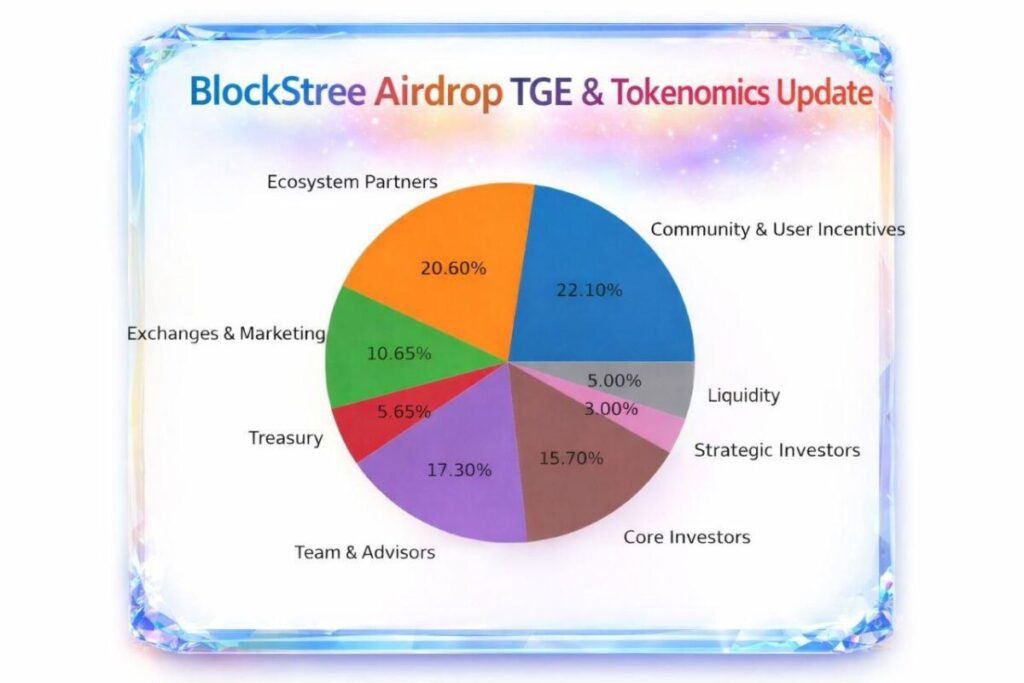
The total supply of $BSD is 1,000,000,000 tokens (1 billion). The initial circulating supply at TGE is approximately 20.775%; roughly 207.75 million $BSD entering the market at launch.
| Category | Allocation | TGE Unlock | Vesting Schedule |
| Community & Users | 22.10% (221M) | 3.125% | 5-year linear |
| Ecosystem Partners | 20.60% (206M) | 2.00% | 5-year linear |
| Exchanges & Marketing | 10.65% (106.5M) | 10.65% — Fully Unlocked | None |
| Liquidity | 5.00% (50M) | 5.00% — Fully Unlocked | None |
| Treasury | 5.65% (56.5M) | 0% | 6-month cliff + 5-year vesting |
| Team & Advisors | 17.30% (173M) | 0% | 12-month cliff + 5-year vesting |
| Core Investors | 15.70% (157M) | 0% | 12-month cliff + 4-year vesting |
| Strategic Investors | 3.00% (30M) | 0% | 12-month cliff + 4-year vesting |
3.2 $BSD Token Utility
Trading and Liquidity Participation: $BSD provides depth in platform liquidity pools, earning fee revenue for participants in Aqua’s market-making infrastructure.
Fee Discounts: $BSD holders receive reduced fees across both Aqua (execution) and Everst (lending and borrowing); creating a direct financial incentive for active platform users to hold.
Premium Access: Higher leverage tiers, priority RFQ routing, and advanced Everst lending parameters are gated behind $BSD staking thresholds.
Governance: $BSD holders vote on protocol upgrades, fee parameters, and treasury deployment.
Revenue Sharing and Buyback/Burn: A confirmed portion of platform trading fees is used to buy $BSD on open markets and distribute to stakers or burn; creating deflationary pressure that scales with platform volume growth.
4. BlockStreet Airdrop Farming Guide: Step-by-Step Participation

4.1 Step 1 — Platform Onboarding (One-Time)
Navigate to blockstreet and connect your EVM wallet (MetaMask or Rabby). Switch your network to BNB Chain before connecting. Complete the jump-start onboarding flow to unlock the full mission dashboard and receive your baseline points allocation.
4.2 Step 2 — Complete Social Baseline Tasks (One-Time)
Secure your account’s anti-bot baseline before doing anything on-chain:
- Follow @BlockSt_HQon X (Twitter)
- Join the official BlockStreet Discord
- Link your X and Discord accounts to your rewards profile
These tasks are free and establish your identity within the platform’s Sybil filtering system. Accounts without completed social binding have historically received reduced allocations or been partially filtered at snapshot.
4.3 Step 3 — The Daily Swap Routine
Execute 1 to 2 token swaps on BlockStreet every day. The recommended approach for most users: Swap USDT = USDC on BNB Chain.
This is optimal for three reasons:
- Zero market risk — swapping between two dollar-pegged stablecoins carries no price exposure on either side of the trade
- Negligible gas cost — BNB Chain fees are fractions of a cent per transaction, making daily execution economically trivial
- Full contract credit — the swap still registers as a complete on-chain interaction with the BlockStreet smart contract, earning full daily points
Keep swaps consistent and spread across individual daily sessions. Batching multiple swaps in one session earns less than one swap per day across the same number of days.
4.4 Step 4 — DeFi Mission Completions
The dashboard contains tasks with significantly higher point values than daily swaps:
Buy a Tokenized Stock via Aqua Borrow tokenized AAPL, TSLA, NVDA, or MSTR through the Aqua execution layer. This demonstrates genuine financial platform intent and directly engages the RFQ infrastructure the protocol is built around.
Supply and Borrow on Everst Deposit any supported asset as collateral and borrow against it. Even a minimal position registers as an Everst interaction and contributes to your on-chain activity depth profile — a metric the platform tracks separately from basic swap count.
4.5 Step 5 — Referral Program
Share your referral link from the platform dashboard. Referrals are only credited once the referred user has completed at least one verified on-chain swap.
5. Why BlockStreet Deserves Attention: Investment Value Analysis
5.1 Tokenized Equities Are the Dominant RWA Category in 2026
The RWA tokenization narrative has moved decisively beyond stablecoins and treasury products. Tokenized equities; stocks that trade, lend, and settle on-chain with institutional-grade execution represent 2026’s most significant growth frontier in the space. BlockStreet’s positioning as the settlement and lending infrastructure for this market is directly aligned with the largest capital inflows entering on-chain finance this year.
5.2 The Team Brings Rare TradFi Precision to DeFi Infrastructure
Most DeFi infrastructure teams are built from crypto-native engineers who have never operated within traditional equity markets. BlockStreet’s team includes operators from Citadel and Point72 among the most rigorous quantitative equity trading environments in global finance. This gives the product credibility that crypto-native competitors structurally cannot replicate.
5.3 Hack VC and TradFi Angels Represent Genuine Institutional Conviction
Hack VC backs infrastructure with long-term holding conviction. The additional presence of angel investors from Jane Street and HRT firms whose core business depends on execution quality validates BlockStreet’s technical approach in a way that generalist crypto VC participation does not.
5.4 Aqua’s RFQ Model Addresses a Real and Measurable Problem
MEV leakage in AMM systems is a quantifiable tax on every retail trade routed through an automated market maker. For tokenized equity markets where institutional-grade spread tightness is a baseline requirement, AMM routing is architecturally unsuitable. Aqua’s RFQ model is the structurally correct approach. Production-scale execution on mainnet remains to be validated, but the architecture is sound.
5.5 Verdict
Strengths:
- $11.5M from Hack VC, DWF Labs, and TradFi angels from Jane Street, Point72, and HRT
- RFQ-over-AMM execution is the right architecture for tokenized equity trading
- 484,000+ active users and 2.8M+ transactions; verified pre-mainnet traction
- Correct narrative positioning: tokenized equities are 2026’s dominant RWA segment
- Low-friction BNB Chain farming loop; minimal gas, daily habit, net-positive ROTI
Risks and Honest Assessments:
- TGE has already slipped once (Q4 2025 → Q2 2026); Monad ecosystem delivery has been inconsistent
- Day-1 supply structure heavily favors exchange and marketing allocations over community holders
- Not a strong long-term hold without post-mainnet production volume evidence
7. Quick-Start Checklist
- Connect EVM Wallet on BNB Chain
- Follow @BlockSt_HQ + Join Discord & Telegram
- Link X + Discord to Rewards Profile
- Execute 1–2 Daily Stablecoin Swaps (USDT↔USDC)
- Daily Login / Check-In (streak bonus)
- Buy a Tokenized Stock via Aqua
- Supply + Borrow on Everst
- Share Referral Link (verified swap required
8. FAQ: Common Questions Answered
What is the BlockStreet ($BSD) airdrop? BlockStreet is rewarding early platform users with $BSD points through activity on blockstreet.money. Points are earned via daily swaps, DeFi missions, social tasks, and referrals. These points convert to $BSD tokens at TGE, currently targeting March to Q2 2026. The platform is live on Monad testnet with mainnet expanding to Ethereum, BNB Chain, and Base.
Why use BNB Chain instead of Ethereum for farming? Ethereum mainnet gas fees range from $5 to $50+ per transaction depending on network congestion. BNB Chain fees are typically under $0.01. Since BlockStreet rewards transaction frequency rather than dollar volume, BNB Chain delivers identical points at a fraction of the cost; making daily participation economically sustainable across a multi-month farming window.
What is Aqua? Aqua is BlockStreet’s RFQ execution engine. Unlike AMM-based DEXs, Aqua has off-chain market makers compete to fill each order with EIP-712-signed quotes that are verified on-chain before settlement. This eliminates MEV leakage and produces tighter spreads both critical requirements for institutional-grade tokenized equity execution.
What is Everst? Everst is BlockStreet’s lending and liquidation module for tokenized equities. It allows users to borrow against, short, and hedge tokenized stocks using dual-oracle price aggregation and hybrid on-chain/off-chain liquidation routing addressing slippage failures that occur in crypto-native liquidation systems during volatile equity market conditions.
Has BlockStreet launched on mainnet yet? As of March 2026, the primary farming campaign is running on Monad testnet. The original Q4 2025 mainnet target has been delayed; the current TGE window is March to Q2 2026. Monitor @BlockSt_HQ on X for the official mainnet and TGE announcement.
Disclaimer: This article is provided for informational purposes only and does not constitute financial or investment advice. Cryptocurrency markets involve significant risk. Please conduct independent research or consult a qualified professional before making any investment decisions.
