


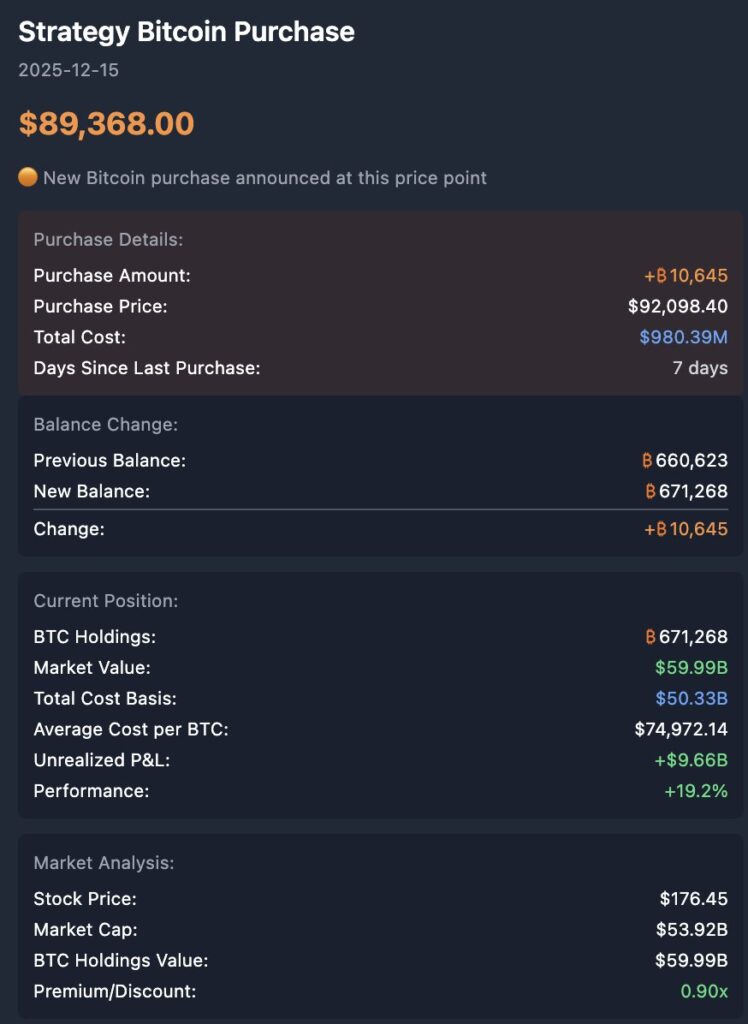
Michael Saylor did it again. Strategy Inc. (formerly MicroStrategy) announced its second consecutive billion-dollar Bitcoin purchase this morning, acquiring 10,645 BTC for $980.3 million at an average price of $92,098 per coin between December 8-14. The relentless accumulation pushes the company’s total holdings to 671,268 BTC, worth approximately $60 billion at current prices—making Strategy the undisputed largest corporate holder of Bitcoin by an enormous margin and cementing Saylor’s status as the most aggressive institutional Bitcoin bull in history.
The numbers are staggering. Strategy now controls more than 3.2% of Bitcoin’s entire 21 million token supply cap, a level of concentration that rivals sovereign-scale holdings in traditional commodity markets. For context, this represents nearly double the Bitcoin the company held at the end of 2024, demonstrating acquisition velocity that has actually accelerated during the brutal Q4 correction that saw BTC crash 28% from October’s $126,000 all-time high. While others panicked and sold, Saylor bought aggressively, adding 21,269 BTC ($1.94 billion) in just the first two weeks of December alone.
The stock-funded acquisition machine shows no signs of slowing. Strategy raised $989 million through sales of common stock (MSTR) and various preferred shares (STRK, STRD, STRF) during the December 8-14 period, immediately converting proceeds into Bitcoin despite BTC trading near multi-month lows around $90,000. This marks the 12th consecutive week of purchases and demonstrates a strategy that has made MicroStrategy synonymous with institutional Bitcoin exposure—achieving 24.9% BTC Yield year-to-date in 2025 even as MSTR stock has fallen 41.2% during the same period.
The Purchase: $980M at $92,098 Average Price
The Details:
Strategy disclosed the Bitcoin acquisition in an 8-K SEC filing submitted December 15, 2025, providing full transparency on funding sources and purchase mechanics as required for publicly traded companies.
Purchase Metrics:
- Bitcoins Acquired: 10,645 BTC
- Total Cost: $980.3 million (including fees)
- Average Price: $92,098 per BTC
- Purchase Period: December 8-14, 2025
- Funding Source: At-the-market (ATM) stock sales
Current Holdings:
- Total BTC: 671,268
- Total Cost Basis: $50.33 billion
- Average Purchase Price: $74,972 per BTC
- Current Value: ~$60 billion (at BTC ~$89,000)
- Unrealized Gain: ~$9.7 billion
- Supply Ownership: 3.2% of 21 million total supply
Year-to-Date Performance:
- BTC Yield: 24.9% (Saylor’s custom metric measuring Bitcoin appreciation on capital deployed)
- Purchases in 2025: Massive acceleration from 2024 levels
- Q4 2025 Purchases: Over $5 billion deployed despite market downturn
How It Was Funded: The ATM Machine
Strategy’s Bitcoin accumulation strategy relies on continuously raising capital through at-the-market (ATM) equity offerings—a mechanism allowing the company to sell shares directly into the public market over time rather than through traditional underwritten offerings.
December 8-14 Stock Sales:
MSTR (Common Stock):
- Shares Sold: 4,789,664
- Net Proceeds: $888.2 million
- Average Price: ~$185 per share
STRD (Perpetual Stride Preferred Stock):
- Shares Sold: 1,029,202
- Net Proceeds: $82.2 million
- Notional Value: $102.9 million
STRF (Perpetual Strike Preferred Stock):
- Shares Sold: 163,306
- Net Proceeds: $18.0 million
- Notional Value: $16.3 million
STRK (Perpetual Stride Preferred Stock):
- Shares Sold: 7,036
- Net Proceeds: $0.6 million
- Notional Value: $0.7 million
STRC Stock: No sales during this period
Total Net Proceeds: $989.0 million
The company immediately deployed $980.3 million to purchase Bitcoin, with the small difference likely covering operational expenses and maintaining minimal cash reserves.
The Controversial Model:
This continuous stock dilution frustrates some shareholders. MSTR stock is down 41.2% year-to-date (compared to Bitcoin’s 3.8% decline), suggesting the market penalizes dilution despite Bitcoin accumulation. However, Saylor argues the “BTC Yield” metric—measuring how much Bitcoin per share increases despite dilution—is what matters. At 24.9% YTD, shareholders own proportionally more Bitcoin per share than at start of 2025, even though share count expanded.
The Saylor Strategy: Buying the Dip
Contrarian Timing:
Strategy’s December purchases stand out for their contrarian timing. Bitcoin crashed from $95,000 to $89,000 following Fed Chair Powell’s hawkish December 10 guidance, yet Saylor accelerated buying:
Week 1 (Dec 1-7): 10,624 BTC for $962.7M at $90,615 average Week 2 (Dec 8-14): 10,645 BTC for $980.3M at $92,098 average
The second week’s higher average price reflects Bitcoin’s brief rally to $94,000 post-Fed announcement before subsequent crash. Rather than waiting for lower prices, Strategy bought consistently regardless of short-term volatility—demonstrating commitment to long-term accumulation over tactical timing.
The Philosophy:
Saylor famously views Bitcoin as “digital property” superior to all other forms of capital storage. His argument: fiat currencies debase at 7-15% annually through money printing; Bitcoin’s fixed 21M supply makes it ideal store of value for corporate treasuries. Even if Bitcoin experiences 30-50% drawdowns, holding it 4+ years generates superior returns to cash, bonds, or most equities.
The Track Record:
Strategy began accumulating Bitcoin in August 2020 when BTC traded around $11,000. Through Nov 2021’s peak ($69K), 2022’s crash to $16K, 2024’s rally to $126K, and 2025’s correction back to $89K, the company never sold a single Satoshi. This diamond-hands conviction has generated $9.7 billion in unrealized gains despite brutal volatility—validating Saylor’s thesis for believers, though critics note gains are “paper profits” until realized.
The Scale: 3.2% of All Bitcoin, Ever
Supply Context:
Bitcoin’s code caps total supply at 21 million coins, with approximately 19.6 million already mined. Strategy’s 671,268 BTC represents:
- 3.2% of total 21M supply
- 3.4% of currently circulating ~19.6M supply
- Roughly double 2024 year-end holdings
For comparison, this Bitcoin stash exceeds the reserves of many nation-states’ sovereign wealth funds. Few entities in traditional commodity markets control 3%+ of global supply in actively traded assets.
Comparative Holdings:
#1: Strategy (671,268 BTC)#2: Marathon Digital (44,394 BTC)#3: Riot Platforms (17,429 BTC)#4: Tesla (11,509 BTC—hasn’t added since 2021)#5: Coinbase (9,000 BTC)
Strategy owns 15x more Bitcoin than the #2 corporate holder. This dominance gives the company outsized influence: if Strategy hypothetically dumped 10% of holdings, it would overwhelm order books and crash prices. Conversely, continuous buying creates permanent demand supporting higher price floors.
The Network Effect:
Strategy’s success inspired copycats. Companies like Semler Scientific, Metaplanet (Japan), and others adopted similar Bitcoin treasury strategies in 2024-2025. However, none scaled to Strategy’s level. Combined, all other public companies hold ~100,000 BTC—still 6.7x less than Strategy alone.

The Stock Tickers: MSTR, STRC, STRK, STRF, STRD, STRE
The Expanding Universe:
Saylor’s December 15 announcement referenced six different tickers: $MSTR $STRC $STRK $STRF $STRD $STRE. This alphabet soup reflects Strategy’s evolution from single stock to multi-vehicle Bitcoin proxy:
MSTR: Traditional common stock STRC, STRK, STRF, STRD: Perpetual preferred stocks with different yields/structures STRE: Newest addition to the suite
These instruments target different investor bases:
- MSTR attracts growth-oriented equity investors
- Preferred stocks appeal to income-focused buyers seeking yield + Bitcoin exposure
- Multiple tickers create arbitrage opportunities and expand total addressable market
The Strategy:
By offering multiple ways to gain Bitcoin exposure, Strategy taps retail investors (who buy MSTR through Robinhood), institutions (who buy preferred stocks for Treasury management), and hedge funds (who arbitrage between vehicles). This diversified capital raising sustains the Bitcoin buying machine regardless of which specific security is trading at premium/discount.
Market Reaction: MSTR Down 3.7% Despite Purchase
Stock Performance:
Paradoxically, MSTR closed Friday (Dec 13) down 3.7% at $176.45 despite announcing the massive Bitcoin purchase. Pre-market trading Monday shows MSTR up just 0.4%—minimal reaction to news that increased Bitcoin holdings by $1 billion.
Why the Muted Response?
Dilution Concerns: Selling 4.8M shares expanded float, reducing earnings per share and ownership percentage for existing shareholders.
BTC Price Weakness: Bitcoin trading at $89,000 vs. $126,000 October peak means Strategy’s entire $60B Bitcoin treasury has lost $28B in market value. Even adding 10,645 BTC doesn’t offset the broader portfolio decline.
Fed Hawkishness: Powell’s December 10 guidance that Fed will only cut rates twice in 2026 (not four times) created risk-off sentiment suppressing all leveraged Bitcoin plays.
Fatigue: Markets may be numb to Strategy’s weekly purchases. What was exciting in 2020-2021 is now routine, reducing news value.
YTD Performance:
- MSTR: -41.2% in 2025
- Bitcoin: -3.8% in 2025
The 37.4 percentage point underperformance suggests investors prefer direct Bitcoin exposure (via ETFs or custody) over Strategy’s leveraged, dilutive model.
The Bull Case: Why This Could Be Genius
Long-Term Conviction:
Saylor’s model only works if Bitcoin appreciates significantly over 5-10 years. At $74,972 average cost and current $89,000 price, Strategy sits on 19% unrealized gains. If Bitcoin hits $150,000 (Bernstein’s 2026 target) or $200,000 (Standard Chartered’s forecast), those gains become 100-167% returns.
Leverage Without Liquidation:
Unlike retail traders using 10-50x leverage on futures (who get liquidated in 30% crashes), Strategy’s equity-funded purchases carry zero liquidation risk. The company can endure Bitcoin dropping to $20,000 without forced selling. This patient capital advantage lets Strategy buy when others panic-sell.
BTC Yield Metric:
At 24.9% BTC Yield, MSTR shareholders own proportionally more Bitcoin per share than year-start despite dilution. If this metric sustains 20-30% annually, long-term shareholders benefit regardless of MSTR stock price fluctuations.
Copycat Inspiration:
Strategy’s success inspired other corporations to adopt Bitcoin treasuries, creating network effects that increase overall corporate demand. This secular shift supports higher long-term Bitcoin prices, benefiting Strategy’s massive holdings.
The Bear Case: Why This Could Implode
Perpetual Dilution:
If Strategy keeps issuing stock to buy Bitcoin, shareholder ownership gets perpetually diluted. At what point does the dilution overwhelm Bitcoin’s appreciation? If BTC stagnates at $90K-$100K range for years, MSTR shareholders suffer permanent value destruction.
Regulatory Risk:
If regulators restrict corporate Bitcoin hoarding or impose punitive taxes on unrealized gains, Strategy’s model breaks. The company’s concentrated Bitcoin position makes it vulnerable to targeted legislation.
Liquidity Crisis:
Strategy holds $60B in Bitcoin but minimal cash. If operational needs require capital and equity markets close (bear market, recession), the company might be forced to sell Bitcoin at unfavorable prices—destroying the “never sell” thesis.
Opportunity Cost:
MSTR’s -41.2% YTD performance vs. Bitcoin’s -3.8% means shareholders would’ve been better off buying BTC directly. Saylor’s premium for “professional management” costs 37.4 percentage points of underperformance.
The Ponzi Critique:
Critics argue Strategy’s model resembles Ponzi dynamics: issue stock → buy Bitcoin → Bitcoin goes up → issue more stock at higher prices → buy more Bitcoin. If Bitcoin price stagnates or declines long-term, the entire structure collapses as stock issuance can’t continue indefinitely.
What Happens Next: The $42B Plan
Strategy announced a $42 billion capital raise plan in October 2025 to continue Bitcoin purchases through 2027. The December acquisitions represent early execution of this multi-year strategy.
Remaining Capacity:
After December’s $2B of purchases, Strategy has ~$40B remaining under the ATM programs. If Bitcoin stays depressed at $90K-$100K range, this capacity could fund acquisition of another 400,000-450,000 BTC—potentially bringing total holdings above 1 million BTC (4.8% of total supply).
The Endgame:
Saylor envisions Strategy as “Bitcoin bank” offering financial products backed by BTC reserves. Potential future offerings:
- Bitcoin-backed corporate bonds
- Lending against Bitcoin collateral
- Yield products for institutional cash management
- Acquisition of smaller Bitcoin treasury companies
If executed, Strategy evolves from simple Bitcoin holder to financial services provider—monetizing its massive BTC position through lending spreads and product fees rather than selling coins.
Conclusion: The Unshakeable Conviction
Michael Saylor’s Strategy just purchased another 10,645 Bitcoin for $980 million, bringing total holdings to 671,268 BTC worth $60 billion—more than 3.2% of all Bitcoin that will ever exist. The December 15 announcement marks the second consecutive week of billion-dollar purchases, demonstrating conviction that remains unshakeable despite brutal market conditions.
For believers, this is genius: accumulating scarce digital property while others panic-sell, positioning for massive gains when Bitcoin eventually crosses $150K-$200K. The 24.9% BTC Yield validates that dilution is offset by appreciation, rewarding patient shareholders with proportionally more Bitcoin per share.
For skeptics, this is madness: perpetual stock dilution funding speculative asset accumulation with no endgame beyond “number go up.” MSTR’s 41.2% YTD decline vs. Bitcoin’s 3.8% drop demonstrates the model underperforms direct Bitcoin ownership while introducing corporate governance, regulatory, and liquidity risks.
The truth likely lies between extremes. Saylor built the most aggressive institutional Bitcoin accumulation vehicle in history—for better or worse. Whether Strategy becomes case study in visionary capital allocation or cautionary tale of leveraged speculation depends entirely on Bitcoin’s long-term trajectory.
One certainty: Michael Saylor isn’t stopping. With $40B remaining capital capacity, hundreds of millions in weekly stock sales, and unshakeable conviction that Bitcoin represents humanity’s best store of value, Strategy will continue buying regardless of price, sentiment, or market conditions.
The world’s largest corporate Bitcoin holder just got larger. Again. And Saylor’s showing no signs of slowing down.
Disclaimer:This content is for educational and reference purposes only and does not constitute any investment advice. Digital asset investments carry high risk. Please evaluate carefully and assume full responsibility for your own decisions.
