Stable is becoming one of the most talked-about Layer 1 Blockchains thanks to its USDT-Native design and its ambition to build a specialized payment infrastructure for stablecoins. As the market shifts toward real-world applications, Stable aims to solve core issues of on-chain payments such as volatile fees, slow confirmations and fragmented liquidity. However, only a few days after mainnet launch, the price performance of STABLE has fallen short of expectations, raising concerns among investors that Stable might repeat the same fate as Plasma.
1. Overview of Stable
1.1 What is Stable?
Stable is a Layer 1 Blockchain purpose-built for stablecoin payments, with its defining feature being the use of USDT (Tether) as both the native asset and Gas Token. This USDT-Native design stabilizes transaction fees, eliminates the need for a separate gas token and significantly reduces complexity for mainstream users. Stable focuses on solving the long-standing issues of traditional blockchain payments including volatile fees, fragmented liquidity, confirmation delays and enterprise integration challenges. The network’s approach highlights a clear direction: building a stable, predictable and real-world-ready payment layer for stablecoin usage.
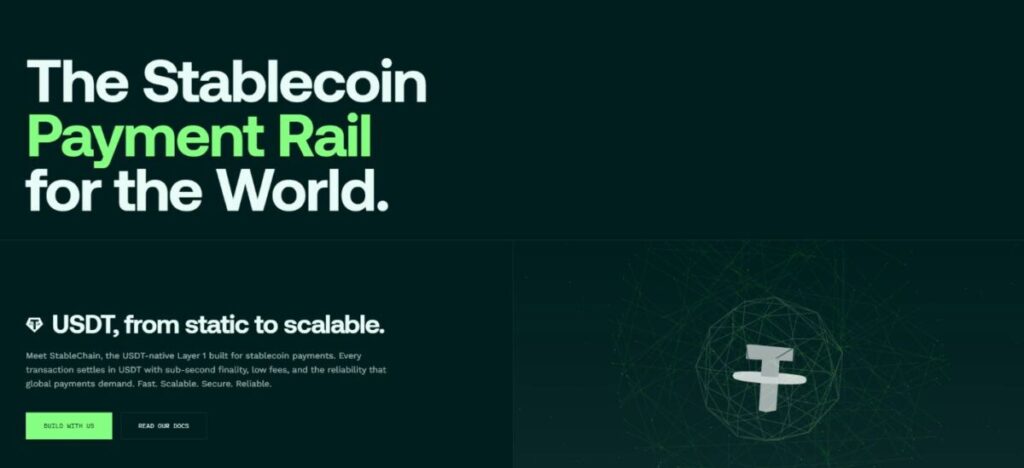
Since October, Stable has shown rapid development with milestones such as launching its public Testnet and preparing for Mainnet on December 8, 2025, along with multiple strategic partnerships. Its Pre-Deposit campaign attracted over 2.6 billion USD from more than 26,000 wallets, demonstrating strong interest from both communities and institutions.
1.2 Team
Stable is operated by an experienced core team of three:
- Brian Mehler – CEO: responsible for strategic leadership, growth direction, fundraising and partnerships
- Sam Kazemian – CTO: responsible for blockchain infrastructure design, consensus, smart contract compatibility, performance and the USDT-native gas model
- Thibault Reichlt – COO: responsible for operations, enterprise relations, business integration and compliance, especially important as Stable targets merchant payments, enterprise settlement, fiat on/off ramps and regulated financial integration.

1.3 Fundraising
Stable has raised 28 million USD from top-tier investors such as Bitfinex, Hack VC and PayPal Ventures. This provides strategic support and sufficient initial capital for long-term development and network operations.

1.4 Tokenomics
Stable has released the tokenomics for STABLE, the coordinating token of the entire ecosystem. The Stable network acts as a Settlement Layer where all transactions occur in USDT with predictable costs and instant Finality. Although users interact only with USDT, the network still requires a native token for governance, security and long-term coordination, which is the role of STABLE.
STABLE supports three main functions:
- Network security through Delegated Proof of Stake on StableBFT where validators must stake STABLE and face slashing for violations
- Governance including protocol upgrades, parameter adjustments and community resource allocation
- Network economics where all USDT fees accumulate in the Fee Vault and are distributed to validators and delegators, creating alignment between network activity and staking demand without complicating the user experience
The total supply of STABLE is fixed at 100 billion, non-inflationary and not used as gas. Allocation includes 10 percent Genesis Distribution, 40 percent Ecosystem and Community, 25 percent Team and 25 percent Investors and Advisors. Team and Investor allocations have a 48-month vesting schedule with a 12-month lock.

In the staking model, validators stake STABLE to participate in consensus, while holders can delegate and earn USDT rewards based on network activity. As USDT transaction volume increases, the Fee Vault grows, boosting demand for staking STABLE and creating natural token demand.
2. The Stable Operating Model
The Stable operating architecture focuses on reducing latency, increasing throughput, standardizing fees and ensuring compatibility so businesses and institutions can integrate without changing internal processes.
2.1 Execution Layer: EVM Compatible and Moving Toward Parallel Execution
Stable maintains EVM compatibility, allowing developers to use Solidity and familiar tools such as Hardhat, Foundry and Remix. This reduces migration risk and accelerates integration. However, the sequential nature of the EVM limits throughput.
To address this, Stable implements Optimistic Parallel Execution, which allows transactions to be processed in parallel under the assumption of no conflicts. If conflicts arise, the system rolls back the affected transactions and re-executes them sequentially. This model takes inspiration from Aptos and Sui while maintaining full compatibility with EVM smart contracts.
2.2 Data Layer: StableDB and State Access Optimization
StableDB is a state storage system designed to reduce data access latency and improve write efficiency for high-frequency payment workloads. It uses a Log Structured Storage design suited for heavy write operations, especially under tens of thousands of transactions per second. Snapshot-based state reads minimize random access costs.
This design reduces state storage bottlenecks in EVM systems and supports the parallel execution architecture planned for Phase 2.
2.3 Consensus Layer: From Low Latency BFT to DAG-Based Consensus
In early stages, Stable uses an optimized BFT algorithm designed for low latency. BFT is ideal for payment-focused networks because it avoids chain reorganizations, a critical requirement for instant-finality systems. Combined with short block times, Stable achieves sub-second finality suitable for commercial and enterprise-grade payments.
In Phase 3, Stable transitions to DAG-based consensus, enabling multiple blocks or transactions to be ordered in parallel rather than sequentially. This removes traditional bottlenecks and enables scalability beyond 10,000 TPS for global payment scenarios.
2.4 Gas Fee Design
Using USDT as gas is one of Stable’s most important design decisions. Traditional networks require users to hold a native token, creating extra conversion costs and volatility risk. Stable removes this barrier and uses USDT for gas payments. This requires protocol-level handling for fee processing, validator rewards and market stability. The benefit is a predictable, simple and enterprise-friendly fee system, similar to traditional payment networks where fees do not fluctuate with market volatility.
2.5 Enterprise-Oriented Design
Stable integrates compliance features natively, enabling regulated institutions and enterprises to operate legally. Partnerships with Standard Chartered, Libeara and Wellington Management require support for controlled issuance, product-level compliance, custody integration and auditability. Stable also offers enterprise SDKs with on-chain settlement APIs, batch payroll processing and treasury management frameworks, allowing businesses to integrate blockchain without restructuring legacy systems.
3. Recent Key Developments
3.1 Mainnet Launch
On December 8, 2025, Stable officially launched its Mainnet, moving from testing to real operation. Mainnet enables the USDT-Native model, sub-second finality and StableBFT infrastructure, allowing DeFi, payment and tokenization applications to deploy immediately.
The launch generated strong attention but also strong market reaction. STABLE experienced a deep correction of 50 to 60 percent in the first days due to limited liquidity, Genesis unlocks and cautious market sentiment. Still, on-chain activity increased rapidly in validators, delegators and USDT flows.
STABLE was listed on major exchanges such as MEXC with trading pairs STABLE/USDT and STABLE/USDC. MEXC launched zero-fee campaigns and a Launchpad subscription event with up to 60 percent discounts and small giveaways, increasing user reach.
3.2 Ecosystem Partnerships and Integrations
Stable released its detailed whitepaper, RWA integration roadmap and listings on platforms such as Binance Alpha (with airdrops), Bitget and Aster Perpetual offering 5x leverage. Community updates highlight rapid development, including Stable Pay, a gas-free payment experience using usernames, expected to transform Web3 payments.
3.3 Stable and Theo Commit 100 Million USD to ULTRA
Stable and Theo committed over 100 million USD to ULTRA, the only AAA-rated tokenized treasury product by Particula. ULTRA is supported by Libeara’s compliant tokenization infrastructure, managed by Wellington Management and FundBridge Capital and custody provided by Standard Chartered. Institutional users can access

ULTRA through Theo’s thBILL, which has surpassed 200 million USD in AUM. Stable emphasizes that integrating ULTRA strengthens the network’s ability to connect stablecoins with traditional finance.
4. Commentary on STABLE
Stable is pursuing a USDT-Native payment ecosystem with fast finality and a near gas-free experience. However, current market demand for a pure payment chain is still limited, and the Stable ecosystem lacks compelling components to attract crypto users. Plasma’s case study illustrates the risks of similar models with weak incentives and insufficient real-world usage, which led to ecosystem collapse within months. Stable faces the risk of repeating this trajectory without stronger liquidity incentives.
Mainnet launch issues further exposed model weaknesses. Users faced gas errors, complex bridging to claim or withdraw assets and poor early UX that reduced confidence. Combined with tokenomics heavily weighted toward team and investors and the fact that STABLE is not essential for transactions since USDT handles gas, there is minimal natural demand to hold STABLE. Many users compare it to older governance tokens with low utility, high emissions and limited innovation over previous payment chains.

Still, in the long term, if StableChain successfully attracts real payment volume through USDT-Native design and sub-second finality, staking demand could increase and create a more sustainable ecosystem. The project’s ability to pivot, improve gas UX, expand institutional integrations and build real applications will determine whether Stable escapes the “Plasma trajectory” or becomes another abandoned payment chain.
5. Conclusion
Stable is building a payment infrastructure centered on USDT with the goal of improving on-chain transaction experience and expanding real-world stablecoin usage. However, user adoption remains a challenge as the current DeFi ecosystem is not strong enough to drive frequent activity. Without effective incentive programs and sustainable liquidity strategies, Stable risks following the failures of previous payment-focused chains. On the other hand, if it leverages its USDT-Native advantage and continues expanding enterprise partnerships, Stable could become a foundational payment layer for stablecoins in the near future.
Disclaimer: This content does not constitute investment, tax, legal, financial, or accounting advice. MEXC provides this information for educational purposes only. Always do your own research, understand the risks, and invest responsibly.
Join MEXC and Get up to $10,000 Bonus!
Sign Up