
Recent remarks by Larry Fink — the CEO of BlackRock — that several sovereign wealth funds (SWFs) are “quietly buying Bitcoin ETFs in phases at the 120k, 100k, and even 80k levels,” while emphasizing that “Bitcoin should be held for many years; this is not a short-term trade,” have sparked intense discussion across the crypto community.
To fully grasp the significance of his statement, we need to place it in context: Who is BlackRock? What exactly are sovereign wealth funds? And why does their “DCA into Bitcoin” carry major implications for the macro market?
1. Context: From “Anti-Bitcoin” to a Strong Supporter
For nearly a decade, Larry Fink — CEO of BlackRock, the world’s largest asset management firm — repeatedly expressed skepticism toward Bitcoin. Between 2017 and 2020, he described Bitcoin as a “speculative tool,” “an asset used for money laundering,” and doubted it could ever become part of traditional finance. However, from 2023 to 2025, Fink’s perspective shifted so dramatically that he openly admitted he had misjudged Bitcoin.
Across multiple interviews and public events, Fink began portraying Bitcoin as a “legitimate asset within the global financial system,” comparable to digital gold, and even as a potential hedge against inflation, fiat currency debasement, and the escalating sovereign debt crisis facing many nations. This shift is not merely personal — it reflects BlackRock’s strategic outlook as they observe rising demand from major institutions.
In tandem with this change in mindset, BlackRock executed a historic move: launching the iShares Bitcoin Trust (IBIT) — BlackRock’s first spot Bitcoin ETF. Immediately after its debut, IBIT saw an extraordinary surge of inflows: tens of billions of dollars within months. It quickly became one of the fastest-growing ETFs in BlackRock’s history, far exceeding market expectations and solidifying BlackRock’s role as the leading gateway for institutional capital entering Bitcoin.
At the New York Times DealBook Summit, Fink revealed a statement that stunned the market:
“We’re seeing more and more long-term, legitimate investors coming in. I can tell you that a number of sovereign wealth funds… they’ve been buying gradually at 120k, 100k; and I know they’ve added more when the price fell to the 80k range. They are building long-term positions — you hold it for years… this is not a trade; you hold it for a purpose.”
This comment opened an entirely new perspective: not only hedge funds or private companies are accumulating Bitcoin — but sovereign wealth funds, which manage the national assets of entire countries, are quietly building BTC exposure through Bitcoin ETFs.
Fink went further, describing Bitcoin as an “asset of fear” — meaning an asset investors turn to when they lose confidence in the traditional financial system: concerns about sovereign debt, banking risks, or currency weakness. This indicates that Fink no longer views Bitcoin as a speculative gamble, but as a macro-hedging instrument within the same category as gold, defensive bonds, or scarce assets.
In summary, BlackRock is not merely “talking positively” about Bitcoin. They are:
- operating the largest and fastest-growing Bitcoin ETF in the market,
- standing at the center of institutional capital flowing into BTC,
- and actively reshaping Bitcoin’s narrative into that of a long-term hedge asset rather than a financial experiment.
Larry Fink’s transformation from “anti-Bitcoin” to “one of its strongest advocates” signals a new era for Bitcoin — one where it is no longer outside the financial system, but increasingly integrated into global institutional capital flows.
2. Who Are Sovereign Wealth Funds, and Why Are They Important Enough to “Shape” the Bitcoin Narrative?
To understand the weight of Larry Fink’s statement, we must first understand what sovereign wealth funds (SWFs) are — and why their quiet accumulation of Bitcoin has implications far beyond price action.
2.1. What Are SWFs?
Sovereign wealth funds are state-owned investment funds created to manage a nation’s financial assets, which may include:
- budget surpluses,
- revenue from oil, gas, or natural resources,
- foreign exchange reserves,
- returns from financial activities.
Unlike hedge funds, private equity firms, or venture capital funds, SWFs have unique characteristics:
- Long-term horizons of 10–30 years, instead of short-term cycles.
- Massive scale, often ranging from hundreds of billions to over a trillion USD.
- Decision-making shaped by national financial strategy, not market sentiment or short-term volatility.
Some of the world’s most prominent SWFs include:
- Norges Bank Investment Management (Norway) — manages ~USD 1.4 trillion, the largest fund globally.
- Saudi Arabia’s Public Investment Fund (PIF) — rapidly expanding into technology and infrastructure.
- Abu Dhabi’s Mubadala, Qatar Investment Authority, Singapore’s GIC and Temasek, and more.
While not all countries publicly disclose their investment strategies, many SWFs are gradually expanding into non-traditional assets as global economics shift — including technology, AI, clean energy, and increasingly, crypto and blockchain infrastructure.
2.2. Why Do SWFs Carry Tremendous Influence?
SWF actions are not just financial transactions — they represent national strategic direction. When SWFs begin considering Bitcoin, it signals several critical developments:
(1) Bitcoin Is Moving Closer to Becoming a Recognized Reserve Asset
SWFs are not allowed to invest in assets deemed “non-transparent” or “non-legitimate.” Thus, their purchase of Bitcoin ETFs demonstrates:
- BTC has moved beyond its stigma as an “illicit” asset.
- Governments are beginning to view BTC as a legitimate long-term asset class, similar to gold or international bonds.
If SWFs are quietly increasing Bitcoin exposure, it may mark the beginning of:
=> Bitcoin evolving into a new form of state-level reserve asset.
Something previously unthinkable — except for El Salvador.
(2) SWFs Are the Ultimate “Smart Money” at the National Level
If any investor group is immune to FOMO, FUD, and market manipulation, it is SWFs. They possess:
- macroeconomic research teams,
- exclusive data sources,
- the ability to withstand multi-billion-dollar drawdowns,
- and minimal pressure from quarterly reporting or retail investor sentiment.
Their purchases at 120k – 100k – 80k are not attempts to “catch the top” or “miss the bottom,” but rather:
=> A long-term capital allocation strategy that ignores short-term volatility.
They do not care whether Bitcoin is 80k or 150k today — they care where it will stand 10 years from now within the global financial system.
(3) SWF Capital Creates Stability and Forms “Macro Floors” in Markets
Unlike hedge funds, which may withdraw hundreds of millions in a matter of weeks, SWFs:
- rarely panic-sell,
- rarely shift their stance based on short-term trends,
- willingly accumulate during market fear and capitulation.
This creates a powerful effect:
=> SWF capital can act as the macro-level “buyer of last resort” during deep market corrections.
When Bitcoin falls to 80k or lower, retail panic — but SWFs view it as an opportunity to strengthen their position.
This is why Larry Fink emphasized:
- they are “adding incrementally,”
- they do not see Bitcoin as a trade but a multi-year strategic holding.
(4) SWF Participation Signals to the Entire Institutional Ecosystem
In traditional markets, SWFs are considered trend-setters.
When SWFs invest in a new asset class:
- pension funds begin to follow,
- investment banks start deeper research,
- ETFs and related financial products proliferate,
- traditional asset managers feel pressured to include BTC or risk underperformance.
If SWFs are indeed accumulating Bitcoin, this could mark the beginning of:
=> The institutionalization and legitimization of Bitcoin at unprecedented scale.
2.3. SWFs Buying Bitcoin Through ETFs — A Critical Turning Point
What’s noteworthy is that SWFs are not buying Bitcoin directly on crypto exchanges. Instead, they prefer:
- spot Bitcoin ETFs (like BlackRock’s IBIT)
- regulated trusts and transparent financial products
This indicates:
- they prioritize regulatory clarity,
- they want risk managed under traditional financial standards,
- they view ETFs as the bridge enabling Bitcoin to enter official portfolios.
In the past, a nation buying BTC was seen as a rule-breaking anomaly. But buying a Bitcoin ETF?
=> It is fully legal, audited, and treated just like any other ETF.
This is why Fink’s comment is so important:
=> It proves that Bitcoin has quietly entered a domain traditional investors never expected — national wealth management.
2.4. Summary: Why SWFs Are a Critical Piece of the Bitcoin Landscape
- They represent nation-level financial power, not private institutions.
- They invest with a 10–30 year horizon, unaffected by short-term volatility.
- Their involvement gives legitimacy and narrative weight to any asset they touch.
- Their capital provides macro support during major market downturns.
- Their use of Bitcoin ETFs shows BTC has cleared the regulatory barrier and entered the formal financial system.
In other words:
=> If retail investors create waves, SWFs are the ones who shape the horizon for Bitcoin.
3. Why Do Sovereign Wealth Funds Choose an “Institutional DCA Strategy” When Buying Bitcoin?
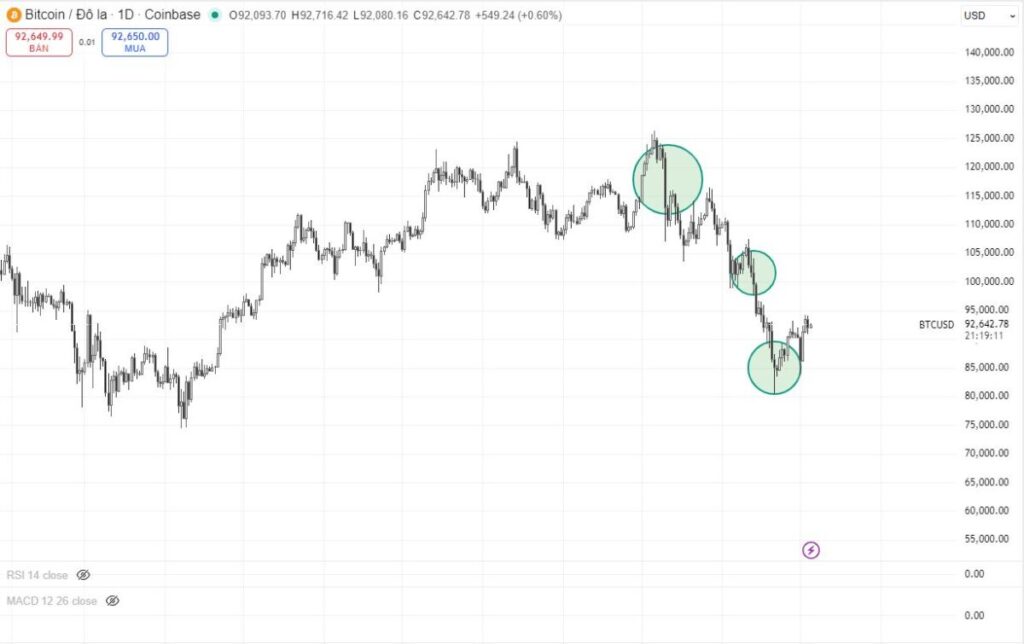
In Larry Fink’s remarks at the DealBook Summit, the surprising part was not just that SWFs are buying Bitcoin — but how they are buying it:
“They are buying gradually at 120k, 100k; and I know they’ve added more when prices dropped into the 80k range.”
This is not speculation or bottom-catching — this is institutional dollar-cost averaging (DCA). Why would nation-level investment funds adopt such a strategy? The analysis below explains why.
3.1. Bitcoin Is Too Volatile to “Go All-In” — but Too Important to Ignore
Bitcoin is extremely volatile: historical drops of 30–50% within weeks are completely normal. For an SWF managing hundreds of billions:
- They cannot afford to bet everything at one price level.
- But they also cannot remain on the sidelines while Bitcoin evolves into a durable global asset class attracting institutional capital worldwide.
Thus, the most rational approach is:
– Enter the market step-by-step, allocate modest but consistent tranches, and avoid short-term price dependencies.
This is how SWFs approach every emerging asset class — renewable energy, AI, biotech, infrastructure, and now Bitcoin.
3.2. DCA Minimizes “Timing Risk” — Something Even Trillion-Dollar Funds Cannot Perfect
No institution, regardless of size, can predict:
- where Bitcoin’s next peak will be,
- how strong the next halving cycle will become,
- or whether the 80k correction is the true macro bottom.
SWFs do not try to “predict.” They avoid prediction entirely.
DCA solves the problem:
- it smooths out short-term volatility,
- reduces the risk of entering at the wrong moment,
- standardizes acquisition cost over time.
They understand something retail often forgets:
=> The biggest mistake is not buying at the wrong price — it is missing a long-term growth asset because of short-term fear.
3.3. SWFs Seek “Strategic Positioning,” Not “Quick Profits”
When Fink said these funds are “building long-term positions,” he meant:
- They see Bitcoin as part of a structural, multi-year portfolio allocation, like gold, real estate, or sovereign bonds.
- They do not expect returns in 3–6 months, but in 5–10+ years.
- Bitcoin may help reduce systemic risk when the global economy enters periods of stress.
Thus, SWFs are not trying to optimize short-term returns, but:
=> Optimize their presence in a strategic asset of the future.
This mindset is unique to institutions responsible for managing national wealth.
3.4. Bitcoin Fits Naturally Into Long-Term Asset Allocation Models Used by SWFs
Most SWFs operate with allocation frameworks like:
- 40–60% global equities,
- 20–30% bonds,
- the remainder in alternatives: real estate, infrastructure, private equity, and non-traditional assets.
Bitcoin is increasingly being classified as:
- low correlation to equities,
- digital gold with a scarcity narrative,
- fixed supply (21 million BTC),
- increasingly held by major institutions.
This makes BTC an ideal candidate for a small but strategic allocation.
DCA enables SWFs to incorporate Bitcoin without destabilizing their overall risk structure.
3.5. Gradual Accumulation Prevents Market Disruption
Given the scale of SWFs:
- buying even a few billion USD of Bitcoin in one transaction could distort the market,
- cause unfavorable price spikes,
- attract excessive media attention,
- and trigger concerns from regulators.
Instead, they choose to:
- buy via ETFs,
- buy in small recurring tranches,
- buy during deep corrections (80k, 100k, 120k).
This approach allows them to:
- absorb liquidity quietly,
- avoid signaling their strategy,
- support consistent ETF inflows (e.g., IBIT).
Thus, DCA is not just an investment method — => It is a market-stabilization strategy.
3.6. DCA Reflects a Belief That Bitcoin Will Become “Bigger” in the Future
No SWF acts unless it believes in a 10-year trajectory.
The DCA approach reflects:
- a belief that Bitcoin is still early relative to its long-term potential,
- a belief that BTC will become a core financial asset, not just a speculative cycle,
- a belief that ETFs will serve as the institutional gateway for Bitcoin adoption.
DCA is not a strategy for those who lack conviction. => It is the strategy of those who believe Bitcoin’s future value will far exceed its current state.
3.7. Summary: SWFs Buy Bitcoin Institutionally Because They Don’t Need to Be Right — They Need to Endure
Unlike retail investors, SWFs:
- do not fear drawdowns,
- do not fear liquidation,
- do not need perfect market timing,
- do not answer to quarterly performance demands.
What they require is:
- an asset that preserves value over decades,
- reduces exposure to systemic financial risks,
- generates steady return potential,
- and positions their nations advantageously in a post-globalization world.
DCA is the most effective strategy to achieve all these objectives.
SWFs do not buy Bitcoin to beat the market in one month — => They buy Bitcoin to avoid being left behind in the next ten years.
4. Impact on Bitcoin’s Market Structure: When “Nation-Level Capital” Enters the Crypto Arena
The quiet accumulation of Bitcoin by sovereign wealth funds through ETFs is not merely a larger-than-normal inflow of capital. It represents a structural shift—one that changes how Bitcoin behaves, from liquidity dynamics and supply distribution to investor psychology and the degree to which BTC becomes integrated with the traditional financial system.
Below are the most profound effects.
4.1. Bitcoin’s Investor Composition Is Changing: From Retail → Institutions → Nation-State Level
Historically, the Bitcoin market consisted of three main groups:
- Retail investors — creating short-term waves and sentiment-driven moves.
- Private whales — exerting strong influence on liquidity flow.
- Private-sector institutions — crypto-native funds, hedge funds, and public companies like MicroStrategy.
But with SWFs entering, a completely new layer emerges:
=> Sovereign-Level Holders — nation-backed investors.
This group has:
- the longest investment horizon,
- the largest scale of capital,
- the highest tolerance for drawdowns,
- the lowest portfolio turnover.
They do not trade. They do not react to FOMO or panic. They do not need Bitcoin profits to “cash out for holiday spending.”
Their presence makes Bitcoin’s supply dynamics:
- older,
- more stable,
- less susceptible to short-term manipulation or sudden sell-offs.
When state-backed entities hold BTC:
- selling frequency decreases,
- real liquid supply declines,
- market depth becomes more stable.
All of this signals that Bitcoin is transitioning into a legitimate component of the financial system.
4.2. Liquid Supply Shrinks Dramatically — Future Bull Runs May Become More “Compressed”
Bitcoin’s total supply is capped at 21 million. But in practice:
- only about 12–14 million BTC are truly liquid,
- the rest are lost, locked, or held long-term in dormant wallets.
When SWFs and mega-ETFs like IBIT absorb large quantities of BTC:
- free float (tradable supply) decreases month by month,
- more BTC moves into the hands of “professional long-term holders,”
- natural sell pressure diminishes progressively.
This leads to an important effect:
=> When demand spikes, Bitcoin can accelerate upward much faster — because there are fewer sellers.
In previous bull cycles, sell pressure mainly came from:
- miners,
- retail investors,
- crypto-native funds.
But today:
- miners have reduced output due to halving,
- retail makes up a smaller share of the market,
- institutions and SWFs rarely sell.
→ Future bull runs may become steeper, sharper, and more compressed.
4.3. Bitcoin’s Volatility May… Decrease and Increase at the Same Time
It sounds contradictory — but it is accurate.
(1) Volatility decreases in medium-term downturns
With long-term buyers like SWFs and ETFs:
- deep market dips are absorbed reliably,
- retail panic-selling triggers fewer domino effects,
- the market gains a “natural safety net” from institutional demand.
As a result:
-40% crashes may become rarer and shorter-lived.
(2) Volatility increases during strong uptrends
Because liquid supply is shrinking, when demand rises:
- prices can spike violently,
- vertical rallies become more common,
- bull markets become more intense — often chased by retail FOMO.
The net effect:
=> Bitcoin becomes less volatile during downturns but more volatile during surges.
This mirrors gold during the period when central banks were aggressively accumulating it.
5. Risk Perspective: When Institutional and Nation-State Capital Enters Bitcoin — What Are the Hidden Downsides?
While SWF accumulation brings optimism, no major trend is one-sided. Institutional capital — powerful and durable as it is — also introduces structural, political, regulatory, and market risks that investors must understand.
Below are the most important risks.
5.1. Concentration of Bitcoin Ownership Among Large Institutions
One of Bitcoin’s core values is decentralization.
But as BTC is increasingly held by:
- major ETFs,
- large financial institutions,
- and especially sovereign wealth funds,
a new axis of power emerges.
=> A small group of institutions could eventually control a significant share of Bitcoin’s supply.
For example:
If BlackRock’s ETF held millions of BTC in the future, and SWFs held substantial portions of those shares, ownership concentration could exceed even Bitcoin’s early-mining era.
This creates risks of:
- institutional influence over wallet standards, KYC processes, or custody norms,
- coordinated action (or inaction) that impacts market stability.
In extreme scenarios, Bitcoin could lose part of the decentralization ethos the community cherishes.
5.2. Bitcoin Becomes More Dependent on ETFs and Traditional Finance
Spot ETFs solve the access problem — but introduce new risks:
- Bitcoin becomes increasingly “Wall Street–ified.”
- Price reacts heavily to ETF flows rather than on-chain activity.
- Traditional crypto exchanges may lose influence.
If a major ETF:
- halts trading,
- faces legal trouble,
- or is restricted in certain countries,
the entire Bitcoin market could feel the domino effect.
Once Bitcoin is ETF-dependent:
=> BTC’s price becomes tied to interest rate policy, fund flows, and regulatory shifts — not just organic crypto demand.
5.3. Legal and Geopolitical Risks Grow as Bitcoin Enters the Realm of Nation-States
When governments participate in Bitcoin through SWFs or national pension funds, regulatory risk may rise, not fall.
Governments may impose:
- tighter surveillance,
- stricter KYC/AML rules,
- specific custody or auditing requirements,
- taxation or trading restrictions.
Furthermore, not all nations benefit equally from Bitcoin. Some see it as a threat.
In geopolitical competition:
- Country A accumulates BTC → Country B may restrict it.
- High-inflation nations may use BTC as a hedge.
- Strong-currency nations may view BTC as a competitor.
This could escalate into monetary policy conflicts involving Bitcoin.
5.4. Market Dynamics Become Less “Natural” When SWFs Act as the Buyer of Last Resort
When Bitcoin was retail-dominated, the market was shaped by:
- organic supply and demand,
- cycles of FOMO and FUD,
- halving behavior and sentiment swings.
But with SWFs stepping in as deep buyers:
- price may not fall as low as before,
- major dips are absorbed quickly,
- traditional 4-year cycle models may weaken.
This stabilizes markets, but carries a downside:
- prices may become artificially elevated,
- deep flush-outs that cleanse the market become rare,
- old behavioral patterns may lose predictive power.
Bitcoin begins to resemble gold or bonds — less freedom, more structure.
This benefits long-term holders, but reduces appeal for short-term traders.
5.5. Moral Hazard: Retail Investors May Become “Overconfident” in Institutions
When people hear that:
- BlackRock,
- SWFs,
- pension funds,
- major banks
are buying Bitcoin, retail may assume:
“If they’re buying, Bitcoin must go up.”
This is a dangerous misconception.
Because:
- SWFs can tolerate 70% drawdowns — retail cannot.
- Institutions protect their interests, not retail’s.
- Institutions have data, resources, and risk management retail cannot match.
Relying on SWF behavior to justify personal investment decisions is extremely risky — especially for younger investors.
No asset is guaranteed to win, and even the largest institutions have made catastrophic mistakes in the past.
6. Conclusion: Bitcoin Enters a New Era — Where National Capital Shapes the Market’s Future
Larry Fink’s remarks not only revealed that sovereign wealth funds have been quietly accumulating Bitcoin at multiple price levels, but also highlighted a broader truth: Bitcoin is transitioning from a “peripheral asset” to a mainstream strategic asset within the global financial system.
The shift in perception from BlackRock and other major institutions shows that Bitcoin has moved beyond its phase of being treated purely as speculation. Sovereign wealth funds are not buying to trade; they are building long-term strategic positions, positioning Bitcoin alongside assets that nations have historically relied on — much like gold in previous decades. This fundamentally alters the market structure: liquid supply decreases, investor behavior evolves, and Bitcoin becomes increasingly intertwined with macroeconomic cycles.
However, this maturation comes with trade-offs. Large capital inflows make Bitcoin more stable, but also more dependent on:
- ETFs and traditional financial infrastructure,
- regulatory frameworks,
- political decision-making.
Bitcoin’s core value — decentralization — may be tested as more BTC becomes concentrated in the hands of a small number of financial institutions and sovereign entities.
In the broader landscape, SWF accumulation is not a signal that “Bitcoin will definitely rise,” but rather evidence that Bitcoin is being taken seriously by the largest, most long-term–oriented, and least emotionally driven players in the market. This marks a defining milestone for Bitcoin — transforming from an experimental asset held by early adopters into a strategic holding within national portfolios.
Ultimately, whether you are a retail investor, an institutional participant, or simply an observer, the key is not to blindly follow SWF actions, but to understand how the market is evolving — and to prepare for a new Bitcoin era, where the game no longer resembles the cycles of the past.
Disclaimer:The information provided here is for informational purposes only and should not be considered financial, investment, legal, or professional advice. Always conduct your own research, consider your financial situation, and, if necessary, consult with a licensed professional before making any decisions.
Join MEXC and Get up to $10,000 Bonus!
Sign Up