Amid a strong inflow of capital into RWAs and increasing interest from traditional financial institutions in blockchain, the market is witnessing another significant milestone: Figure, a home-equity platform valued at over $19 billion, has officially launched the RWA Consortium and selected Chainlink as its standard oracle infrastructure. Immediately after, the RWA ecosystem continued to heat up as HastraFi PRIME announced its expansion to Solana via Chainlink CCIP, along with Kamino’s PRIME Vaults being powered by sub-second data from Chainlink Data Streams.
These consecutive moves not only signal the growing maturity of RWAs but also mark the convergence between next-generation oracle technology and large-scale financial platforms, opening a completely new phase of development for Web3.
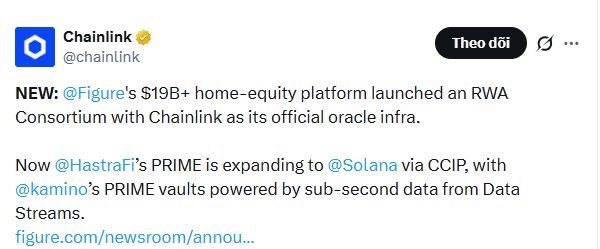
1. Figure launches the RWA Consortium and selects Chainlink as its official oracle infrastructure
Figure — a company well-known in the home-equity lending sector and having processed more than $19 billion in loan volume — has announced the formation of the RWA Consortium, an alliance aimed at standardizing, scaling, and accelerating the tokenization of real-world assets on blockchain.
The establishment of the RWA Consortium carries significant meaning: instead of every project implementing RWA in its own way, this consortium aims to create a unified ecosystem where financial institutions, fintech companies, and DeFi protocols can use the same data standards, the same infrastructure, and the same asset-verification methods. This helps RWAs move beyond small-scale experiments toward institutional-level deployment and real commercial adoption.
One of the consortium’s most important decisions is selecting Chainlink as its official oracle infrastructure. This is not just a technical choice but a long-term strategic move based on three major reasons:
• First: Chainlink provides the most secure off-chain → on-chain connectivity in the market
Figure manages massive data sets involving collateralized assets, ownership records, appraisal values, etc. All of this data originates from traditional systems and cannot be pushed on-chain carelessly.
Chainlink provides a reliable middleware layer that:
- verifies data before sending it on-chain
- ensures data integrity and provenance
- prevents manipulation and falsification
This is a critical requirement for financial institutions.
• Second: Chainlink supports data standardization across the entire consortium
When multiple organizations participate in the RWA Consortium, having each party use different data standards would create major risks. Chainlink enables synchronization of how data is transmitted, verified, and updated, thereby:
- establishing a unified standard for the entire ecosystem
- reducing inconsistencies, conflicts, or data vulnerabilities
- making it easier for institutions to integrate and operate RWA products
This is particularly important as Figure pursues a multi-institution collaboration model.
• Third: Chainlink has proven reliability at multitrillion-dollar scale in DeFi
For years, Chainlink has been the industry standard for oracles, securing trillions of dollars in DeFi value. For traditional enterprises like Figure, credibility and stability are essential factors when selecting technology partners.
Additionally, Figure’s choice of Chainlink sends a powerful message:
RWAs are no longer just for Web3 startups — they have become a strategic component for major financial institutions.
The participation of Figure, backed by tens of billions of dollars in real assets, shows that RWAs are entering a mature phase where blockchain is being applied directly to real assets, real processes, and real cash flows.
2. HastraFi PRIME expands to Solana via Chainlink CCIP
HastraFi — a protocol specializing in RWA yield and financial products backed by real-world assets — has announced the expansion of its PRIME product line into the Solana ecosystem. This is a strategic move, as Solana is currently one of the fastest-growing blockchains in terms of ecosystem development, users, and liquidity.
However, the most important point in this announcement is not simply “expanding to Solana”, but that HastraFi has chosen Chainlink CCIP (Cross-Chain Interoperability Protocol) as its cross-chain communication protocol to operate PRIME across multiple blockchains.
To understand the significance, we need to look deeper into the three major advantages CCIP provides:
• 1. CCIP enables PRIME to scale multichain safely without rebuilding its entire system
As RWAs grow rapidly, a protocol cannot remain on a single blockchain. PRIME needs the ability to:
- expand into ecosystems with high liquidity
- reach diverse user communities
- optimize transaction costs and user experience
Chainlink CCIP allows HastraFi to connect PRIME across chains like Ethereum, Solana, Avalanche, and more — without rewriting all the core logic.
This is a huge advantage, as building a custom bridge or implementing a proprietary cross-chain system is extremely risky and expensive.
• 2. CCIP ensures enterprise-grade security for cross-chain RWA transfers
With RWAs, every transaction must be absolutely secure. CCIP is built with a defense-in-depth security model, meaning:
- multiple independent security layers
- separate monitoring systems
- detection and prevention of abnormal activities
This model is considered suitable for institutional assets and is fundamentally different from typical DeFi bridges.
Thus, HastraFi’s use of CCIP for PRIME aims to ensure that:
- the movement of real-world assets onto blockchain is always secure
- operations meet compliance requirements
- financial institutions can participate without cross-chain risk
• 3. PRIME on Solana benefits from high speed and low cost
Solana offers:
- extremely fast transaction processing
- extremely low fees
- a fast-growing Web3 user ecosystem (DeFi, NFT, memecoins, RWAs, AI, etc.)
When PRIME expands to Solana:
- users can transact RWAs in near-real-time
- investors benefit from far lower fees compared to Ethereum
- PRIME products become more accessible to a much larger user base
The combination of secure cross-chain technology and high-performance blockchain infrastructure makes PRIME one of the most practical RWA products available today.
3. Kamino PRIME Vaults integrate sub-second Chainlink Data Streams
Within the Solana ecosystem, Kamino is one of the most prominent protocols for automated strategies, liquidity optimization, and yield products in DeFi. Kamino’s operation of PRIME Vaults — HastraFi’s RWA-related vaults — marks a major advancement, especially as they integrate Chainlink Data Streams, a next-generation high-speed oracle technology.
What sets this apart is the ability to deliver real-time data with sub-second latency. This is a foundational improvement for DeFi, as oracles have long been the bottleneck preventing protocols from achieving performance comparable to traditional finance.
Below is a detailed overview of why Data Streams are so important and why Kamino chose this technology.
• 1. Data Streams solve the biggest oracle problem: latency and instability
In traditional oracle systems:
- price data often updates slowly
- delays of 5–30 seconds can occur
- during high volatility, data may become desynchronized
This results in:
- incorrect liquidations
- unfair arbitrage
- losses for protocols and users
Chainlink Data Streams fundamentally solve this issue using a streaming data model that:
- updates prices continuously, nearly in real time
- minimizes latency
- ensures data is always accurate and transparent
For vaults holding real-world assets or derivatives, this level of precision is absolutely critical.
• 2. PRIME Vaults can execute automated strategies with far greater accuracy
Kamino’s PRIME Vaults typically utilize:
- automated position-management strategies
- asset rebalancing
- real-time risk management
Previously, oracle latency made these strategies less efficient.
With Data Streams:
- vaults can react instantly when data changes
- rebalancing actions become smoother
- “oracle lag” — a common cause of DeFi exploits — is greatly reduced
This brings PRIME Vaults closer to the operational capabilities of traditional financial trading systems, which rely on constantly updated data.
• 3. Sub-second data significantly enhances security and manipulation resistance
When data updates slowly:
- attackers can exploit delay windows to create artificial price movements
- protocols become vulnerable to price-manipulation exploits
- oracle attacks are harder to detect
With Data Streams:
- near-zero latency makes price manipulation extremely difficult
- multi-layer validation ensures data integrity
- the system can detect and block abnormal activity
The result: vaults become safer, appealing not only to DeFi users but also to institutions entering the RWA space.
• 4. The combination of Chainlink, HastraFi, and Kamino demonstrates the new technological standard for RWAs
A strong RWA protocol requires three core components:
- Reliable real-world asset data (Figure → Chainlink)
- Secure cross-chain infrastructure (HastraFi → CCIP)
- High-speed oracle data for investment product operation (Kamino → Data Streams)
Kamino PRIME Vaults complete the “operational performance” layer in the RWA pipeline, ensuring RWA products run smoothly, securely, and with optimal yields.
4. The convergence of major projects marks the acceleration phase of RWAs
The simultaneous major announcements from Figure, Chainlink, HastraFi, and Kamino are not a coincidence. This is a clear signal that RWAs have entered a new stage of evolution — a stage where real-world assets are no longer just experimental in DeFi but are gradually becoming a strategic sector at institutional scale.
For years, RWAs existed mostly in small pilot programs, limited by technology, operational processes, and market confidence. But now, with serious participation from multi-billion-dollar enterprises like Figure and increasingly mature Web3 infrastructure, RWAs are transforming into one of the foundational pillars of the next wave of Web3.
Below are the core factors driving the unprecedented growth of RWAs:
1. Traditional financial institutions are joining the game
The participation of Figure — a company that has processed over $19 billion in assets — shows that Web3 has reached a level of maturity where:
- blockchain technology is sufficiently secure and transparent
- tokenization processes can run reliably
- real-world applications outperform traditional systems in several aspects
This is crucial because RWAs can only scale when paired with real assets, real institutions, and real capital, rather than relying solely on DeFi community activity.
This marks a strategic shift, not just a temporary trend.
2. Web3 infrastructure is now strong enough for large-scale RWA operations
The infrastructure stack projects are using today is far beyond its early-stage limitations:
- Chainlink Oracle → ensures data quality & security
- Chainlink CCIP → enterprise-grade cross-chain connectivity
- Chainlink Data Streams → sub-second real-time data
- Solana → fast, low-cost, high-throughput blockchain
- Kamino → optimization layer for investment products
Together, they form a complete ecosystem capable of operating real-world-asset products — something Web3 could not reliably support just 3–5 years ago.
3. Institutional capital is flowing aggressively into RWAs
RWAs are currently the fastest-growing segment in the entire crypto market, with:
- continuous growth in stablecoins
- booming tokenization of government assets (e.g., U.S. treasuries)
- investment funds & banks beginning to test RWA products
When Figure, HastraFi, and Kamino release major products simultaneously, it signals more than just technical progress — it indicates that large pools of capital are preparing to enter, and these projects are building the infrastructure to capture that influx.
4. A unified industry standard for RWAs is emerging
RWAs cannot scale if each project uses its own isolated standard. For the first time, we are seeing a complete value-chain model:
- Figure → provides real assets + tokenization standards
- Chainlink → ensures data, security, and cross-chain connectivity
- Solana → delivers a high-speed transactional environment
- HastraFi & Kamino → create practical investment products for users
This combination transforms RWAs from a promising concept into a fully structured framework where assets can be brought on-chain, verified, utilized, and traded like true financial instruments.
Crypto has spent years trying to build a standardized ecosystem like this — and now it is finally taking shape.
Summary
Overall, the events of Figure launching the RWA Consortium, HastraFi PRIME expanding to Solana via CCIP, and Kamino deploying PRIME Vaults with sub-second Data Streams show that the entire RWA ecosystem is entering its strongest maturity phase to date. This is no longer a story of a few individual projects experimenting with blockchain technology — it is the convergence of multi-billion-dollar enterprises and institution-grade Web3 infrastructure.
Figure’s decision to choose Chainlink as its official oracle marks an important step toward bringing real-world assets onto the blockchain in a transparent, safe, and verifiable way. Conversely, HastraFi and Kamino’s use of CCIP and Data Streams demonstrates that next-generation RWA protocols are aiming for high speed, high security, and multichain scalability — capabilities that earlier DeFi systems could not achieve.
Together, these pieces affirm that RWAs are becoming a strategic pillar of Web3, drawing interest not only from crypto users but also from traditional financial institutions. As real assets, reliable data, and cross-chain infrastructure converge, the RWA market will unlock a new wave of global liquidity, where capital can move more efficiently and transparently than ever before.
It is clear that these are not isolated news events — they are signals of a new growth cycle for the blockchain industry, where RWAs are expected to become the true bridge between traditional finance and decentralized finance.
Disclaimer:The information provided here is for informational purposes only and should not be considered financial, investment, legal, or professional advice. Always conduct your own research, consider your financial situation, and, if necessary, consult with a licensed professional before making any decisions.
Join MEXC and Get up to $10,000 Bonus!
Sign Up