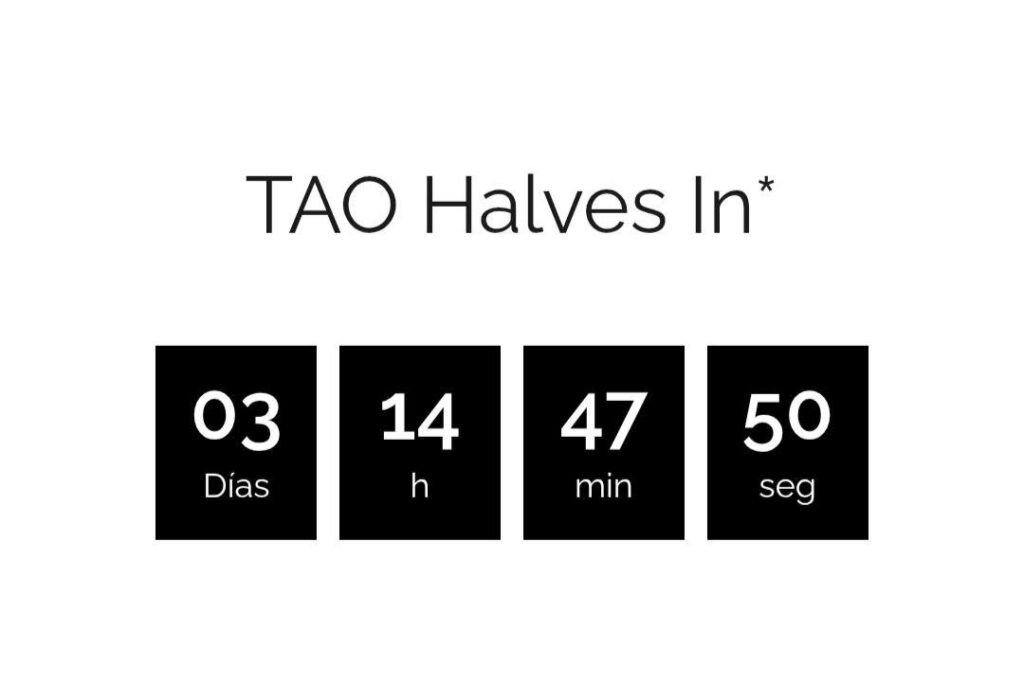
History is happening right now on Bittensor. Between December 12-15, 2025, the decentralized AI network undergoes its first-ever halving event, cutting daily TAO token emissions from 7,200 to 3,600 in a supply shock mirroring Bitcoin‘s scarcity model but applied to artificial intelligence infrastructure. The exact timing depends on when circulating supply hits the 10.5 million TAO threshold (currently 10.451 million), making today the beginning of crypto’s most anticipated AI token event of 2025.
The stakes couldn’t be higher. TAO trades at $299 after a 15% rally from seven-month lows at $250, but technical analysis reveals $17 million in long positions face forced liquidation if price drops below $243.50. This creates binary outcome: either the halving catalyzes the predicted surge to $1,000 by year-end as reduced supply meets institutional demand, or we see “sell the news” capitulation dropping TAO below $230, potentially even $200 according to bearish analysts warning momentum “hasn’t been on Bitcoin’s side lately.”
For traders who’ve watched Bitcoin‘s halvings deliver 9,000% (2012), 2,800% (2016), and 700% (2020) rallies in subsequent 12-18 months, Bittensor’s inaugural supply reduction represents rare opportunity to participate in a major protocol’s first scarcity event. But with 71.67% of TAO already staked and miner profitability about to get cut in half, the next 72 hours will determine whether TAO becomes case study in successful Bitcoin-style tokenomics—or cautionary tale about overhyping supply shocks in bear markets.
The Halving Mechanism: What’s Happening Right Now
Technical Execution:
Bittensor’s halving activates when circulating supply reaches 10.5 million TAO. As of December 11, supply stands at 10.451 million, meaning the threshold could be crossed any moment between now and December 15. Every 12 seconds, a new block completes,emitting 1 TAO into the network. Post-halving, this drops to 0.5 TAO per block.
Current Metrics:
– Daily Emissions (Pre-Halving): 7,200 TAO (~$2.15M at $299/TAO)
– Daily Emissions (Post-Halving): 3,600 TAO (~$1.08M)
– Annual Inflation (Pre-Halving): ~26%
– Annual Inflation (Post-Halving): ~13%
– Total Supply Cap: 21 million TAO (Bitcoin-identical)
– Current Circulating: 10.451 million (~49.7% of max)
Why Supply Matters:
The halving cuts new supply entering circulation by 50%, theoretically creating scarcity if demand remains constant or grows. For context, if TAO price holds at $299 and buying pressure continues at recent $3-5 million daily levels (based on trading volume), the supply/demand imbalance tilts dramatically bullish. Currently, miners dump 7,200 TAO daily (~$2.15M) to cover operational costs. Post-halving, daily sell pressure drops to ~$1.08M, a $1.07M daily reduction. Over 30 days, that’s $32M less TAO hitting markets.
The Dynamic TAO Complication:
Unlike Bitcoin’s time-based halvings, Bittensor introduced Dynamic TAO (dTAO) in February 2025, where each subnet has its own Alpha token trading against TAO. Both TAO and Alpha tokens follow the same halving schedule, but Alpha rewards distributed to miners, validators, and subnet owners do not halve and remain constant. This creates complex dynamics where subnet-specific incentives may override the broader TAO supply shock, potentially dampening price impact compared to Bitcoin’s cleaner model.
The $17M Liquidation Risk: Technical Breaking Point
Critical Support Level:
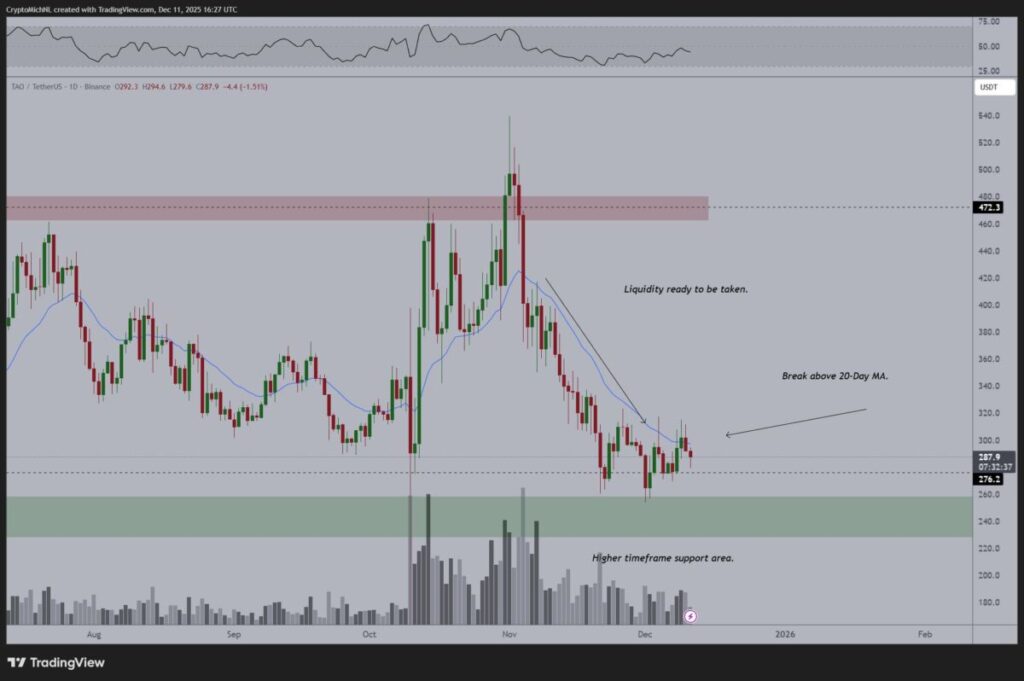
Technical analysts identify $243.50 as liquidation threshold for approximately $17 million in long positions accumulated during TAO’s recent rally from $250. If price breaks below this level, forced selling cascades could push TAO toward $230 or lower, triggering the “sell the news” scenario bears are predicting.
Current Technical Structure:
Price: $299 (December 11, 2025)
Recent High: $360 (October support that broke down)
Recent Low: $243 (seven-month bottom, November)
Key Resistance: $340 (20-day SMA), $360 (former support turned resistance)
Critical Support: $243.50 (liquidation cascade trigger)
Analysts note TAO recently broke below its 10-month moving average for the first time in nearly four years, a significant technical breakdown suggesting institutional conviction has weakened. One trader warned: “I warned of a potential sell the news event, and it is looking more likely. The 3-day zone I highlighted has been lost, and we just saw an aggressive rejection on the reclaim attempt. If $300 now continues as resistance I think this very likely retraces to $230, and I would not be surprised to see it below $200 either.”
The Falling Wedge Pattern:
Bulls counter with technical breakout signals. TAO formed a falling wedge pattern, historically bullish with breakout above $300 potentially targeting $360-$400 in the near term. However, falling wedges require volume confirmation on breakouts. Without sustained buying pressure, false breakouts become bull traps.
The Bull Case: $1,000 by Year-End, $2,000 by Q1 2026
Analyst Consensus:
Multiple forecasts project significant TAO appreciation following the halving:
– Year-End 2025: $600-$1,000 range (optimistic scenarios)
– Q1 2026: $1,000-$2,000 targets
– Mid-Term 2026: $1,168-$1,691 averages
– Long-Term 2030: $3,000-$7,000 depending on AI adoption
Historical Precedent:
Bitcoin’s halving history provides template. From current $299 to $1,000 requires 235% appreciation. Aggressive but not impossible, Bitcoin’s post-2012 halving delivered 9,000% returns within 18 months. Even conservative application suggests 200-400% appreciation is achievable, putting TAO at $897-$1,497 range.
Catalysts Supporting Rally:
1. Reduced Miner Sell Pressure:
Miners currently liquidate 7,200 TAO daily (~$2.15M) to cover costs. Post-halving, daily sell pressure drops by $1M+. If buying pressure remains constant at $3-5M daily (based on recent volume), supply/demand imbalance creates upward price pressure.
2. Institutional Accumulation:
– Nasdaq-listed Synaptogenix and Oblong purchased $17.5M in TAO since June 2025
– Grayscale Bittensor Trust launched October 2025 providing institutional access
– Corporate treasuries holding $12M+ in TAO (rare for 2-year-old protocol)
– STAO ETP listed on SIX Swiss Exchange for European institutional exposure
3. AI Sector Momentum:
The AI boom continues accelerating. Major tech companies spend tens of billions on data centers, GPUs, and infrastructure. Bittensor offers decentralized alternative where anyone can contribute computing power or AI models and earn TAO rewards. As centralized AI faces scaling limitations and regulatory scrutiny, decentralized alternatives gain appeal.
4. High Staking Rate (71.67%):
Nearly three-quarters of TAO is currently staked, signaling strong holder conviction. This locked supply reduces available tokens for trading, amplifying scarcity effects from halving.
5. Subnet Expansion:
Bittensor now hosts 129 specialized AI subnets offering services from inference to data labeling. Growth from ~30 subnets (early 2025) to 129 demonstrates ecosystem momentum. Each active subnet requires TAO for staking and fees, creating organic demand beyond speculation.
The Bear Case: “Sell the News” Capitulation to $200
Skeptical Analysts:
Despite bull narratives, multiple technical analysts warn halving may already be priced in. One prominent voice stated: “I am not expecting TAO to move on the halving event. Over time, increased scarcity will matter.. as it has for Bitcoin every four years. But.. I don’t see it being an important catalyst to price in the short term.”
Why Bears Could Be Right:
1. High Inflation Even Post-Halving:
At 13% annual inflation, TAO still emits far more new supply than mature cryptocurrencies:
– Bitcoin: ~1.7% inflation
– Ethereum: ~0.5% (deflationary during high activity)
– Solana: ~5% inflation
3,600 daily TAO emissions represent $1M+ in sell pressure that demand must absorb. If AI narrative cools or institutions pause accumulation, price could stagnate or decline despite reduced supply.
2. Miner Capitulation Risk:
If TAO price doesn’t rise post-halving, miners face 50% revenue cut overnight. Those operating at break-even instantly become unprofitable, potentially forcing network exits. Miner capitulation creates negative feedback loop: fewer miners → reduced security → decreased confidence → lower prices → more miner exits.
3. Weak Subnet Performance:
Bittensor’s dTAO upgrade shifted liquidity to performance-based subnet pools. High-value AI services attract capital; weak subnets face liquidity crises. If halving occurs while subnet utility remains unproven, reduced emissions might not drive TAO demand, users would simply avoid participating in networks lacking real-world applications. Approximately 30% of subnets are failing post-dTAO upgrade, potentially validating this concern.
4. Macro Headwinds:
– Federal Reserve delivered hawkish rate cut December 10, signaling only 2 cuts in 2026 (not 4)
– Bitcoin down 28% from $126K October ATH, stuck at $90K
– Risk-off sentiment dominates (Crypto Fear Index at 29)
– Bitcoin ETF outflows totaling $2.6B in November alone
Even with halving tailwinds, macro conditions could override supply dynamics, keeping TAO range-bound or declining.
Conclusion: History Begins Today
Bittensor’s first halving beginning December 12-15, 2025 represents historic moment for decentralized AI. By cutting daily emissions from 7,200 to 3,600 TAO, the network creates artificial scarcity modeled on Bitcoin’s proven approach. Combined with institutional accumulation, Grayscale Trust launch, and 129 active AI subnets, the setup appears bullish.
However, execution matters more than tokenomics. Halvings don’t guarantee appreciation—they create conditions where appreciation becomes possible if demand materializes. For TAO to reach $1,000 by year-end, the network must sustain subnet growth with real paying customers, attract additional institutional treasury adoption, maintain miner profitability despite 50% revenue cut, and navigate macro headwinds affecting all risk assets.
The $17M in long positions facing liquidation below $243.50 creates binary dynamics. If bulls defend this level and push TAO above $340, halving narrative validates and $1,000 targets activate. If bears break support and trigger cascading liquidations, “sell the news” thesis proves correct and $200 becomes realistic.
For traders, the next 72 hours demand caution and flexibility. The halving could spark volatility in either direction. Those positioned correctly stand to profit significantly; those caught wrong-footed risk painful liquidations. In markets trading on expectations rather than fundamentals, the actual supply reduction matters less than whether market participants believe it matters.
The countdown is over. The halving has begun. Let’s see who’s right.
Disclaimer: This content is for educational and reference purposes only and does not constitute any investment advice. Digital asset investments carry high risk. Please evaluate carefully and assume full responsibility for your own decisions
Join MEXC and Get up to $10,000 Bonus!
Sign Up