Introduction:
The fusion of artificial intelligence (AI) and cryptocurrency trading marks one of the most transformative shifts in modern finance. As blockchain technology matures and markets operate around the clock, AI agents autonomous software systems capable of analyzing data, making decisions, and executing trades are redefining how investors engage with digital assets.
In the same way that algorithms revolutionized traditional stock markets, AI agents are now driving a new era of autonomous, data-driven, and emotion-free crypto trading. But how exactly do they work, what advantages do they bring, and what risks should traders be aware of?
What Are AI Agents in Crypto Trading?
An AI agent is not just a trading bot it’s a self-learning system designed to observe, decide, and act in complex market environments. Unlike traditional rule-based bots, AI agents employ machine learning, natural language processing, and reinforcement learning to adapt to dynamic market conditions.
In crypto, these agents typically perform several key functions:
- Market analysis: Collecting and interpreting price movements, volume patterns, and volatility indicators.
- On-chain intelligence: Tracking wallet activity, smart-contract flows, and token transfers.
- Sentiment tracking: Analyzing news headlines, social media sentiment, and global events.
- Trade execution: Automatically executing buy or sell orders based on predictive models or user-defined strategies.
- Portfolio optimization: Managing risk and rebalancing assets across multiple exchanges or blockchains.
The result is a 24/7 digital trader that can operate with precision and speed no human could match.

The Advantages of AI-Driven Trading:
1. Emotion-Free Decision-Making:
Crypto markets are notorious for volatility and emotional swings. AI agents trade purely on data and probability eliminating human biases like greed, fear, or FOMO. This often results in more disciplined and consistent trading performance.
2. Real-Time Market Adaptation:
AI systems can process massive datasets in milliseconds, adjusting strategies in real time as prices fluctuate. For instance, an AI agent can detect sudden liquidity movements, whale transactions, or sentiment shifts and react instantly well before manual traders even notice.
3. 24/7 Operation:
Unlike human traders who need rest, AI agents operate continuously. This non-stop presence is essential in crypto, where opportunities and risks can emerge at any hour.
4. Multi-Exchange and Multi-Chain Capability:
Advanced agents can monitor and trade across multiple centralized and decentralized exchanges simultaneously. This allows them to exploit arbitrage opportunities buying low on one platform and selling high on another automatically.
5. Scalable Intelligence: AI agents can be trained to specialize. Some focus on high-frequency trading (HFT), others on DeFi yield optimization, or cross-chain arbitrage. Their modularity makes them scalable across strategies, tokens, and timeframes.
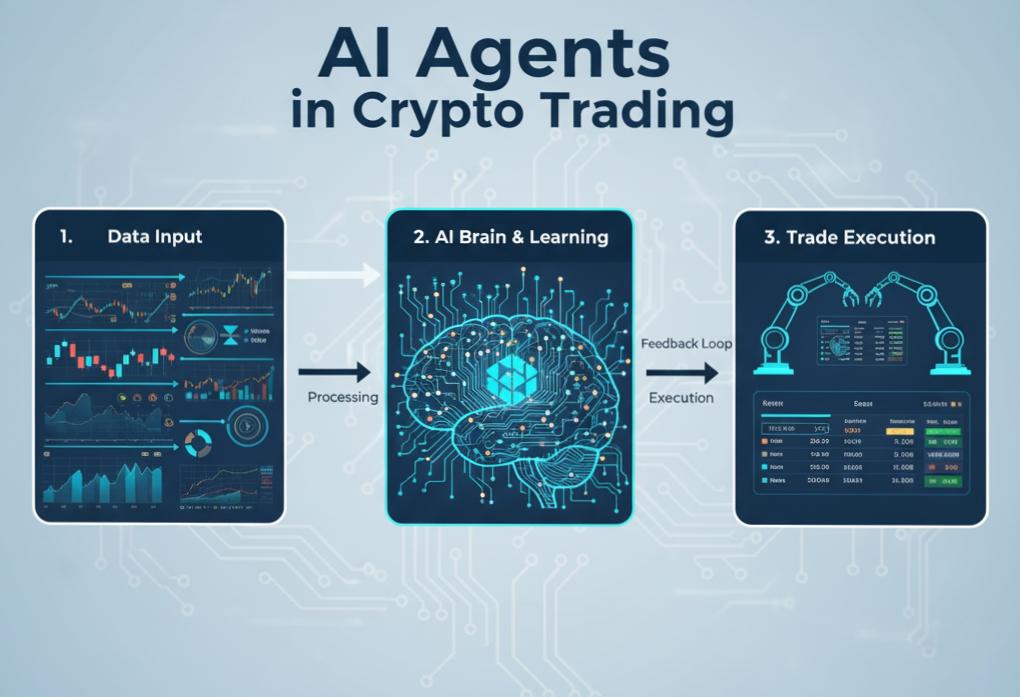
How AI Agents Works Inside the System:
- Data Input Layer:
AI agents rely on diverse data sources:
- Market feeds from exchanges (price, order books, trade history).
- Blockchain data (wallet activity, token minting/burning, gas fees).
- External signals like news, social media sentiment, or macroeconomic indicators.
- Learning and Decision Layer:
This is the brain of the system. It involves:
- Machine learning models (neural networks, reinforcement learning) that predict trends or classify signals.
- Backtesting and continuous retraining to adapt to new patterns.
- Risk algorithms to manage position size, stop-losses, and portfolio exposure.
- Execution Layer:
Once a decision is made, the agent acts:
- Executes trades via APIs or smart contracts.
- Adjusts positions in milliseconds to minimize slippage.
- Routes orders through liquidity pools or exchanges with the best prices.
- Feedback and Optimization:
AI agents continuously learn from performance data, success rates, losses, or market anomalies to refine future actions. Over time, this creates self-improving trading behavior.
Real-World Use Cases:
- Automated Trading Bots:
Platforms like 3Commas or Kryll integrate AI models for predictive analytics.
- DeFi Optimization :
Agents move funds across lending and yield-farming protocols to maximize returns.
- Arbitrage Systems:
Detecting price gaps between exchanges and executing profitable trades automatically.
- Sentiment-Driven Trading :
Using natural language processing (NLP) to react to Twitter trends or news events.
- Institutional Portfolio Management:
Hedge funds use AI agents to balance crypto portfolios and hedge risk dynamically.
The Risks and Limitations:
While AI agents can amplify trading efficiency, they are not risk proof. Understanding their risks is critical:
- Black-Box Decision Making:
Many agents operate as opaque systems users may not fully understand how decisions are made. This lack of transparency can lead to unexpected losses when market conditions change abruptly.
- Overfitting and Market Regime Changes:
If an AI agent is trained only on bull-market data, it might fail in bearish or sideways markets. Without continuous retraining, even the most advanced models can collapse.
- Security and API Vulnerabilities:
Because agents often access wallets or exchange APIs, a single exploit can lead to direct financial loss. Proper key management and security protocols are essential.
- Data Reliability:
AI depends on accurate data. False or manipulated information common in low-liquidity tokens can mislead the model, resulting in poor trades.
- Regulatory Uncertainty:
With governments worldwide drafting crypto and AI policies, the legal responsibilities of autonomous agents remain unclear. Liability in case of algorithmic errors or market manipulation is still debated.
Best Practices for Traders Using AI Agents:
- Start small:
Test agents with minimal capital in live markets before scaling.
- Use hybrid control:
Combine human oversight with automation; let the AI execute within defined limits.
- Monitor performance metrics:
Track win rates, drawdowns, and risk-adjusted returns regularly.
- Secure your infrastructure:
Use read-only APIs when possible; never expose private keys.
- Stay updated:
AI models degrade over time retrain or recalibrate frequently.
- Verify authenticity:
Avoid projects that exaggerate returns or hide their algorithms behind marketing buzzword.
Future Outlook:
The rise of AI-powered trading ecosystems is inevitable. In coming years, we can expect:
- Tokenized AI agents that operate autonomously and earn performance-based fees.
- Cross-chain intelligence, where agents interact seamlessly across blockchains.
- Collaborative swarms of agents, optimizing liquidity, staking, and yield collectively.
- Regulatory frameworks that define ethical and operational standards for autonomous trading.
- As crypto markets mature, these agents will likely become core components of decentralized finance (DeFi) bringing speed, scalability, and smart automation to every corner of the ecosystem.
Conclusion:
AI agents are transforming crypto trading from a human-driven practice into a machine-augmented ecosystem. Their ability to process immense data, execute with precision, and operate non-stop makes them invaluable for both retail and institutional traders.
Yet, like every technological leap, they come with challenges security, transparency, and regulatory risk. Success lies in using AI as an assistant, not a replacement combining human intuition with machine intelligence.
In the long run, AI agents will not just participate in markets; they may become the markets themselves autonomous systems shaping liquidity, price discovery, and financial evolution in the digital age.

DISCLAIMER: This content is for educational and reference purposes only and does not constitute any investment advice. Digital asset investments carry high risk. Please evaluate carefully and assume full responsibility for your own decisions.
Join MEXC and Get up to $10,000 Bonus!
Sign Up