

Key Takeaways
- Market Position: As of Jan 20, 2026, TSLA trades at $437, commanding a $1.45T market cap, despite a P/E ratio (292x) that defies traditional auto-industry logic.
- The Core Conflict: The valuation is currently propped up by “Tech Giant” promises (Robotaxi, Optimus) while the legacy “Auto Manufacturer” business faces shrinking margins and a 9% global sales dip in 2025.
- Critical Catalyst: The success of the Austin unsupervised Robotaxi rollout (Q1 2026) is the binary event that will likely determine if the stock pushes toward $600 or retraces to $300.
- Investment Verdict: TSLA has effectively decoupled from auto fundamentals. It is now a leveraged bet on general-purpose AI and robotics.
Tesla’s stock is defying gravity again. Hovering around $437 per share this week, the company is sitting on a market capitalization of $1.45 trillion, cementing its place among the global top ten most valuable companies.
But look closer, and you see a stock at war with itself. On one side, you have the stagnating fundamentals of a car manufacturer facing fierce competition. On the other, you have the explosive potential of an AI monopoly. We are strictly examining whether TSLA is simply an overpriced automaker or the most undervalued tech disruptor on the NASDAQ.
Here is the deep dive into the data driving Wall Street’s most polarizing debate.
Table of Contents
Current Market Snapshot: Valuation vs. Reality
Trading at $437 | Market Cap: $1.45T | P/E Ratio: 292
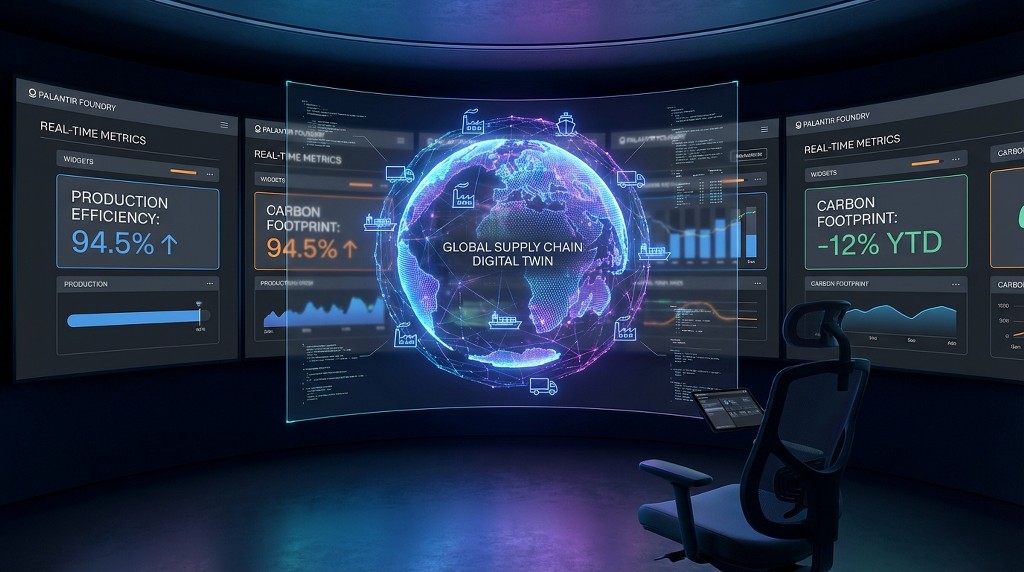
Tesla’s current valuation implies perfection, yet the reported numbers for fiscal year 2025 were mixed. Revenue came in at $97.7 billion, a respectable figure, but earnings growth stalled as the company engaged in aggressive price wars to defend territory.
The stock has been volatile, bouncing between $435 and $447 in mid-January. While the broader EV market cooled, Tesla managed a surprising coup: smashing sales records in China this past December, capturing roughly 4% of the massive Chinese market. This resilience in Asia is keeping the bears at bay, for now.
Analysts maintain a consensus “Buy” rating with an average price target of $397, suggesting the market is already pricing in a successful pivot from hardware to software.
The Bull Thesis: A Trillion-Dollar AI Monopoly
The Argument: “Stop valuing Tesla like Ford. Start valuing it like Nvidia.”
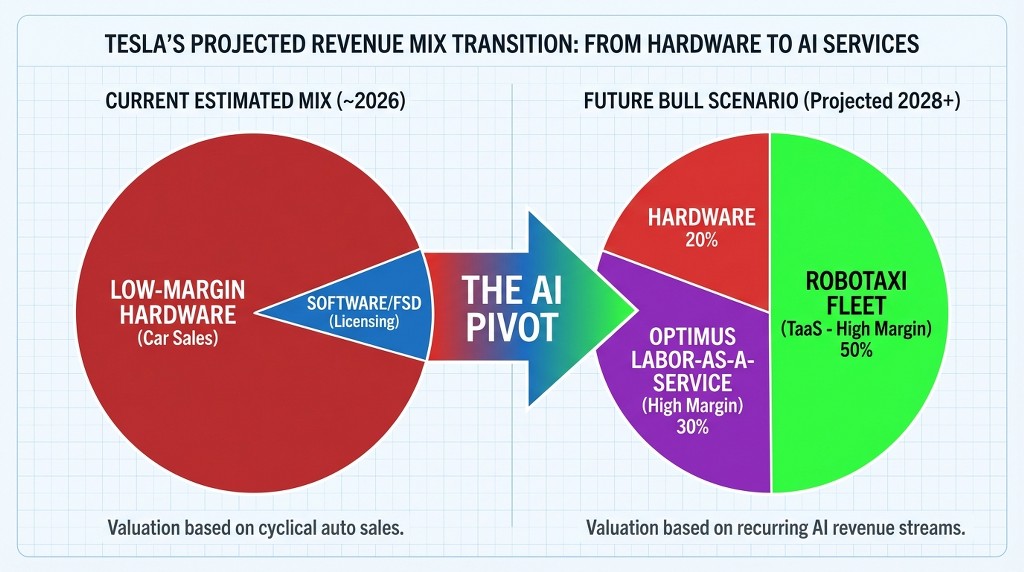
For the bulls, the car is merely a Trojan horse. The real valuation driver is the high-margin AI stack built on top of the fleet. By late 2026, bulls envision a path to a $2–3 trillion market cap, driven by three non-auto pillars.
1. The Unsupervised Robotaxi Rollout
Elon Musk’s claim that Full Self-Driving (FSD) is “pretty much solved” is facing its ultimate test. The unsupervised Robotaxi fleet is scheduled to hit the streets of Austin, Texas, in early 2026. If successful, this shifts Tesla’s business model from one-off hardware sales to recurring, high-margin “Transport-as-a-Service” (TaaS) revenue. Bulls project fleets could double in size rapidly, turning depreciating assets (cars) into 24/7 revenue generators.
2. Optimus Gen 3: The Labor Market Disruptor
Perhaps the most aggressive bull argument centers on the Optimus Gen 3 humanoid robot. With production costs estimated at just $10,000 per unit, the margin potential is staggering. If Musk’s projection holds that robots could eventually drive 80% of future revenue, Tesla is effectively creating a new industry larger than the global auto market combined.
3. Vertical Integration as a Moat
Unlike Google (Waymo) or legacy auto, Tesla owns the entire stack: the battery supply chain, the inference chips (Dojo), the manufacturing (Gigafactories), and the data collection fleet. This vertical integration offers a cost advantage that competitors, relying on third-party suppliers, simply cannot match.
The Bear Thesis: Cyclical Risks & Margin Compression
The Argument: “Hype doesn’t pay the bills. Declining delivery numbers do.”
Bears argue that until the AI revenue actually materializes, Tesla remains a car company, and right now, it’s a car company with shrinking margins and slowing growth.
1. The 2025 EV Sales Slump
There is no hiding the data: Global EV sales dipped 9% in 2025. Tesla was not immune. Its market share in the U.S. has slipped to 40%, eroded by a flood of affordable Chinese NEVs (New Energy Vehicles) and a resurgence of hybrids from European legacy brands. If the core auto business contracts faster than the AI business grows, the stock could face a severe correction.
2. The “Q1 2026” Demand Cliff
Investors are nervously eyeing the current quarter. With several EV tax credits facing sunset and early adopter demand fully saturated, Q1 2026 deliveries are at risk of underwhelming. A miss here would squeeze margins further, especially if Tesla is forced to cut prices again to move metal.
3. The “Execution Gap”
We have been here before. Promises of “next year” autonomy have circulated since 2016. If the Austin Robotaxi launch faces regulatory hurdles or technical delays, the market creates a “valuation vacuum”—where the stock price (based on AI) collapses down to the reality of the auto business (worth perhaps $130/share).
Comparative Data Analysis: Choosing Your Reality
This table breaks down the divergent paths for TSLA stock based on which narrative prevails in 2026.
| Metric | Bull Case Scenario (The Tech Giant) | Bear Case Scenario (The Auto Maker) | Investment Impact |
| Price Target | $600+ (Path to $3T Market Cap) | $130 (Reversion to Auto Mean) | High Volatility Risk |
| Primary Revenue | Optimus & FSD Licensing (80% mix) | Hardware/Car Sales (90% mix) | Valuation Multiple Expansion vs. Contraction |
| Market Moat | Unrivaled AI Data & Chip Leadership | Eroding Brand Loyalty vs. BYD/Xiaomi | Long-term Sustainability |
| 2026 Catalyst | Successful Robotaxi Launch (Austin) | Q1 Delivery Miss & Margin Drop | Binary Event Watch |
Conclusion: How to Position Your Portfolio
The days of viewing Tesla as a simple growth stock are over. It has evolved into a venture capital-style bet at a mega-cap scale.
If you are holding TSLA at $437, you are implicitly betting that the “Auto” identity is dying and the “AI” identity is being born. Watch the Q1 2026 delivery numbers closely, not for the revenue, but for proof of floor stability. However, the real signal will come from Austin. If the first unsupervised ride is hailed successfully, the bear case effectively dissolves.
Verdict: For risk-tolerant investors, the AI asymmetry justifies the premium. For value investors focused on P/E, the exit door is likely the safest option.
Whether you anticipate a breakout to $600 or a correction back to $130, volatility creates opportunity. Don’t just watch the price action, capitalize on it. Use MEXC Stock Futures to go long or short on TSLA with leverage, or build your long-term position instantly via MEXC Spot xStocks.
Frequently Asked Questions (FAQ)
Is Tesla stock a “Buy” at $437 in January 2026?
The consensus remains a “Buy” with a conservative target of $397, but buying at $437 requires conviction in the “Tech Giant” thesis. If you believe in the AI roadmap, the stock is still early in its repricing. If you focus on 2025 auto earnings, it is overbought.
Can Optimus really generate trillions in value?
Mathematically, yes. If Tesla creates a functional labor-bot for a $10,000 cost and leases it for $20,000+ per year (or sells for $25,000), the Total Addressable Market (TAM) exceeds the global auto industry. However, this is currently largely speculative.
Why did Tesla’s EV market share drop in 2025?
Two factors: Competition and Saturation. Chinese competitors (like BYD and Xiaomi) introduced high-tech EVs at significantly lower price points, while European consumers shifted slightly back toward hybrids. Tesla’s aging Model 3/Y lineup faced pressure against these fresher alternatives.
What is the single biggest risk for TSLA this year?
Regulatory gridlock. Even if the technology works, if regulators in the US or EU block unsupervised Robotaxis due to safety concerns, Tesla’s premium valuation, which hinges on high-margin software revenue, could deflate rapidly.
Disclaimer: This article is for informational purposes only and does not constitute financial advice. Please conduct your own research (DYOR) and assess your risk tolerance before trading. MEXC does not accept liability for any investment decisions made based on the information provided herein.
