

Key Takeaways:
- Market Leadership: RTX leads the group with a $240B market cap and a 43% yearly stock surge, driven by a diversified portfolio across commercial and defense sectors.
- Contrasting Strategies: While Boeing focuses heavily on commercial aviation recovery (up 31%), Lockheed Martin relies on its strong defense foundation and offers a 2.0% dividend yield.
- Financial Momentum: RTX’s Q3 earnings beat expectations by 20%, supported by a massive $72B order backlog that secures future revenue visibility.
- Industry Drivers: Growing defense budgets and substantial Pentagon contracts (such as the recent $7.8B missile allocation) continue to boost the aerospace sector.
RTX Corporation is currently a major player in the aerospace sector, with a market capitalization of $240 billion. In the third quarter, the company reported earnings of $1.70 per share, exceeding analyst expectations by 20%. As of late 2025, its stock price had increased by 43% over the year, reaching $179. This article examines the stock performance and market positions of three major aerospace companies: RTX, Boeing, and Lockheed Martin, using recent financial data.
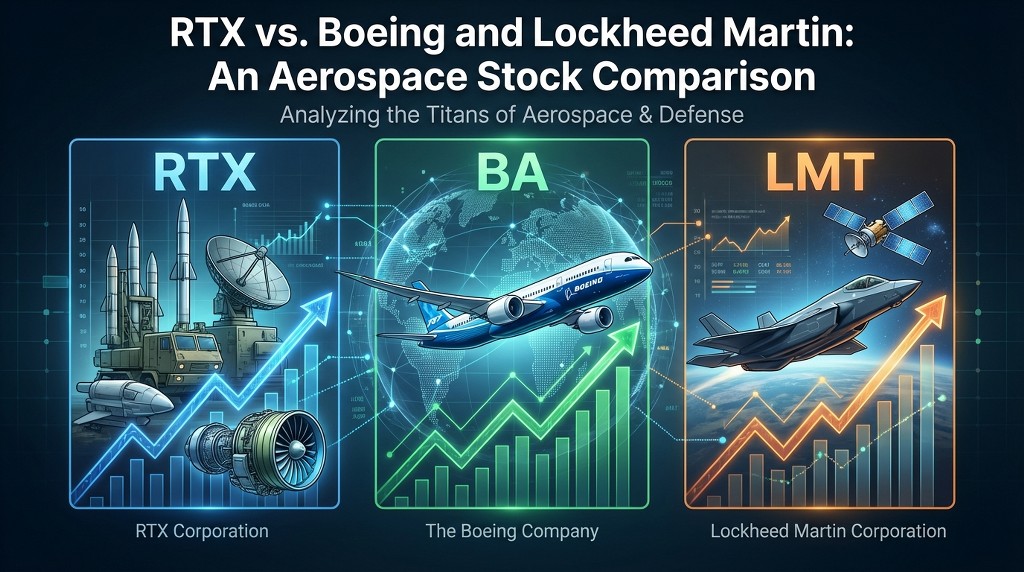
Table of Contents
Current Stock Performance
RTX has seen significant growth recently. RTX stock price reached $179, representing a 43% increase over the past year and a 12% increase over the past week. This growth follows a Q3 revenue report of $22.5 billion, which was higher than forecast.
- Market Position: RTX has a market cap of $240 billion and a beta of 0.88, indicating relatively moderate volatility compared to the broader market.
- Earnings: Its reported EPS is $1.70. The next earnings report is expected on January 27, 2026, with an estimated EPS of $1.47.
- Boeing: The company’s stock increased by 31% over the year to $223, supported by increased production rates.
- Lockheed Martin: The stock decreased by 14% to $486, though the company maintains a 2% dividend yield.
| Metric | RTX | Boeing (BA) | Lockheed Martin (LMT) |
| Current Price | $179 | $223 | $486 |
| Market Cap | $240B | $174B | $152B |
| Yearly Change | +43% | +31% | -14% |
| P/E Ratio | 37 | 322 | 31 |
| Dividend Yield | 1.5% | N/A | 2.0% |
Company Overviews and Core Products
RTX, founded in 1922 and based in Arlington, Virginia, operates in both the commercial and defense sectors. The company employs 186,000 people and reports full-year (FY) revenue of approximately $81 billion. It consists of three main divisions:
- Collins Aerospace: Supplies avionics, interior systems, and power components for various aircraft.
- Pratt & Whitney: Manufactures engines, including the GTF engines used in the A320neo and military aircraft.
- Raytheon: Produces defense systems, such as AMRAAM missiles and radar tracking technology.
In contrast, Boeing primarily focuses on commercial aviation (such as the 737 and 787 models) and also produces military aircraft like the F-15. Lockheed Martin specializes heavily in defense, notably the F-35 fighter jet program and JASSM missiles.

Aerospace Competition Analysis
The aerospace market is highly competitive. RTX’s projected 2025 revenue of $88 billion indicates a strong position, supported by its presence in multiple sub-sectors.
- Engines: Pratt & Whitney (RTX) competes with manufacturers like CFM International (which produces the LEAP engine used by Boeing) in the commercial engine market regarding fuel efficiency.
- Defense Systems: RTX and Lockheed Martin are the primary competitors in the missile sector (AMRAAM vs. JASSM).
- Government Contracts: RTX and Lockheed Martin receive a larger share of U.S. Department of Defense contracts compared to Boeing.
RTX currently reports an order backlog of $72 billion, which provides clear visibility into its future revenue streams.
Recent News and Contracts
Recent developments show continued activity and investment in the sector. RTX secured $37 billion in new contracts, contributing to its Q3 performance. Following this, analysts at Bank of America raised their price target for RTX to $215.
- Defense Contracts: In 2025, the Pentagon allocated $7.8 billion for missiles, which was divided between RTX ($3.5 billion for AMRAAMs) and Lockheed Martin.
- Boeing Updates: Boeing continues to increase production of its 737 line and benefits from defense contracts like the KC-46 tanker.
- Commercial Agreements: Pratt & Whitney recently secured a partnership with Wizz Air.
- Lockheed Martin: Production of the F-35 remains a steady revenue source for the company.
Financial Metrics Comparison
RTX’s financial data shows stable performance compared to its peers. The company reported full-year revenue of $80.7 billion and net income of $4.8 billion.
- Profitability: The basic earnings per share (EPS) is $4.92, with a profit margin of approximately 13%.
- Cash Flow: The company maintains positive free cash flow, which supports research and development as well as dividend payments.
- Competitor Revenue: In comparison, Boeing’s defense division generated $23 billion in revenue, while Lockheed Martin’s total defense revenue reached $65 billion.
| Financial Metric | RTX | Boeing | Lockheed Martin |
| FY Revenue | $80.7B | Defense: $23B | $75B |
| Net Income | $4.8B | N/A | N/A |
| EPS Growth | 41% | 112% (2026 proj.) | 34% (2026 proj.) |
| Employees | 186,000 | N/A | N/A |
Future Outlook and Investment Insights
The outlook for these aerospace companies depends on several market factors. Some analysts have set a maximum price target of $217 for RTX, citing the performance of its various business segments and its push into hypersonic technology.
- Industry Drivers: Key factors for growth include recovering commercial aircraft demand, cybersecurity solutions, and defense budgets.
- Boeing: The company is focusing heavily on recovering and accelerating its commercial production rates.
- Lockheed Martin: The ongoing F-35 program provides a stable foundation for its order backlog.
Investors often monitor aerospace ETFs, such as ITA, to track the collective performance of these three companies.
Conclusion
In summary, RTX’s diversified business model, spanning commercial engines and defense systems, has contributed to its recent financial growth and competitive edge. Investors will likely focus on the upcoming January earnings report to assess whether this trend continues relative to competitors like Boeing and Lockheed Martin.
Frequently Asked Questions
How does RTX stock compare to Boeing and Lockheed Martin in late 2025/early 2026?
RTX has shown a 43% annual gain and reached a market capitalization of $240 billion. Its diversified portfolio across commercial and defense sectors contrasts with Boeing’s commercial focus and Lockheed Martin’s defense concentration.
What are the recent contract developments between RTX and Lockheed Martin?
In 2025, the U.S. Department of Defense allocated $7.8 billion for missile contracts. This included $3.5 billion for RTX’s AMRAAM and $4.3 billion for Lockheed Martin’s JASSM. RTX also reported total backlog growth of $37 billion.
What is the market share comparison between Boeing and RTX?
RTX reported $81 billion in FY revenue, reflecting its broad presence. Boeing has a strong position in the commercial aircraft market but currently trails RTX in overall and defense-specific revenue.
What factors have influenced RTX’s recent stock performance?
The 43% yearly increase in stock price is largely attributed to a Q3 EPS that exceeded expectations by 20%, $22.5 billion in quarterly revenue, ongoing demand for GTF engines, and an order backlog of $72 billion.
How do defense budgets impact these aerospace stocks?
Increases in defense spending generally benefit all three companies. RTX and Lockheed Martin, in particular, see direct revenue growth from government contracts for munitions and missile systems.
Disclaimer: This article is for informational purposes only and does not constitute financial advice. Please conduct your own research (DYOR) and assess your risk tolerance before trading. MEXC does not accept liability for any investment decisions made based on the information provided herein.
