
Key Takeaways
- IonQ (IONQ): The “Quality” Play. Wins on accuracy (99.99% fidelity), low error rates, and a massive cash pile ($656M).
- Rigetti (RGTI): The “Speed” Play. Wins on processing speed and manufacturing scalability, with huge recent stock momentum (+83%).
- Verdict: Choose IonQ for long-term stability; choose Rigetti for aggressive short-term growth.
The race for quantum dominance is heating up between IonQ (NYSE: IONQ) and Rigetti Computing (NASDAQ: RGTI). By 2026, both have captured investor attention, IonQ with a massive $16.6B market cap and Rigetti with surging stock momentum.
While they share the goal of solving “impossible” problems like drug discovery, their methods differ wildly. IonQ bets on atomic precision, while Rigetti bets on chip-based speed. Here is how to spot the winner for your portfolio.
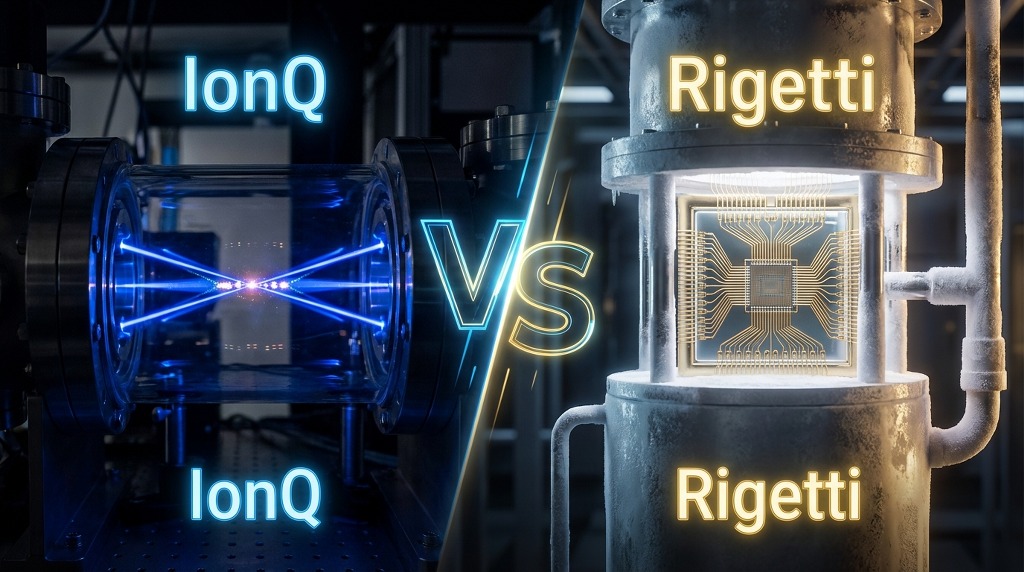
Table of Contents
Quantum Computing Basics
To understand the stock potential, you have to understand the hardware. The core difference lies in how they build their “qubits”, the quantum equivalent of a computer bit.
- IonQ (Trapped-Ion): IonQ uses individual atoms (ions) suspended in a vacuum by electromagnetic fields. Because these are natural atoms, they are identical and highly stable. They operate at room temperature and have long “coherence times” (meaning they can hold information for minutes), whereas other types lose data in microseconds.
- Rigetti (Superconducting): Rigetti uses man-made electronic circuits printed on chips, similar to traditional CPUs but made of superconducting materials. These are incredibly fast—operating about 10,000 times quicker than trapped ions—but they require expensive, extreme refrigeration (cryogenics) to function.
The Bottom Line: IonQ focuses on stability and longer calculation times; Rigetti focuses on blazing-fast speed and chip manufacturing.
Technology Comparison
When we look at performance, the trade-off is between accuracy and speed.
IonQ excels in fidelity. Their system allows “all-to-all” connectivity, meaning any qubit can talk to any other qubit directly. This reduces errors significantly, allowing them to hit 99.99% fidelity. They are currently targeting over 100 qubits with their “Tempo” system.
Rigetti is chasing scale through speed. Their Ephe-136Q system has achieved 99.5% fidelity on two-qubit gates. While slightly less accurate than trapped ions, their gates are faster, and their modular chip design aims to scale to 1,000+ qubits by 2027.
| Feature | IonQ (Trapped-Ion) | Rigetti (Superconducting) |
| Stability (Coherence) | Minutes-long (Very Stable) | Microseconds (Fleeting) |
| Accuracy (Fidelity) | 99.99% | 99.5% |
| Temperature | Room Temperature | Cryogenic (Near Absolute Zero) |
| Connectivity | All-to-all (Low Error) | Lattice-based (Neighbor-only) |
| Roadmap Target | 100+ qubits (Tempo) | 1,000+ qubits by 2027 |
Financial Performance
Innovation requires capital, and the balance sheets of these two companies tell different stories about their path to commercialization.
IonQ is the more capitalization-heavy of the two, holding $656 million in cash with zero interest costs. This gives them a long runway to refine their technology without immediate pressure to raise funds. Their revenue growth has been steady, driven by bookings from cloud giants.
Rigetti, with $570 million in cash, is showing impressive improvements in its return on capital. The market has rewarded this efficiency, leading to a significant stock surge leading into 2026. While IonQ has the cash safety net, Rigetti is currently offering higher gross margins.
Stock Performance (2025-2026)
The last 12 months have been volatile but rewarding for quantum investors.
Rigetti has been the high-beta mover, soaring roughly 83% over the past year. This momentum was fueled by successful hardware launches and deeper integration with Nvidia’s platform. In January 2026 alone, the stock pushed up another 15.2%.
IonQ has seen a more modest but steady climb of 17%. Their growth is driven less by hype and more by consistent partnership announcements, including deals with the U.S. Air Force.
What to watch: Keep an eye on the Q1 2026 earnings reports. Rigetti needs to prove its manufacturing consistency, while IonQ needs to show it can turn its high booking numbers into recognized revenue.
Market Position and Roadmap
Who is winning the race to be the industry standard?
IonQ is playing the “compatibility” game. By making their hardware available on Azure, Google Cloud, and AWS, they are positioning themselves as the go-to backend for software developers. Their roadmap focuses on achieving fault tolerance (error-free computing) within the next three years.
Rigetti is taking a more specialized approach. They are selling integrated systems (like the Novera QPU) directly to research labs and leveraging their “NVQLink” to work efficiently with classical supercomputers. They have a strong foothold in the Department of Defense and enterprise sectors that need hybrid setups.
Risks for Quantum Investors
Despite the excitement, this sector remains risky. The primary challenge is the immense cost of Research & Development (R&D). Both companies burn cash to achieve these engineering breakthroughs.
Furthermore, competition is fierce. Legacy tech giants like IBM are not sitting on the sidelines—they are building their own massive superconducting systems. IonQ and Rigetti must continue to offer unique advantages (like IonQ’s accuracy or Rigetti’s speed) to survive against these deep-pocketed competitors.
Conclusion
So, which stock belongs in your portfolio?
- Choose IonQ if: You prioritize high accuracy, a massive cash safety net, and a broad, cloud-accessible strategy. It is the “steady” play for long-term utility.
- Choose Rigetti if: You are looking for aggressive growth, manufacturing scalability, and shorter-term stock momentum. It is the high-risk, high-reward “speed” play.
Frequently Asked Questions
Is IonQ or Rigetti a better buy in 2026?
Rigetti suits growth traders chasing momentum (up ~75% recently). IonQ is for long-term investors seeking stability and cash safety.
What is IonQ’s main advantage?
Accuracy. Its trapped-ion tech delivers 99.99% fidelity and superior stability at room temperature.
How does Rigetti’s tech compare?
Speed. Its superconducting chips are ~10,000x faster than trapped ions but require extreme cooling.
Are these companies profitable yet?
Not yet. Both burn cash for R&D. Rigetti currently leads in margin trends; IonQ leads in cash reserves.
When will quantum computing go mainstream?
3+ years. Expect robust 100–1,000 qubit commercial systems between 2026 and 2027.
Disclaimer: This article is for informational purposes only and does not constitute financial advice. Please conduct your own research (DYOR) and assess your risk tolerance before trading. MEXC does not accept liability for any investment decisions made based on the information provided herein.
Join MEXC and Get up to $10,000 Bonus!
Sign Up


