

Key Takeaways
- Market Momentum: INTC reclaiming $48.56 (Jan 21, 2026) signals renewed Wall Street confidence after prolonged volatility.
- Execution Pivot: Under Lip-Bu Tan, Intel is refocusing on 18A node yields and operational efficiency over broad expansion.
- Sovereign Support: $8.9B in CHIPS Act funding and strategic backing help de-risk heavy fab investments.
- Valuation Reality: Despite weak trailing earnings, forward estimates point to deep value upside versus NVIDIA and AMD—if execution delivers.
For years, investing in Intel Corporation (INTC) has been a lesson in patience, and pain. Missed deadlines, losing the process lead to TSMC, and watching NVIDIA capture the AI crown left the former semiconductor titan looking vulnerable.
But the chart in early 2026 tells a different story.
Trading at $48.56 as of the January 21 close, with intraday highs breaching $50, Intel is staging its most credible recovery attempt in years. With a market cap stabilized around $242 billion, the conversation on Wall Street is shifting from “survival” to “revival.” The catalyst? A perfect storm of government backing, a stabilizing PC market, and a leaner, meaner corporate structure.
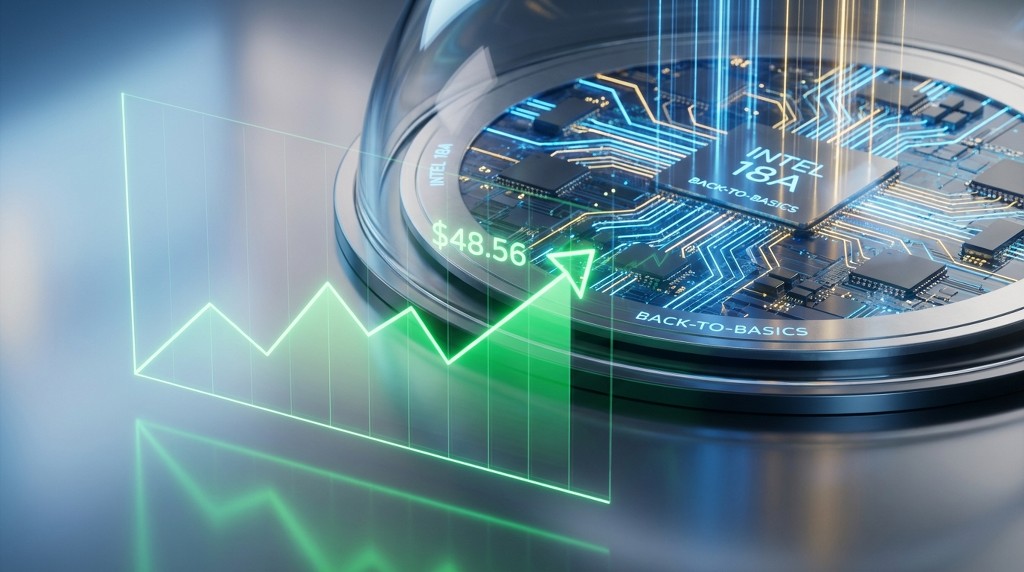
Table of Contents
The “Back-to-Basics” Strategy Shift
The headline isn’t just the technology; it’s the governance. While CEO Pat Gelsinger’s IDM 2.0 vision laid the ambitious roadmap, the market is crediting Lip-Bu Tan for the newfound discipline seen in 2025.
The approach has pivoted from empire-building to ruthless execution:
- 18A or Bust: The company’s future hinges on the 18A process node. Designed to compete with TSMC’s 2nm technology using PowerVia (backside power delivery), 18A is Intel’s bid for performance leadership. Unlike previous cycles, the company is not chasing every market—it is singularly focused on yielding this node for both internal products and foundry customers.
- Asset Rationalization: Intel has moved to trim the fat. By evaluating spins or IPOs for non-core assets like Altera and Mobileye, management is unlocking shareholder value and directing all free cash flow toward the core logic and foundry businesses.
Financial Health: The “Sovereign Shield”
The bear case for Intel traditionally centered on its terrifying cash burn. Building fabs in Ohio and Arizona costs tens of billions, a burden no other US company is shouldering alone.
However, the 2026 financial picture is distinct because Intel is no longer spending just its own money.
- Government Backstop: The $8.9 billion in CHIPS Act grants acts as a non-dilutive capital injection, effectively subsidizing the company’s capex.
- Strategic Capital: Investments from partners, including the reported $5 billion from NVIDIA and $2 billion from SoftBank for guaranteed foundry capacity, have significantly bolstered liquidity.
With a cash position now reported at $30.9 billion, the imminent liquidity crisis that bears feared in 2024 has effectively been taken off the table.
The Growth Engines: AI PCs and Defense
Intel isn’t trying to beat NVIDIA in training large models in the data center. Instead, it is cornering the market where it still has an advantage: the device on your desk.
1. The Edge AI Monopoly
The “AI PC” supercycle is the dominant theme of 2026. As inference moves from the cloud to the device (to save costs and preserve privacy), Intel’s Core Ultra chips are positioned to capture 60% of the AI PC market this year. This volume creates a defensive moat against encroaching ARM-based competitors.
2. The “Secure Enclave”
In a fracturing geopolitical world, the U.S. government cannot rely on chips made in Taiwan for critical defense systems. Intel is currently the only option for leading-edge logic manufactured on US soil. Recent defense contracts, totaling over $3 billion, confirm that Intel is becoming a “quasi-sovereign” asset, too strategically important to fail.
The Risks: Why Caution is Still Required
Despite the rally to $48, this remains a “Show Me” stock.
- Valuation Complexity: Investors shouldn’t be misled by trailing P/E ratios, which remain distorted by past write-downs. The thesis relies entirely on forward earnings growth. If the 18A ramp encounters delays, similar to the 10nm debacle of the past, that forward guidance will collapse.
- The ARM Threat: While Intel is holding the line in PCs, ARM-based silicon (from Qualcomm and Apple) continues to offer superior battery life. Intel needs 18A efficiency not just to win servers, but to stop the bleeding in laptops.
Verdict: A Asymmetric Bet
Intel at $48.56 is not the “safe” bet of the 1990s. It is a high-stakes turnaround play.
For investors, the thesis is simple: If Intel captures even a modest slice of the foundry market and holds its PC dominance, the stock is undervalued relative to its peers. But until the 18A yields are proven in high-volume manufacturing later this year, position sizing should remain disciplined.
Whether you are bullish on Intel’s 18A recovery or looking to hedge against short-term execution risks, having the right access is critical.
MEXC now bridges the gap between crypto and traditional equities, offering you versatile tools to capture this semiconductor volatility. You can accumulate positions directly via Spot xStocks for the long term, or actively trade the price action with Stock Futures.
FAQs
Is Intel’s dividend safe in 2026?
Intel is best viewed as a turnaround play, not an income stock. Cash reserves and government support add stability, but Capex takes priority, keeping dividends conservative until FCF improves.
INTC price target?
Estimates are rising. If 18A execution succeeds, institutional models suggest $60+ by end-2026, driven by margin expansion.
Does Intel make chips for NVIDIA?
Yes. NVIDIA uses Intel’s advanced packaging (and potentially future nodes), validating Intel’s neutral foundry strategy.
Why is 18A critical?
18A is the inflection point. It aims to beat TSMC in performance per watt, enabling premium in-house chips and high-margin foundry customers like Microsoft and Amazon.
Disclaimer: This article is for informational purposes only and does not constitute financial advice. Please conduct your own research (DYOR) and assess your risk tolerance before trading. MEXC does not accept liability for any investment decisions made based on the information provided herein.
