Abstract: Datagram Network (DGRAM) is a Layer 1 blockchain network dedicated to providing low latency, high throughput, and global interconnection for Web3, AI, IoT and other application scenarios. The project achieves efficient node quotas and cross-chain interoperability through its innovative “Hyper-Fabric” network architecture, combined with decentralized physical infrastructure network (DePIN). This article will delve into the core technology, token economy, market opportunities, and challenges of Datagram Network, helping investors fully understand the potential and risks of the project.
TL;DR:
- Project Background : Datagram Network promotes the integration of decentralized physical infrastructure network (DePIN) and real-time connection through its self-developed Layer 1 blockchain and “Hyper-Fabric” architecture, aiming to break through the bottleneck of traditional Cloud Service architecture and improve the availability and security of the global network.
- Technical Architecture : including self-developed Layer 1 blockchain, globally distributed network nodes, AI-driven intelligent routing, low latency and high throughput features, and cross-chain interoperability.
- Token Economy : DGRAM tokens are used to pay network service fees, reward node contributions, and participate in Platform Governance, with a total of 10 billion tokens.
- Market Prospects : Targeting multiple high-growth areas such as Web3, AI, gaming, and IoT, aiming to become a leader in decentralized infrastructure building.
- Risk Factors : The project is still in the early stages, the technology implementation faces challenges, the market awareness is low, and it faces competition with traditional Cloud as a Service providers and other DePIN projects.
1. Datagram Network Project Background: Driving the Revolution of Decentralized Infrastructure
While blockchain and decentralized finance (DeFi) are booming, traditional Cloud Services and Internet infrastructure still face many challenges, such as high cost, low efficiency, and single point of failure risk. Datagram Network aims to solve these problems and create a global distributed infrastructure platform through decentralized physical infrastructure network (DePIN) and efficient cross-chain communication mechanism.
The platform provides low-latency, high-throughput network services through an architecture based on Layer 1 blockchain , combined with global nodes and real-time data transmission. Datagram Network aims to become the underlying network infrastructure that supports Web3, AI, IoT, and real-time applications, breaking through the limitations of traditional cloud architecture and promoting the construction of the next generation of the Internet.

2. Datagram Network Technology Architecture: Innovative “Hyper-Fabric” Networks
2.1 Layer 1 Blockchain Architecture
Datagram Network adopts its self-developed Layer 1 blockchain, which is designed to be compatible with multiple ecosystems (such as ARC-20, BSC, etc.) and has high throughput and low latency characteristics. The core functions of blockchain include but are not limited to:
- Efficient Transaction Processing : Supports large-scale concurrent transactions to ensure fast response on a global scale.
- Low Latency : Optimized the communication protocol of the blockchain network, reducing the transmission time of data, especially suitable for application scenarios such as AI and games that require high real-time performance.
- Cross-chain Interoperability : By interconnecting with other blockchain networks, Datagram Network enables multi-chain compatibility of decentralized ecosystems.
2.2 Hyper-Fabric Network Architecture
“Hyper-Fabric” is the core innovative architecture of Datagram Network. It optimizes the resource allocation and data processing of global nodes through the following characteristics:
- Global Node Distribution : The nodes in the network are widely distributed, covering more than 150 countries, supporting high-speed data transmission and low-latency services worldwide.
- AI-Driven Intelligent Routing : Datagram Network intelligently routes network traffic through Machine Learning algorithms and dynamic optimization technology to ensure the best path is available at all times, reducing latency and improving network efficiency.
- Decentralized Physical Infrastructure Network (DePIN) : By combining physical devices and blockchain technology, Datagram Network enables decentralized computing resources and storage quotas, providing reliable support for Web3 and decentralized applications.
3. Datagram Network Application Scenarios
3.1 Web3 and DeFi
Datagram Network provides a powerful underlying infrastructure for Web3 and decentralized finance (DeFi), supporting fast, secure, and low-cost asset transfers and transactions. Through its low-latency network and high-throughput capabilities, Datagram can provide reliable smart contract support for DeFi applications, improve transaction efficiency, and meet high-frequency trading needs.
3.2 AI and Big data
With the rise of artificial intelligence and big data, Datagram Network provides powerful computing resources to support Data Analysis and Model Training. Through its EdgeComputing capabilities and efficient data processing capabilities, Datagram Network can provide strong support for AI algorithms, promoting more efficient and intelligent decision-making systems and automation.
3.3 Games and virtual reality
Datagram Network provides an ideal solution to meet the high-performance and low-latency demands of large-scale online gaming and virtual reality (VR) platforms. Its high-throughput and low-latency network architecture allows players to enjoy a smoother, real-time gaming experience while supporting various real-time interactions in the virtual world.
3.4 Internet of Things (IoT)
Internet of Things (IoT) devices require efficient data transmission and processing capabilities to collect and analyze massive amounts of data in real-time. Datagram Network provides high-speed data transmission and secure storage solutions through its decentralized infrastructure, ensuring that IoT systems can operate and be effectively managed in real-time.
4. DataRAM Network Token Economic Model
As the core token of Datagram Network, DGRAM plays a crucial role in the platform ecosystem. According to the official website, the total supply of DGRAM is 10 billion coins.
The main uses of DGRAM tokens include:
- Payment of network service fees : Users can use DGRAM tokens to pay for various services provided by the platform, such as data storage, computing power, internet bandwidth, etc.
- Reward nodes : Users who participate in the operation and resource provision of network nodes will receive DGRAM as a reward.
- Platform Governance : Users holding DGRAM can participate in the governance voting of the platform to decide the future development direction and technical upgrades of the platform.
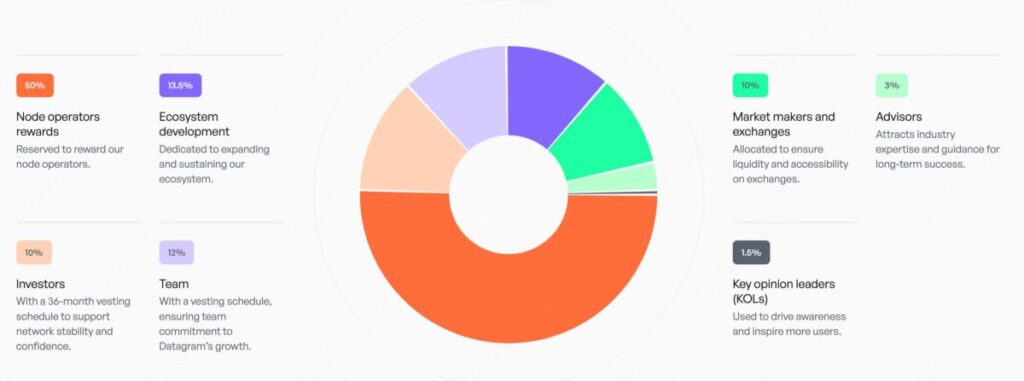
The following is the distribution ratio of DGRAM tokens:
| Assignment category | Proportion | Explanation |
| Node Operator Rewards | 50 % | Used to reward operators who provide network resources (nodes, bandwidth, computing) |
| Ecosystem development | 13.5 % | For ecosystem building, community incentives, partner support |
| Team | 12 % | Team holding, usually accompanied by lock release mechanism |
| Investors | 10 % | Early investors or early supporters hold, usually with an unlocking period |
| Market/liquidity provider | 10 % | For exchange liquidity, marketing activities |
| Consultants | 3 % | Attract Subject-Matter Experts and Consultants to participate in the project |
| KOL/Promotion | 1.5 % | For Key Opinion Leaders, Community Communication Rewards |
5.How to trade DGRAM tokens on MEXC?
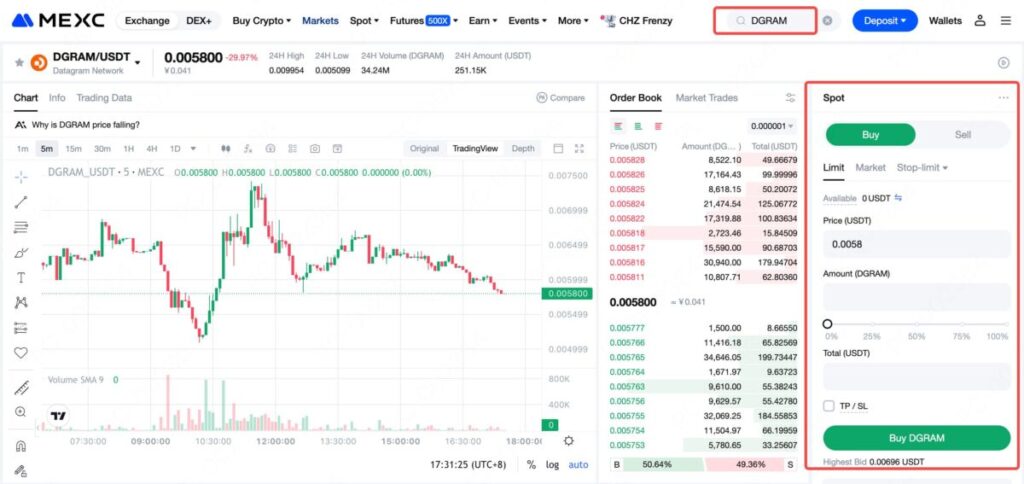
As the world’s leading digital asset trading platform, MEXC has launched the DGRAM token . Users can easily trade DGRAM tokens on MEXC by following these simple steps:
- Open and log in to the MEXC App or visit the official website ;
- Enter the DGRAM token name in the search box and select to enter Spot or Futures Trading ;
- Set your order parameters (including price and quantity) to complete the transaction.
6. Datagram Network Market Prospects and Challenges
6.1 Market Opportunities
With the rise of Web3 and decentralized applications, Datagram Network has huge market potential. Its innovative decentralized infrastructure can not only meet the needs of low latency and high throughput in fields such as AI, Big data, and IoT, but also provide reliable underlying support for Web3. In addition, the trend of decentralized physical infrastructure networks (DePINs) is also becoming a hot spot for investors. Datagram Network’s global node layout and cross-chain interoperability will give it a favorable position in this Emerging Market.
6.2 latent Risk
- Technology Implementation Challenges : Although Datagram Network provides an ambitious technology architecture, it still faces significant technical challenges in global node deployment, network stability, and cross-chain compatibility.
- Market competition : Compared with other decentralized infrastructure platforms (such as Filecoin, Helium ), Datagram Network needs to further increase investment in market awareness, technology landing and ecosystem construction.
- Token circulation and governance issues : The Incentive Mechanism and governance structure of the DGRAM token still needs time to verify its sustainability, especially as the global user base and market circulation increase.
7. Conclusion
Datagram Network (DGRAM), as an innovator in the field of decentralized infrastructure, combines Layer 1 blockchain with “Hyper-Fabric” network architecture to propose a new solution for application scenarios such as Web3, AI, and IoT. Although the project is still in its early stages and faces challenges from Technology Implementation and market competition, its strong technical foundation, innovative token economy model, and advantages of decentralized physical infrastructure networks make it have great potential in the future. For investors, Datagram Network provides an infrastructure investment opportunity worth paying attention to. However, considering that the project is still under development, investors need to closely monitor its technological implementation, ecosystem construction progress, and market response, and carefully evaluate its long-term value and risks.
Join MEXC and Get up to $10,000 Bonus!
Sign Up