


Introduction: The Convergence of AI and Blockchain
Artificial Intelligence (AI) and blockchain are two of the most transformative technologies shaping the modern digital economy. Over the past decade, blockchain technology has revolutionized financial systems by introducing decentralization, transparency, and trustless transactions. At the same time, artificial intelligence has significantly improved data analysis, automation, and decision-making capabilities across multiple industries.
Today, the convergence of AI and cryptocurrency is creating a new technological ecosystem. Intelligent algorithms can analyze large volumes of blockchain data, automate complex financial processes, and support decentralized decision-making systems.
Major Blockchain networks such as Bitcoin and Ethereum have already demonstrated how decentralized infrastructure can support global financial activity. When combined with AI-driven analytics and automation, these networks have the potential to power smarter decentralized applications that may redefine how digital economies operate.
For traders and investors interested in emerging AI-powered crypto projects, platforms such as MEXC provide access to a wide range of digital assets, advanced trading tools, and real-time market data.
What Are AI Crypto Projects?
AI crypto projects are blockchain platforms or tokens that integrate artificial intelligence technologies such as machine learning, predictive analytics, and autonomous decision-making.
These projects use AI algorithms to analyze large datasets, optimize blockchain performance, and improve transaction efficiency. By combining decentralized infrastructure with intelligent systems, AI-based platforms aim to create more advanced financial and technological ecosystems.
Definition of AI Tokens
AI tokens represent a growing class of digital assets designed to support decentralized artificial intelligence networks. These tokens can power autonomous applications, enable data-driven services, and facilitate payments within AI-based digital marketplaces.
In many cases, AI tokens also act as incentives for developers and contributors who provide computing power, machine learning models, or valuable datasets to decentralized AI ecosystems.
How AI Integrates with Blockchain
The integration of AI with blockchain technology opens several new opportunities for innovation across the crypto industry.
1. Smarter Smart Contracts
Artificial intelligence can enhance smart contracts by enabling them to process external data and execute actions based on complex conditions. This allows decentralized applications to become more adaptive and responsive to real-world events.
2. On-Chain Data Analysis
Blockchain networks generate massive amounts of on-chain data. AI models can analyze this information in real time, helping investors and developers identify patterns, trends, and unusual market activity.
3. Decentralized AI Networks
Some blockchain platforms are building decentralized marketplaces where developers can deploy AI algorithms and provide intelligent services globally. These networks allow AI models to operate without relying on centralized cloud providers.
For investors interested in AI-related cryptocurrencies, exchanges like MEXC provide access to a variety of emerging AI tokens within a secure and liquid trading environment.
Key Use Cases of AI in the Crypto Industry
1. Market Forecasting and Analysis
AI algorithms can analyze massive datasets from cryptocurrency markets, including historical prices, trading volumes, and sentiment indicators. These insights help traders identify potential market trends and make more informed investment decisions.
Machine learning models can process information far more quickly than traditional analysis methods, making them especially useful in highly volatile markets like cryptocurrency trading.
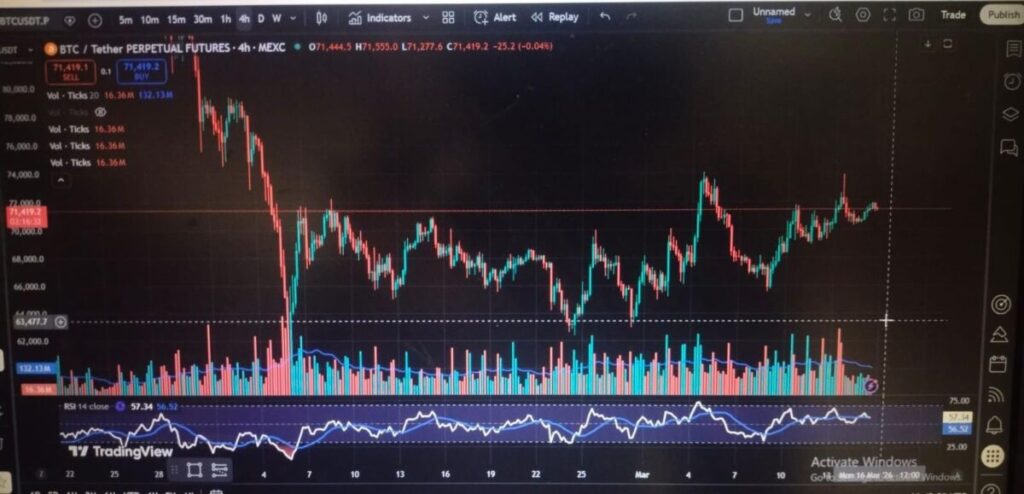
Bitcoin (BTC/USDT) 4H Chart — Source:( TradingView)
2. Algorithmic Trading
Algorithmic trading is one of the most important applications of artificial intelligence in crypto markets. AI-powered trading systems use machine learning models to detect market patterns and automatically execute trades based on predefined strategies.
These systems analyze multiple data sources, including:
- Historical price movements
- Trading volume data
- News sentiment analysis
- Social media trends
- Macroeconomic indicators
By processing these inputs simultaneously, AI systems can identify trading opportunities that may not be immediately visible to human traders.
3. Cryptocurrency Fraud Detection and Security
Security remains a major concern in the cryptocurrency ecosystem. AI-based monitoring systems can continuously analyze blockchain transactions and detect suspicious behavior patterns.
These systems can identify anomalies such as unusual transaction activity, potential hacking attempts, or fraudulent trading behavior. As a result, integrating AI into blockchain security frameworks can significantly improve protection for users and exchanges.
4. Smart Contract Optimization
AI tools can also analyze smart contract code to detect vulnerabilities, inefficiencies, and potential security risks. By simulating different execution scenarios, AI systems can predict how contracts will behave under various conditions.
This enables developers to improve contract reliability and security before deploying them on blockchain networks.
Top AI Crypto Projects to Watch
Several blockchain projects are actively developing AI-focused ecosystems. Below are three notable examples gaining attention in the industry.
Bittensor ($TAO)
Bittensor is one of the most prominent decentralized AI networks. It functions as a global marketplace where machine learning models compete to provide useful intelligence.
Developers contribute models to the network and receive rewards based on the quality of their outputs. With the expansion of its subnet architecture, Bittensor is rapidly scaling its decentralized AI infrastructure.
NEAR Protocol ($NEAR)
NEAR Protocol is a high-performance Layer-1 blockchain designed to support scalable decentralized applications. Recently, the network has increasingly focused on supporting AI-driven applications and AI agents.
Its Nightshade sharing technology allows the network to handle large volumes of data, which is essential for AI-powered systems.
Artificial Superintelligence Alliance ($FET)
The Artificial Superintelligence Alliance is a collaboration between Fetch.ai, SingularityNET, and Ocean Protocol. The initiative aims to build one of the largest decentralized AI ecosystems in the blockchain industry.
The FET token powers autonomous AI agents and supports decentralized machine learning services across the network.
Key AI Crypto Projects and Their Use Cases
| Project | Category | Primary Use Case |
| Bittensor | AI Infrastructure | Decentralized machine learning network |
| NEAR Protocol | AI Blockchain | Infrastructure for AI agents and decentralized applications |
| Artificial Superintelligence Alliance (FET) | AI Ecosystem | Autonomous AI agents and decentralized intelligence |
These projects represent some of the most influential AI-focused ecosystems currently emerging in the cryptocurrency market.
Benefits of AI Integration in Crypto
The integration of artificial intelligence into blockchain systems offers several advantages:
Faster Data Processing
AI systems can analyze large datasets in seconds, enabling faster insights for traders and developers.
Improved Trading Strategies
Predictive models help investors optimize trading strategies and manage market risk.
Enhanced Security
AI algorithms can detect suspicious activity and strengthen blockchain security frameworks.
Automation in DeFi
AI agents can automate financial tasks such as trading, lending, and portfolio management within decentralized finance ecosystems.
Challenges and Risks
Despite its potential, the integration of AI and blockchain also presents several challenges.
Data Reliability
AI models rely heavily on high-quality data. Poor or inaccurate data may lead to incorrect predictions.
Market Manipulation Risks
Advanced AI trading systems could potentially be exploited if vulnerabilities exist.
Regulatory Uncertainty
Both artificial intelligence and cryptocurrency face evolving regulatory frameworks in many jurisdictions.
High Computational Costs
AI models often require significant computational resources, which can increase infrastructure costs.
The Future of AI and Crypto
The intersection of artificial intelligence and blockchain technology is expected to shape the next generation of digital innovation.
In the coming years, AI-powered crypto wallets may automatically analyze market conditions, optimize investment strategies, and interact with decentralized applications. Autonomous AI agents could manage digital assets, execute trades, and even participate in decentralized governance systems.
As these technologies mature, the AI-crypto ecosystem could significantly transform decentralized finance (DeFi), digital identity systems, and data-sharing networks.
However, achieving this vision will require continued technological development, stronger infrastructure, and clearer regulatory frameworks.
Conclusion
The integration of artificial intelligence with blockchain and cryptocurrency represents a major technological evolution. AI-powered crypto projects have the potential to improve financial systems, automate digital services, and unlock new opportunities for developers and investors.
As the crypto industry continues to evolve, the combination of AI and blockchain may become one of the most influential forces shaping the future of decentralized technology.
With exchanges like MEXC offering access to emerging AI tokens and advanced trading tools, market participants can explore this rapidly developing sector more efficiently.
Disclaimer:This article is for informational purposes only and does not constitute financial or investment advice. Cryptocurrency investments involve significant risks, and readers should conduct their own research before making any financial decisions.
