


Key Details:
- Status: CLAIM LIVE — Token Launched January 21, 2026
- Sector: Infrastructure / Blockspace Market / MEV / Realtime Ethereum
- Chain: Ethereum (ERC-20)
- Funding: $12M (Polychain Capital, Amber Group) + $800M in validator liquidity commitments
- Token Status: LIVE & TRADING — CoinMarketCap Rank #339, ~$55M market cap
1. What Is ETHGas? Solving Ethereum’s Blockspace Problem
1.1 The Gas Problem Nobody Solved
Every Ethereum user has a gas fee story. The NFT that cost more to mint than it was worth. The DeFi swap that was abandoned because fees exceeded the trade value itself. The transaction that failed mid-execution; burning gas anyway, with nothing to show for it. For years, these experiences were simply the accepted cost of using the world’s most programmable blockchain.
Gas fees on Ethereum are determined by blind auction. Every transaction competes in the public mempool, bidding against every other transaction for limited blockspace in the next 12-second block. The result is a chaotic, unpredictable fee market that makes institutional-grade reliability essentially impossible, punishes regular users during periods of congestion, and hands enormous power to MEV bots that front-run, sandwich, and extract value from ordinary traders with every block.
While Layer 2 solutions have compressed base fees significantly with simple transfers now costing a few cents and swaps under $0.10 on L1 the fundamental architecture of how blockspace is allocated has remained unchanged since Ethereum’s earliest days. Intense MEV competition has simply migrated to L2 environments and MEV-heavy trading venues, where priority fees, execution guarantees, and pre-confirmation access still drive localized fee spikes orders of magnitude above baseline. The problem did not go away; it moved.
ETHGas was built to solve this structurally; not just for the current fee environment, but for the Realtime Ethereum era that institutional adoption requires.
1.2 What Is ETHGas?

ETHGas is a decentralized infrastructure protocol that introduces blockspace commoditization to Ethereum, creating the first structured marketplace for future blockspace commitments. Rather than competing blindly in the mempool, ETHGas allows validators to sell future blockspace up to 64 slots ahead through a suite of financial products including inclusion pre-confirmations, execution pre-confirmations, whole block commitments, and base fee futures.
The conceptual parallel to traditional commodity markets is precise. Just as oil futures allow airlines to manage fuel costs and natural gas futures help utilities plan their budgets, ETHGas blockspace futures allow DeFi protocols, institutions, and applications to lock in execution costs in advance transforming Ethereum’s chaotic gas market into a structured, predictable financial commodity. As a class of asset, blockspace derivatives are entirely new: they are not bets on token prices, but contracts over the computational resources that make blockchain transactions possible.
Backed by $12 million in seed funding from Polychain Capital and Amber Group, and with approximately $800 million in liquidity commitments from Ethereum validators and block builders, ETHGas launched its $GWEI governance token on January 13, 2026 and opened its “Genesis Harvest” community airdrop claim portal on January 21, 2026. The token surged over 130% in early trading before stabilizing, and as of late February 2026, GWEI is trading on MEXC.
Ethereum co-founder Vitalik Buterin himself proposed a trustless on-chain gas futures market in December 2025, arguing it could allow users to lock in transaction fees and hedge against sudden spikes as the network scales. ETHGas sits squarely at the center of that vision.
1.3 The Blockspace Futures Architecture
ETHGas does not replace Ethereum’s consensus mechanism; it integrates with existing validator software to create a structured layer on top of the public mempool. The core product suite includes four financial instruments:
Inclusion Pre-confirmations: Guaranteed transaction placement within specific future blocks for a fixed gas amount—typically 200,000 gas units. Once purchased, your transaction’s inclusion is a commitment, not a hope.
Execution Pre-confirmations: Guaranteed state outcomes ensuring your transaction executes at a specific price or blockchain state, not just that it gets included. This is critical for DeFi protocols that need predictable execution rather than just predictable fees.
Whole Block Commitments: Primary and secondary markets for entire blocks, enabling bulk purchasing of blockspace for high-volume applications, institutions, and market makers.
Base Fee Futures: Calendar-based gas price hedging with cash settlement—essentially the ability to go long or short on Ethereum gas prices weeks or months in advance, the same way commodity traders hedge oil exposure.
The Realtime Ethereum Engine, shipped in February 2026, fragments Ethereum’s standard 12-second blocks into sub-100ms settlement units targeting an effective settlement time as low as 3 milliseconds for pre-committed transactions. This is a 100x improvement over standard block confirmation intervals and opens strategies previously impossible due to latency constraints.
1.4 The Open Gas Initiative
One of ETHGas’s most strategically significant proposals is the Open Gas Initiative; framework that allows protocols and applications to fund gas costs for their users, making Ethereum interactions effectively “gasless” from the end-user perspective. In this model, “gasless” does not mean free transactions but rather abstracted and budgeted costs that are invisible to end users and financially manageable for the applications serving them. This positions ETHGas as the infrastructure layer that enables consumer-grade DeFi where ordinary users never see a gas prompt.
1.5 $GWEI Token Economics
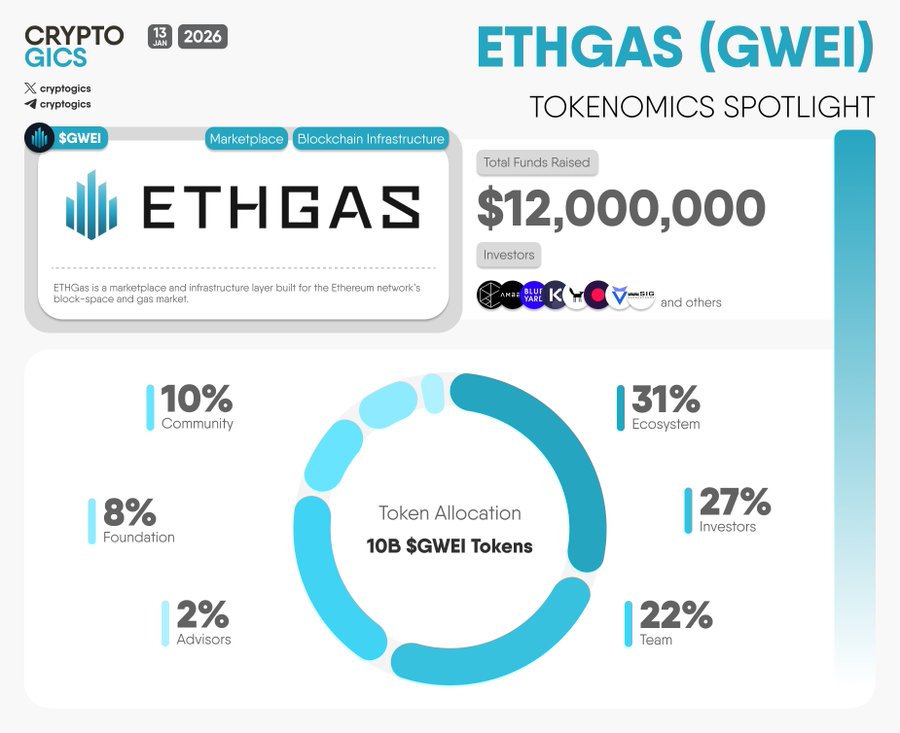
The total supply of GWEI is fixed at 10,000,000,000 tokens (10 billion), with an initial circulating supply of 1.75 billion (17.5%) at launch. The distribution is structured around a 10-year horizon:
- Ecosystem: 31% — allocated to the Open Gas Initiative, developer grants, protocol incentives, and ecosystem growth.
- Investors: 27% — allocated to seed round participants (Polychain Capital, Amber Group, and other undisclosed backers), subject to standard vesting.
- Core Team: 22% — allocated to the founding and development team, subject to multi-year vesting schedules.
- Community: 10% — the Genesis Harvest airdrop and future community distribution rounds.
- Foundation: 8% — reserved for the ETHGas Foundation’s long-term stewardship and treasury.
- Advisors: 2% — allocated to protocol advisors and contributors.
The veGWEI Model: Staking GWEI converts it into veGWEI; a non-transferable governance token that carries voting power proportional to the size and duration of your lockup. Locking for up to 4 years maximizes your veGWEI yield and governance weight. This model is designed to favor long-term protocol participants over short-term traders, and to reduce liquid circulating supply over time as committed holders lock their tokens. A 30-day minimum staking period applies to airdrop recipients before their tokens are fully liquid.
2. The Genesis Harvest: Understanding the ETHGas Airdrop
2.1 What Is the Genesis Harvest?
The Genesis Harvest is ETHGas’s community airdrop program; officially framed as a “Proof of Pain” distribution. The concept is direct: the more you suffered through Ethereum’s gas fee system over the years, the more you receive. Rather than rewarding wallet farming or social quest clicking, the Genesis Harvest uses historical gas expenditure on Ethereum mainnet as its primary eligibility metric, supplemented by participation in ETHGas’s Beans-based community campaign.
The snapshot was taken on January 19, 2026 at 00:00 UTC, capturing years of transaction history for every address that interacted with the Ethereum network. The claim portal went live on January 21, 2026. The ETHGas claim portal is currently open, and this guide is being written while allocations are still claimable.
The dual eligibility structure; historical gas expenditure plus community engagement was an intentional design choice to filter for both genuine Ethereum users and active community participants, reducing pure Sybil farming while rewarding the long-term users who bear the real cost of the system ETHGas is replacing.
2.2 The Gas ID System
The Gas ID is the central mechanism behind the Genesis Harvest. When you connect your wallet to the claim portal, the system queries the full history of your Ethereum mainnet gas consumption and generates a Gas ID; a verifiable proof of your historical on-chain activity. Your Gas ID determines your baseline Proof of Pain allocation: the heavier your historical gas spend, the larger your share of the community distribution pool.
The threshold commonly cited for meaningful eligibility is more than 0.5 ETH spent historically on gas across your Ethereum mainnet activity. Heavy gas spenders; multi-year DeFi users, frequent NFT minters and active traders are likely to have the largest allocations.
3. Eligibility: Who Qualifies for $GWEI?
You are likely eligible to claim $GWEI if your wallet prior to the January 19 snapshot falls into one or more of the following categories:
Heavy Gas Spenders (Primary Category): Wallets with significant historical Ethereum mainnet gas consumption. The commonly referenced threshold is 0.5 ETH or more spent on gas historically. Multi-year DeFi participants, frequent traders, NFT collectors, and protocol power users are most likely to qualify here. The higher your cumulative gas spend, the larger your potential Proof of Pain allocation.
Beans Campaign Participants: Users who connected their wallets to the ETHGas platform, generated their Gas Report, and accumulated at least 500 Beans through the social quests dashboard ahead of the snapshot. Beans were the campaign’s points currency; earned through social engagement tasks including following official accounts, sharing content, completing quizzes, and referring friends.
Active Community Members: Participants who were active contributors in the official ETHGas Discord or Telegram communities ahead of the snapshot. Community engagement was weighted as a secondary signal alongside gas history.
Broader Ethereum Power Users: Given the Proof of Pain framing, experienced Ethereum users across DeFi protocols, lending markets, DEX trading, governance participation, and other heavy mainnet activity are the intended beneficiaries. This is not an airdrop for occasional users, it rewards the people who have genuinely contributed to and suffered through Ethereum’s fee market.
4. Step-by-Step: How to Claim Your $GWEI

Step 1: Access the Official Claim Portal
Navigate directly to ethgas and locate the claim button
Critical Security Warning: ETHGas is a highly anticipated, already-launched protocol with active price action. This means the phishing attack surface is significant and active. X (Twitter), Telegram, and Discord are flooded with fake “claim” links. Always navigate to the claim portal directly.
Step 2: Connect the Right Wallet
Connect the EVM wallet that was your most active Ethereum mainnet wallet; the address with the heaviest historical gas consumption, and/or the wallet you used during the Beans campaign to generate your Gas Report.
If you used multiple Ethereum wallets for DeFi activity over the years, you may need to check each address separately. There is no wallet-merging mechanism in the portal.
Step 3: Check Your Allocation
Once connected, the portal will calculate your Gas ID and display your total $GWEI allocation based on your converted Beans balance and your historical Proof of Pain score.
If your allocation displays zero, this can mean one of three things: the wallet has insufficient historical gas expenditure, the wallet was not used during the Beans campaign, or the wallet’s activity did not meet the threshold criteria applied to the snapshot. In this case, check any alternative active Ethereum addresses you hold.
Step 4: Review the Staking Requirement
Before claiming, note the 30-day staking period that applies to airdrop recipients. Claimed $GWEI tokens are subject to a minimum 30-day lock before becoming fully liquid. This was an explicit design choice to reduce immediate Day 1 sell pressure and to align recipient incentives with the protocol’s long-term success.
If you intend to hold beyond the minimum lock period, consider locking for a longer duration to generate veGWEI yields, which increase proportionally with lockup length up to 4 years.
Step 5: Execute the Claim Transaction
Confirm your allocation details, review the staking terms, and execute the claim transaction. Standard Ethereum gas fees apply for the claim transaction itself. Ensure your wallet holds enough ETH to cover the claim transaction fee before initiating.
5. Investment Thesis: Why $GWEI Deserves Attention
5.1 A Genuinely New Asset Class
Blockspace derivatives are not another DeFi yield product or another governance token for a lending protocol. They are a fundamentally new financial primitive. The global crypto derivatives market represents roughly 75% of all crypto trading volume, with daily perpetual futures activity consistently exceeding spot markets yet essentially all of that activity is bets on token prices. ETHGas introduces the first derivatives market over the computational resources themselves — the blockspace that makes every Ethereum transaction possible. The total addressable market for blockspace futures, if Ethereum continues to scale as the world’s settlement layer, is not measured in billions but in fractions of Ethereum’s total economic activity.
5.2 Polychain Capital and the $800M Validator Signal
Polychain Capital is one of the most selective and thesis-driven funds in crypto. Their backing of ETHGas is a meaningful signal on its own. But the more significant validation is the $800 million in liquidity commitments secured from Ethereum validators and block builders, not cash investments, but blockspace supply commitments from the infrastructure operators who actually control Ethereum’s block production. These are the entities who stand to benefit from structured blockspace markets, and their early buy-in demonstrates that ETHGas has successfully navigated the chicken-and-egg liquidity problem that kills most derivatives protocols before they launch.
5.3 Direct Alignment With Vitalik’s Own Research Direction
In December 2025, Ethereum co-founder Vitalik Buterin publicly proposed a trustless on-chain gas futures market as a research direction for Ethereum’s near-term roadmap. ETHGas was already building exactly this. This alignment is not coincidental; it positions ETHGas favorably as Ethereum’s core protocol continues to evolve toward the “Glamsterdam” and “Hegota” upgrades targeted for 2026, both of which increase demand for predictable, real-time execution. When the network’s founder is publicly advocating for the infrastructure category you’re building, that is a meaningful tailwind.
5.4 The Proof of Pain Distribution Reduces Day-1 Dump Risk
Traditional airdrop campaigns distribute tokens to anyone who completes a checklist of social tasks; creating millions of low-conviction wallet addresses with zero attachment to the project who sell on Day 1. The Genesis Harvest’s Proof of Pain mechanism deliberately distributes to long-term, heavy Ethereum users people who have been paying gas fees for years and have a genuine stake in a better Ethereum fee market. The 30-day minimum staking period further constrains immediate selling. While no distribution model eliminates sell pressure entirely, this structure is demonstrably better than the typical farming campaign.
6. Quick-Start Checklist
- Verify official URL (ethgas) before connecting
- Connect Ethereum wallet with heaviest gas history
- Check $GWEI allocation via Gas ID system
- Review 30-day staking requirement before claiming
- Execute claim transaction
- Consider extended veGWEI lockup for yield
- Follow @ETHGasFNDN on X for protocol updates
7. Frequently Asked Questions (FAQ)
What is ETHGas? ETHGas is a decentralized infrastructure protocol that turns Ethereum blockspace into a structured, tradable commodity. It allows validators to sell future blockspace through financial instruments including inclusion pre-confirmations, execution pre-confirmations, whole block commitments, and base fee futures; replacing Ethereum’s chaotic blind-auction mempool with a predictable futures market for transaction execution. The protocol raised $12M from Polychain Capital and Amber Group and has $800M in liquidity commitments from Ethereum validators.
What is the $GWEI token used for? GWEI is the governance token of the ETHGas protocol. It can be staked to obtain veGWEI, a non-transferable token carrying voting power over protocol parameters, treasury allocation, incentive structures, upgrades, and emergency actions. Longer lockup periods generate higher veGWEI yields, with maximum weight at 4-year locks. GWEI does not represent protocol revenue entitlement or equity — it is a governance and coordination instrument.
The $GWEI token is already launched and trading — is the airdrop still relevant? Yes. The claim portal for the Genesis Harvest is currently open. If you are eligible based on the January 19 snapshot, you can still claim your allocation. The token is live and trading, which means the airdrop has real, immediate monetary value; but it also means you should exercise appropriate judgment about when and whether to sell, stake, or hold your claimed tokens.
What is the Proof of Pain airdrop? The “Proof of Pain” is ETHGas’s framing for its airdrop distribution philosophy: rewards are proportional to historical gas expenditure on Ethereum mainnet. The more ETH you have spent on gas fees over your history on the network, the more $GWEI you receive. This was designed to reward genuine, long-term Ethereum users rather than airdrop farmers who created wallets specifically to qualify.
What is the minimum gas spend to qualify? The commonly cited threshold for meaningful eligibility is more than 0.5 ETH spent historically on gas across your Ethereum mainnet activity. The Beans campaign participation (minimum 500 Beans) also qualifies wallets independently of gas history.
What is the 30-day staking requirement? All airdrop recipients are subject to a 30-day minimum staking period before their $GWEI tokens become fully liquid. This lock was designed to reduce immediate sell pressure at launch. If you claim, your tokens will be locked for 30 days. You can optionally choose a longer lockup (up to 4 years) to generate veGWEI yields.
What is veGWEI? veGWEI is the non-transferable governance token you receive when staking GWEI. It carries voting power within the ETHGas governance system. Unlike regular GWEI, veGWEI cannot be transferred or sold; it represents your committed governance participation. Voting power and veGWEI yield both increase with longer lockup durations.
Where can I trade $GWEI? $GWEI is currently listed and trading on MEXC. Always verify current listing status and trading pairs on official exchange pages.
Official Resources: ethgas · @ETHGasFNDN on X · ETHGas Discord · ETHGas Telegram
Disclaimer: This article is provided for informational purposes only and does not constitute financial or investment advice. Cryptocurrency markets involve significant risk. Please conduct independent research or consult a qualified professional before making any investment decisions
