


Key Details:
- Status: LIVE — RTG Checker Active / Rolling Wave Allocations
- Sector: Privacy / Confidential Computing / AI / DeFi (DeCC)
- Chain: Solana
- Funding: $9M (Coinbase Ventures, Jump Crypto, Greenfield Capital, LongHash Ventures, NGC Ventures)
- Cost: Free (Checking, Claiming & Contributions)
1. What Is Arcium? Solving Solana’s Privacy Problem
1.1 The Transparency Problem Holding Crypto Back
Public blockchains were built on a foundational principle: radical transparency. Every transaction, balance, trade, and position is permanently visible to any observer on the network. For retail users, this openness builds trust. For institutions, enterprises, and sophisticated financial actors, it is a deal-breaking liability.
When every trade strategy is visible, it invites front-running. When every wallet balance is public, it creates security vulnerabilities. When AI models must be trained on data that sits exposed on a public ledger, the most sensitive and valuable datasets from patient records, financial histories, proprietary models can never participate. The result is that blockchain’s most transformative use cases have remained locked behind this transparency ceiling for over a decade.
Up to 40% of US stock trading volume currently happens in dark pools, where major investors benefit from confidentiality, price stability, and efficient execution. On-chain equivalents have been impossible to build until now. This is the exact gap Arcium was created to close.
1.2 What Is Arcium?
Arcium is a decentralized confidential computing network (DeCC) natively built for the Solana ecosystem and designed to function as an encrypted supercomputer for the internet. Founded by the team behind Elusiv; one of Solana’s earliest zero-knowledge privacy protocols Arcium expanded its scope from private transactions to general-purpose encrypted computation, creating an entirely new design space for privacy-preserving applications.
The network’s core insight is that privacy should not be a niche feature bolted onto individual applications, it should be a fundamental, general-purpose design primitive available to every developer building on Solana. As CEO Yannik Schrade put it: “Arcium ensures that privacy is no longer a niche feature but a broad design primitive. We are introducing a general-purpose encrypted supercomputer that opens an entirely new design space for the internet.”
With $9 million in total funding from institutional heavyweights including Coinbase Ventures, Jump Crypto, Greenfield Capital, LongHash Ventures, and NGC Ventures, Arcium launched its Mainnet Alpha in February 2026 the first time its encrypted computation network became live production infrastructure on Solana.
1.3 How Arcium’s Technology Works
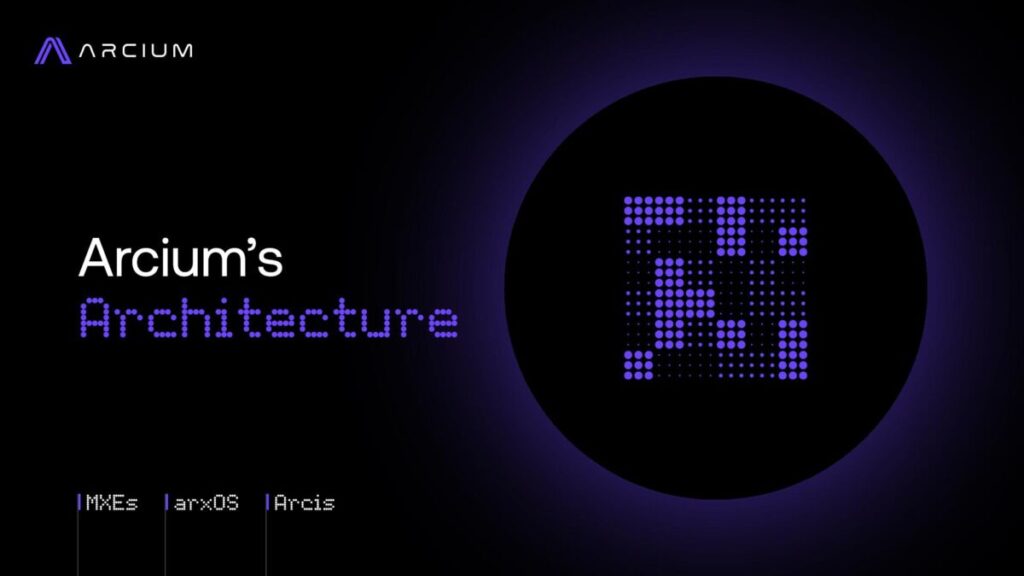
Arcium’s architecture revolves around three core components that work together to enable trustless computation over fully encrypted data:
MXEs (Multiparty Computation eXecution Environments): MXEs are Arcium’s virtual machines for confidential computation. Developers define encrypted execution parameters inside an MXE specifying the MPC protocol, trust assumptions, and hardware requirements and Arcium’s network of decentralized nodes executes computations on fully encrypted data without any single node ever seeing the plaintext. Results are verified and committed back on-chain through Solana, preserving composability.
arxOS (Distributed Operating System): arxOS is the distributed operating system that coordinates Arcium’s decentralized network of Arx nodes. Like cores in a traditional computer, Arx nodes form clusters to process encrypted computations in parallel delivering performance that scales with the network. This parallel architecture significantly outperforms alternative privacy solutions like Fully Homomorphic Encryption (FHE) and Trusted Execution Environments (TEEs), which face computational overhead, hardware trust assumptions, and limited expressivity.
Arcis (Developer Language): Arcis is a Rust-based Domain Specific Language (DSL) designed for writing MPC applications on the Arcium Network. It extends Solana’s familiar Anchor tooling, meaning developers can add confidential computation to their applications simply by marking functions as [confidential]; no cryptography expertise required.
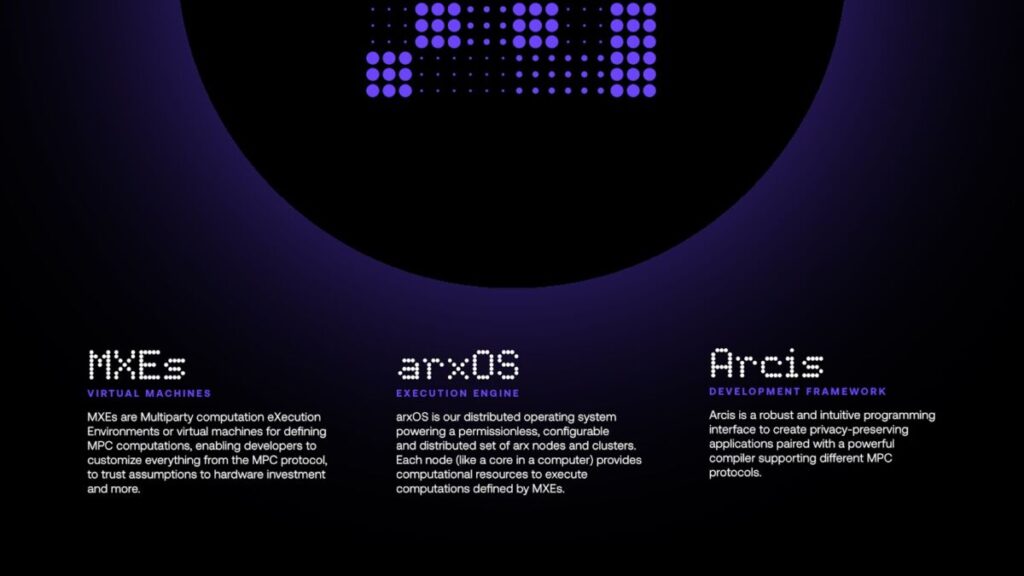
The workflow for an encrypted computation is straightforward: a client encrypts data and sends it to an MXE program; the program submits the computation to Arcium’s network of MPC nodes; nodes process the data while keeping it fully encrypted; the verified result is returned on-chain. At no point in this process is the underlying data ever exposed.
1.4 What Can You Build on Arcium?
Arcium’s encrypted compute layer unlocks use cases that were previously impossible on transparent blockchain infrastructure:
- Private DeFi & Dark Pools: Build on-chain order books where trade sizes and prices remain hidden, enabling confidential trading without front-running or market manipulation. Umbra, the first live application on Arcium Mainnet Alpha offers exactly this: shielded transfers, encrypted swaps, and private yield on Solana.
- Confidential AI Training: Enable AI models to be trained on sensitive, encrypted datasets from patient records, financial data, proprietary models without ever exposing the underlying information.
- Encrypted Gaming: Build hidden-information games (poker, strategy, auctions) where game state remains encrypted throughout gameplay and is revealed only when the rules dictate.
- Private DePIN & IoT: Process and analyze sensitive data from physical infrastructure networks from wireless networks, supply chains, data storage without exposing raw inputs.
- Secure Governance: Run confidential voting and coordination systems where individual votes remain private while outcomes are verifiably correct.
1.5 The C-SPL Standard: Arcium’s Ecosystem-Defining Move
Perhaps Arcium’s most significant near-term development is the Confidential SPL Token Standard (C-SPL), which is nearing completion for launch on Solana. Just as the existing SPL standard allows anyone to launch a token on Solana, C-SPL will allow any protocol to launch a private token, private stablecoin, or confidential financial instrument natively, without leaving the Solana ecosystem.
C-SPL combines Solana’s SPL-Token, the Token-22 standard, the Confidential Transfer Extension, and Arcium’s MXE compute layer into a unified standard for programmable token confidentiality. Unlike Token-22, which only hides transfer amounts, C-SPL enables confidential computation over token state meaning the logic governing token behavior can also be encrypted and executed privately. This positions C-SPL as the missing piece for institutional DeFi adoption on Solana.
2. What Is the Arcium RTG? Understanding the Airdrop Mechanism
2.1 Why Arcium Rejected the Standard Points Airdrop
Arcium made a deliberate and public decision not to run a traditional incentivized points-farming campaign. Their community philosophy, outlined in a document titled “Encrypted, Not Extracted,” states clearly: the testnet is not incentivized and there is no conventional airdrop. This was an intentional rejection of the extractive farming model that has plagued many Web3 launches driving up Sybil bot activity, distributing tokens to inauthentic participants, and resulting in immediate sell pressure at TGE.
Instead, Arcium designed the Retroactive Token Grant (RTG) system. The distinction is meaningful and worth understanding before you engage with the process.
2.2 How RTGs Work: Encrypted Credits, Not Points
The RTG system is built on a currency called Encrypted Credits. Critically, Arcium is explicit that Credits are not points they are not earned by completing gamified quests or clicking daily buttons. They reflect real effort, real contribution, and real impact to the Arcium ecosystem, verified in real time.
Encrypted Credits are earned through:
- Building: Launching tools, integrations, or infrastructure that adds genuine utility to the network.
- Engaging: Consistent, substantive participation in the Arcium community — not passive presence, but active contribution.
- Supporting: Providing critical feedback, identifying issues, helping others, and contributing to ecosystem health.
- Learning: Completing official learning campaigns (like the Arcium Citadel) and demonstrating genuine understanding of the protocol.
The Encrypted Credit system is designed to accurately identify real contributors versus bots and farmers. Anti-Sybil tools and manual review are both applied. The result is a final token distribution that is heavily concentrated in the hands of genuine participants which has significant implications for the token’s post-TGE market dynamics
RTG Types: The system supports both on-chain RTGs (based on verifiable on-chain interactions with Arcium’s testnet and applications) and off-chain RTGs (based on community contributions, content creation, ecosystem building, and developer work). This dual structure ensures that both technical and non-technical contributors are recognized.
2.3 The Rolling Wave Model
Unlike single-snapshot airdrops where one moment in time determines your entire allocation, Arcium’s RTG system operates on rolling monthly recognition waves. Wave 1 eligibility has already been revealed alongside the Mainnet Alpha launch. Subsequent waves will continue rolling out ahead of the full mainnet launch, with each wave focusing on contributions submitted through the RTG portal.
This rolling structure is important for two reasons: it means late participants still have a genuine path to allocation, and it means early participants who continue contributing will accumulate additional recognition across multiple waves.
3. Eligibility: Do You Qualify for an RTG?
3.1 The Arcium Citadel Campaign (Primary Eligibility Signal)
The highest-confidence eligibility pathway is the Arcium Citadel; a six-week educational and community campaign that ran as part of Arcium’s public testnet phase. Participants who completed the full campaign and minted the Apprentice NFT after progressing through the Four Fortresses are among the most likely to have an existing allocation.
The Four Fortresses each correspond to a core use case vertical for Arcium:
- Fortress Defirius: DeFi applications and confidential trading infrastructure.
- Fortress DePIN: Decentralized physical infrastructure network privacy.
- Fortress AI: Encrypted AI training and inference.
- Fortress Gaming: Hidden-information and confidential on-chain games.
Each fortress involved a learning module, a quiz, and an on-chain NFT mint on Solana. Participants who hold the Apprentice NFT in the wallet they connect to the RTG portal should check their allocation immediately; this is the strongest existing eligibility signal Arcium has established.
Additionally, Elusiv community members (from Arcium’s predecessor protocol) received early community member status and are part of the early Encrypted Credit redemption window.
3.2 Other Eligibility Categories
Beyond the Citadel campaign, Arcium has recognized contributions across several categories:
- Testnet participants: Users who interacted with Arcium’s Public Testnet (launched May 2025) through the Dark Pool application, Umbra early access, or developer testing.
- Discord community contributors: Active members who earned roles through Arcium’s Discord role progression system including verified contributors in the ambassador program, those who introduced themselves in the #intuition channel, and members who engaged in the #community-structure system.
- Content creators: Users who earned Encrypted Credits by creating high-quality educational content about Arcium, including articles, tutorials, videos, and social media posts.
- Developers and builders: Teams or individuals who built integrations, launched tools, ran ecosystem nodes, or contributed to Arcium’s open-source repositories.
- Researchers and feedback providers: Community members who submitted critical feedback, reported bugs, or provided meaningful protocol improvement suggestions.
3.3 If You Missed Everything—What Now?
If you have no existing allocation, you are not locked out. The RTG portal’s submission system is open for ongoing contributions, and each monthly wave evaluates new submissions. The path to a future RTG allocation from this point requires genuine contribution, not farming.
4. Step-by-Step: How to Check and Claim Your RTG Allocation
Step 1: Access the Official RTG Portal
Navigate to the official RTG portal at rtg.arcium.com/portal
Security Warning: Arcium is a high-profile Solana project and is actively being targeted by phishing attacks. X (Twitter) and Discord are flooded with fake “claim” links. The ONLY legitimate portal URL is rtg.arcium.com
Step 2: Connect Your Solana Wallet
Connect the Solana-compatible wallet you used during your Arcium interactions; this is the wallet that holds your Apprentice NFT (if applicable) or that you used during the Citadel campaign and testnet participation. Phantom and Solflare are the two most recommended options.
If you participated from multiple wallets, you will need to check each one separately. There is no wallet-merging function.
Step 3: Check Your Wave 1 Allocation
Once connected, the encrypted portal will calculate your Encrypted Credits and display any $ARC token allocation confirmed for you ahead of TGE. The eligibility checker is live as of the Mainnet Alpha launch in February 2026.
If your allocation shows zero, this does not necessarily mean you are permanently excluded, it may mean your contributions have not yet been evaluated or that contributions you made qualify for a future wave rather than Wave 1.
Step 4: Submit Ongoing Contributions for Future Waves (RTG Directory)
If you have no current allocation or want to increase it before TGE, navigate to the RTG Directory inside the portal. Arcium categorizes active bounties and contribution opportunities across three tracks:
Community Track: Creating educational content, growing the Arcium community, producing high-quality articles, tutorials, or social media threads that accurately explain Arcium’s technology and use cases to a broader audience.
Developer Track: Building integrations with Arcium’s MXE framework, contributing to ecosystem tooling, running Arx nodes, writing technical documentation, or building applications that demonstrate C-SPL or encrypted compute capabilities.
Ecosystem Track: Launching meaningful partnerships, driving protocol integrations, identifying and reporting vulnerabilities, or providing substantive feedback that improves the network’s performance or developer experience.
All submissions are manually reviewed by the Arcium team combined with AI anti-Sybil analysis. Approved submissions yield Encrypted Credits, which convert to $ARC token grants in the next monthly RTG wave. Arcium has explicitly stated that 90% of eligible users will know their grant status well ahead of the full mainnet TGE.
Step 5: Engage with the Discord Community for Ongoing Credit Accumulation
Arcium’s Discord role progression system remains an active pathway for Encrypted Credit accumulation. For new community members, this is a crucial entry point
5. Investment Thesis: Why $ARC Deserves Attention
5.1 The C-SPL Standard Is Arcium’s Moat
The Confidential SPL token standard is potentially the most strategically significant move in Solana’s privacy ecosystem. If C-SPL becomes the accepted standard for confidential tokens on Solana; the way SPL became the accepted standard for all tokens then every protocol launching on Solana that wants privacy functionality will build on Arcium’s infrastructure. This is not a feature; it is a platform network effect with compounding value. C-SPL is nearing completion and is targeted for Q1 2026.
5.2 Institutional Backing That Signals Genuine Demand
The presence of Coinbase Ventures and Jump Crypto in Arcium’s funding round is not casual; these are two entities that operate at the intersection of institutional trading, market making, and exchange infrastructure. Both have a direct financial interest in the success of on-chain dark pools and confidential trading environments. Their investment is not just financial validation; it signals active demand for exactly the infrastructure Arcium is building.
The $155 million in ICO commitments that Umbra, the first application built on Arcium raised through MetaDAO in October 2025 is perhaps an even stronger signal of genuine market appetite. This was one of the largest Solana ICOs on record.
5.3 The Anti-Farming Premium on Token Distribution
Because the RTG system manually strips out bot farms, Sybil accounts, and extractive participants, the final circulating $ARC supply will be distributed far more cleanly than typical airdrop launches. Traditional farming campaigns result in millions of wallet addresses holding small quantities of tokens with no genuine connection to the project all of whom sell on Day 1. Arcium’s distribution deliberately avoids this, concentrating tokens in the hands of real contributors who have a genuine interest in the project’s long-term success. This structural difference materially reduces the probability of a catastrophic TGE dump.
5.4 A Fully Live Ecosystem, Not a Whitepaper
As of the Mainnet Alpha launch, Arcium is no longer a promise; it is running production infrastructure with real applications on top of it. Umbra is live with shielded transfers and encrypted swaps. More than 25 projects spanning eight sectors including Melee, Vanish, Anonmesh, Pythia, and others are actively building. The developer tooling (Arcis DSL, TypeScript SDK, CLI) is documented and functional. Arcium also acquired the core technology and team from Inpher, a Web2 confidential computing company founded in 2015, accelerating its enterprise and AI compute capabilities. This is not speculation about future capability; it is evidence of current, functioning infrastructure.
5.5 Solana’s Native Privacy Layer at the Right Moment
Solana has emerged as one of the dominant Layer-1 networks for institutional DeFi, high-frequency trading, and consumer applications. It is fast, cheap, and increasingly liquid. What it has lacked is a credible, performant privacy layer. Arcium is the first project to address this at the infrastructure level not just hiding transaction amounts, but enabling general-purpose encrypted computation. The timing, as institutions begin seriously exploring on-chain capital markets, is precise.
6. Quick-Start Checklist
- Check RTG allocation at rtg.arcium.com/portal
- Connect Solana wallet holding Apprentice NFT
- Review Wave 1 Encrypted Credits allocation
- Submit contributions via RTG Directory
- Join Discord and progress through role system
- Follow @ArciumHQ on X for wave announcements
- Engage with Umbra or other Mainnet Alpha apps
7. Frequently Asked Questions (FAQ)
What is Arcium? Arcium is a decentralized confidential computing network built natively on Solana. It operates as an encrypted supercomputer, enabling developers to run complex computations over fully encrypted data without ever exposing the underlying information. It was founded by the team behind Elusiv and has raised $9 million from institutional backers including Coinbase Ventures, Jump Crypto, and Greenfield Capital. Mainnet Alpha launched in February 2026.
What is the difference between an RTG and a standard airdrop? A standard airdrop distributes tokens based on on-chain activity snapshots, often rewarding bots and farming wallets as much as genuine users. An RTG (Retroactive Token Grant) is a merit-based recognition system. Arcium uses Encrypted Credits earned through genuine, verifiable contributions to the ecosystem to identify real contributors. Grants are awarded retroactively to those who demonstrated actual value, not those who gamed a points system.
What are Encrypted Credits? Encrypted Credits are Arcium’s contribution tracking mechanism. Unlike points in a standard farming system, Encrypted Credits reflect real, meaningful activity: building tools, providing genuine community value, running nodes, creating content, or engaging substantively with the protocol. They are used to determine RTG allocations at TGE and also unlock role progression, prizes, and other opportunities within the Arcium community.
I missed the Citadel campaign. Can I still get an allocation? Yes. The RTG system operates on rolling monthly waves. If you missed the Citadel campaign and have no Wave 1 allocation, you can still earn Encrypted Credits by submitting genuine contributions through the RTG Directory at rtg.arcium.com. Each monthly wave evaluates new submissions. However, the bar is real contribution not superficial engagement.
When is the Arcium TGE? The full decentralized mainnet launch and TGE were originally targeted for Q1 2026. As of the Mainnet Alpha launch in February 2026, Arcium confirmed that new RTG waves will continue rolling out ahead of full mainnet. Follow @ArciumHQ on X and the official Discord for TGE date confirmation.
What wallets are supported? The RTG portal is a Solana-based application. Phantom and Solflare are the two most recommended and tested wallets. Ensure you connect the specific wallet address that held your Apprentice NFT or was used during Citadel and testnet participation.
Is it safe to connect my wallet to the RTG portal? The official portal at rtg.arcium.com is the only legitimate Arcium RTG destination. Before connecting your wallet to any site, verify the URL character by character.
What is C-SPL and why does it matter? C-SPL (Confidential SPL) is Arcium’s token standard for Solana that enables programmable, confidential token logic; not just hidden balances, but encrypted computation over token state. It is designed to become the ecosystem-wide standard for confidential tokens on Solana, the way SPL became the standard for all tokens. C-SPL is nearing completion and is targeted for Q1 2026.
Final Word
Arcium is not a hype-driven points farm. It is one of the few projects in this cycle that has built something real from live production infrastructure, a functioning application ecosystem, and a token distribution mechanism designed explicitly to reward genuine participants over bot farms. Whether you participated in the Citadel campaign or are discovering the project now through the RTG submission system, the opportunity to position yourself ahead of a fully live, institutionally backed privacy infrastructure TGE is worth taking seriously.
Official Resources: arcium.com · rtg.arcium.com/portal · arcium.substack.com · @ArciumHQ on X · docs.arcium.com
Disclaimer: This article is provided for informational purposes only and does not constitute financial or investment advice. Cryptocurrency markets involve significant risk. Please conduct independent research or consult a qualified professional before making any investment decisions.
