


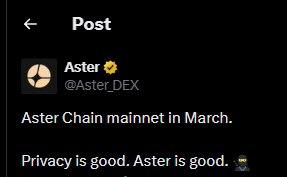
Aster, the decentralized perpetual exchange backed by Binance founder Changpeng Zhao, confirmed on February 12, 2026 that its Aster Chain mainnet will launch in March. The announcement sent the ASTER token surging over 14% as traders positioned for what could become one of the year’s most significant infrastructure deployments in decentralized finance.
The move represents a strategic shift for Aster, which started as a multi-chain perpetual DEX across BNB Chain, Ethereum, Solana, and Arbitrum. By launching its own Layer-1 blockchain, Aster joins an elite group of high-performance decentralized exchanges including Hyperliquid, dYdX, and GMX that have opted to build custom infrastructure rather than rely solely on general-purpose networks.
But Aster Chain isn’t just another application-specific blockchain. With zero-knowledge proofs for privacy, sub-second finality for high-frequency trading, and an ambitious Q2 2026 roadmap that includes real-world asset markets and governance, Aster is positioning itself as the privacy-first alternative in a DEX landscape increasingly dominated by transparent orderbooks. For perpetual futures traders seeking institutional-grade execution with maximum confidentiality, March’s mainnet launch could mark a turning point.
From Multi-Chain DEX to Sovereign Layer-1: Aster’s Evolution
The Genesis: Multi-Chain Perpetual Trading
Aster launched in 2024 as a decentralized exchange focused on perpetual futures trading across multiple blockchain networks. The platform allowed users to trade crypto derivatives with leverage across BNB Chain, Ethereum, Solana, and Arbitrum, providing access to perpetual contracts without the need for centralized intermediaries.
This multi-chain approach had advantages: users could choose their preferred network based on fees, speed, and ecosystem familiarity. But it also created challenges. Liquidity was fragmented across chains. User experience varied depending on the underlying network’s congestion and gas fees. Execution speed was limited by the throughput of general-purpose blockchains not optimized for high-frequency trading.
By late 2025, Aster’s team recognized that competing with emerging application-specific Layer-1 chains like Hyperliquid would require dedicated infrastructure. The cumulative trade volume of perpetual DEXs had nearly tripled by the end of 2025, rising from about $4 trillion to over $12 trillion. This growth validated the thesis that decentralized derivatives could capture meaningful market share from centralized exchanges, but only with infrastructure designed specifically for derivatives trading.
The Pivot: Building Aster Chain
In March 2025, Aster rebranded and announced plans to launch its own Layer-1 blockchain. The decision put Aster in direct competition with Hyperliquid, the perpetual futures exchange running on an application-specific layer-1 blockchain network that had demonstrated impressive performance throughout 2025.
The strategic logic was clear: general-purpose blockchains like Ethereum or Solana prioritize flexibility over optimization for specific use cases. A blockchain designed from the ground up for perpetual futures trading could offer superior speed, lower costs, and features impossible on shared infrastructure.
Aster Chain’s architecture would use zero-knowledge proofs to maximize speed and privacy, allowing traders to hide position sizes and profit-and-loss data while keeping trades verifiable on-chain. The platform would offer an experience closer to centralized exchanges, with an orderbook-style system and sub-second finality for high-frequency strategies.
This move aligned with a broader trend in Web3 where projects are increasingly using specialized blockchains designed for high-throughput transactions. These platforms are choosing infrastructure tailored to their specific needs instead of relying solely on general-purpose networks like Ethereum or Solana.
The Testing Phase: 50,000+ Users Join Testnet
Aster Chain’s testnet development followed a careful rollout strategy. Initial whitelisted testing began in late 2025, allowing the team to stress-test the network with controlled user numbers and identify bugs in a lower-risk environment.
On January 5, 2026, the testnet opened to the public. Within weeks, participation exceeded 50,000 users, demonstrating significant pent-up demand for Aster’s Layer-1 infrastructure. The public testnet phase served multiple purposes: validating technical performance under real user loads, gathering feedback on user experience, building community engagement ahead of mainnet, and identifying edge cases and potential exploits before mainnet deployment.
The successful testnet completion in late January 2026 set the stage for the March mainnet launch announcement. Having tens of thousands of users already familiar with Aster Chain’s interface and mechanics creates a ready user base for day-one mainnet adoption.
March 2026 Mainnet: What’s Being Deployed
Privacy-First Trading with Zero-Knowledge Proofs
The defining characteristic of Aster Chain is its privacy-first architecture built on zero-knowledge (ZK) proofs. This cryptographic technology allows Aster to offer features impossible on transparent blockchains.
On traditional transparent blockchains like Ethereum or Solana, all transaction data is publicly visible. For DeFi users, this creates a significant problem: large traders, institutional participants, and sophisticated strategies become vulnerable to front-running, position-sniping, and copycat trading. When a whale opens a large perpetual position, other traders can immediately see the transaction, anticipate the price impact, and trade ahead of it.
Aster Chain’s ZK proofs change this dynamic. Traders can hide position sizes and profit-and-loss data while keeping trades verifiable on-chain. The network knows a valid trade occurred and can settle it correctly, but the specific details (who traded, how much, at what price) remain confidential unless the trader chooses to reveal them.
This brings Aster closer to the privacy guarantees of centralized exchanges, where your trades aren’t visible to other market participants. For institutional traders and sophisticated retail participants, this privacy premium could be worth paying Aster Chain’s transaction fees rather than trading on transparent competitors.
Sub-Second Finality for High-Frequency Trading
Speed matters in derivatives markets. The difference between 3-second and 0.5-second finality can determine whether a liquidation gets executed in time or whether a scalping strategy is profitable.
Aster Chain targets sub-second finality, meaning trades are confirmed and irreversible in less than one second. This performance matches or exceeds most centralized exchanges and puts Aster in the same performance tier as Hyperliquid, which has demonstrated similar execution speeds.
Achieving sub-second finality requires careful architectural choices. Aster uses an orderbook-style matching engine rather than automated market maker (AMM) pools. Orderbook systems can offer better execution for larger trades, tighter spreads, and more familiar user experience for traders coming from centralized exchanges. Combined with the chain’s optimized consensus mechanism, this enables the high-frequency trading strategies that drive volume on derivatives platforms.
Fiat On/Off Ramps: Bridging Traditional and Crypto Finance
One of the most significant features launching with Aster Chain mainnet is integrated fiat on- and off-ramps. Users will be able to move between traditional money and crypto directly within the Aster ecosystem, without needing to use external services.
This seemingly simple feature addresses a major friction point in DeFi adoption. Currently, users must: buy crypto on a centralized exchange, withdraw to a self-custody wallet, bridge to the appropriate blockchain, connect to the DeFi protocol, and only then can they trade. Each step introduces friction, fees, and potential security vulnerabilities.
Integrated fiat ramps collapse this process. A user can deposit USD directly to Aster Chain, receive stablecoins or ASTER tokens, and immediately begin trading perpetuals. When they want to exit, they can convert positions back to fiat and withdraw to their bank account, all within the Aster interface.
This functionality is particularly important for institutional participants and traditional finance users exploring DeFi. Regulated fiat on/off ramps provide compliance assurance and familiar UX that pure crypto interfaces lack.
Developer Tools: Aster Code Kit
At launch, Aster Chain will support Aster’s trading products and introduce tools for builders, including a developer kit called Aster Code. This signals Aster’s ambition to become more than just a perpetual DEX, positioning instead as a Layer-1 platform that other applications can build on.
Aster Code will presumably provide SDKs, APIs, and documentation for developers who want to build applications on Aster Chain. This could include: trading bots and algorithmic strategies, portfolio management tools, analytics and data platforms, complementary DeFi protocols (lending, options, structured products), and integrations with other ecosystems (bridges, wallets, custodians).
By opening Aster Chain to external developers, Aster creates potential for a broader ecosystem beyond just perpetual trading. If successful, this positions ASTER tokens as the gas asset for a multi-application Layer-1, not just a DEX governance token.
Q2 2026 Roadmap: Staking, Governance, and Real-World Assets
The March mainnet launch is just the first step in Aster’s 2026 plan. The team has outlined an ambitious Q2 roadmap that expands Aster Chain’s functionality significantly.
Staking and On-Chain Governance
In Q2 2026, Aster plans to roll out staking and on-chain governance for the ASTER token. This will give token holders direct participation in platform decisions and create additional utility for ASTER beyond trading fee discounts.
Staking typically serves multiple purposes in crypto ecosystems:
Network Security: Staked tokens can be slashed if validators misbehave, creating economic incentives for honest participation.
Governance Rights: Staked tokens often carry voting power on protocol upgrades, parameter changes, and treasury allocation.
Yield Generation: Stakers typically receive rewards (from inflation, fees, or both) in exchange for locking tokens.
Supply Sink: Staking removes tokens from circulation, reducing sell pressure and potentially supporting price.

Aster’s governance model will likely allow ASTER holders to vote on critical protocol parameters including trading fee structures, which markets/perpetuals to list, treasury management and grant allocations, protocol upgrades and technical roadmap, and risk parameters (leverage limits, liquidation thresholds, etc.).
This creates a flywheel effect: higher trading volume generates more fees, making ASTER staking more attractive. More staking reduces circulating supply, potentially supporting price. Higher ASTER price increases the value of governance votes and protocol alignment. Better governance decisions attract more users and volume.
Synthetic Products: Stock Perpetuals and RWA Markets
Perhaps the most ambitious element of Aster’s Q2 roadmap is expansion into synthetic products, including stock perpetuals and real-world asset markets.
Stock Perpetuals: Aster plans to offer perpetual futures contracts tied to traditional stock prices (think Tesla, Apple, Nvidia). Users could trade synthetic exposure to equity markets 24/7 with crypto collateral, without needing a brokerage account or dealing with market hours. This has been attempted before (FTX offered tokenized stocks; Synthetix offers synths), but regulatory challenges have limited adoption. If Aster can navigate the legal complexity, stock perpetuals could attract significant volume from traders who want equity exposure without leaving crypto.
Real-World Asset (RWA) Markets: The RWA tokenization narrative gained serious momentum in 2024-2025, with projects like Ondo Finance, Centrifuge, and Maple Finance bridging traditional finance assets onto blockchain rails. Aster’s entry into RWA markets could include perpetual contracts on tokenized assets (commodities, bonds, real estate), serving as a trading venue for RWA tokens created by other protocols, or even originating and tokenizing real-world assets directly for trading on Aster Chain.
The global RWA tokenization market is projected to grow from approximately $13.5 billion to potentially $25-40 billion through 2026. If Aster can capture even a small percentage of derivatives trading volume on these assets, it would represent significant revenue and usage.
Competitive Landscape: How Aster Stacks Up Against Hyperliquid and dYdX
Aster Chain launches into a competitive perpetual DEX landscape. Understanding how Aster differentiates is critical for assessing its potential.
Hyperliquid: The Performance Leader
Hyperliquid has been the breakout perpetual DEX of 2024-2025, processing over $500 billion in cumulative volume on its custom Layer-1 blockchain. Hyperliquid’s value proposition centers on institutional-grade performance (10,000+ transactions per second, millisecond latency), fully on-chain orderbook (no off-chain matching or centralized components), and native token (HYPE) that accrued significant value as platform usage grew.
Aster’s differentiation vs Hyperliquid: Privacy is the clearest differentiator. Hyperliquid is fully transparent. Every trade, position, and liquidation is publicly visible. Aster’s ZK architecture offers confidentiality that Hyperliquid cannot match without fundamental redesign. For traders who value privacy (institutions, whales, sophisticated strategies), this alone could justify choosing Aster. Aster also has backing from Changpeng Zhao (CZ), bringing credibility, potential Binance ecosystem integration, and marketing reach that Hyperliquid (backed by crypto-native VCs) cannot match. The fiat on/off ramps that Aster is integrating are more seamless than Hyperliquid’s current UX. And Aster’s Q2 expansion into stock perpetuals and RWA markets represents a broader product vision than Hyperliquid’s current crypto-only focus.
Where Hyperliquid leads: Hyperliquid has a 12-18 month head start, proven product-market fit, massive existing user base and liquidity, and a demonstrated ability to scale to high volumes. Aster must prove it can match this performance in production.
dYdX: The Established Player Rebuilding on Cosmos
dYdX was one of the first successful perpetual DEXs, initially built on StarkEx (Ethereum Layer-2) before migrating to its own Cosmos SDK chain (dYdX Chain) in 2023. The platform has processed over $800 billion in lifetime volume.
Aster’s differentiation vs dYdX: dYdX Chain, built on Cosmos SDK, is a proven but more generic blockchain framework. Aster Chain’s architecture is purpose-built specifically for perpetuals with ZK privacy, potentially offering performance advantages. dYdX’s migration to Cosmos was rocky, with bugs and downtime affecting user trust in 2024. Aster has the advantage of learning from dYdX’s mistakes and building right the first time. Aster’s integrated fiat ramps and Q2 RWA/stock perpetual expansion are more ambitious than dYdX’s current roadmap. And importantly, dYdX is focused primarily on the Western/U.S. market; Aster’s Binance/CZ connection could give it advantages in Asian markets where CZ’s influence remains strong.
Where dYdX leads: Brand recognition and trust (despite recent challenges, dYdX has years of history), massive existing user base, regulatory clarity (dYdX Foundation has worked extensively with U.S. regulators), and deep liquidity across major pairs.
GMX: The AMM Alternative
GMX takes a different approach to decentralized perpetuals, using an AMM-based model rather than orderbooks. Traders trade against the GLP liquidity pool rather than other traders. This model has tradeoffs: more predictable liquidity (the pool is always there) but potentially worse execution on larger trades (price impact from pool rebalancing).
Aster’s differentiation vs GMX: GMX’s AMM model works well for certain use cases but doesn’t match the execution quality of orderbook systems for larger traders. Aster’s orderbook model should offer tighter spreads and better fills for institutional-size positions. GMX operates on Arbitrum and Avalanche (general-purpose chains), accepting their throughput and latency constraints. Aster’s custom chain should offer superior speed. And critically, GMX has no privacy features; all positions are visible. Aster’s ZK privacy is a clear advantage for sophisticated traders.
Where GMX leads: Simpler UX (AMMs are more intuitive than orderbooks for many users), provenDeFi native user base, no need to learn a new chain/bridge to Aster Chain, and strong brand loyalty within the GMX community.
The Bigger Picture: Application-Specific Chains Are Winning
Aster’s move to launch its own Layer-1 reflects a broader trend in crypto infrastructure: application-specific chains are outcompeting general-purpose platforms for high-performance use cases.
Ethereum positioned itself as the “world computer,” a single blockchain that every application would share. But the reality has proven different. Applications with demanding performance requirements (gaming, derivatives, payments) are increasingly opting to build custom chains optimized for their specific needs.
We’ve seen this with Hyperliquid (perpetuals), dYdX (perpetuals), Immutable X (gaming/NFTs), Ronin (gaming), and now Aster (perpetuals). These projects concluded that shared infrastructure’s limitations (congestion, gas fee volatility, throughput caps, lack of customization) outweighed the network effects of building on established chains.
For Aster specifically, the benefits of a custom chain include full control over transaction ordering (preventing MEV and front-running), ability to optimize consensus for sub-second finality, custom privacy features (ZK proofs) impossible on transparent chains, gas fee predictability (ASTER token economics vs ETH volatility), and brand/ecosystem ownership (Aster Chain vs just another Ethereum dApp).
This trend suggests that the future of crypto infrastructure may look less like “a few dominant Layer-1s that everything builds on” and more like “a constellation of application-specific chains connected by interoperability protocols.” If this vision proves correct, Aster Chain’s March launch positions it early in this paradigm shift.
Conclusion: High Risk, High Reward Bet on Privacy-First DeFi
Aster Chain’s March 2026 mainnet launch represents one of the year’s most significant infrastructure developments in decentralized finance. By combining zero-knowledge privacy, sub-second finality, integrated fiat ramps, and an ambitious roadmap encompassing RWA markets and stock perpetuals, Aster is taking a clear shot at displacing Hyperliquid and dYdX as the leading perpetual DEX.
The bull case is compelling: privacy is a genuine competitive advantage that institutional traders will pay for, CZ’s backing provides distribution and credibility that most crypto projects lack, the perpetual DEX market is growing explosively and has room for multiple winners, and Aster’s custom Layer-1 approach has been validated by Hyperliquid’s success.
But the risks are equally significant: technical execution is extraordinarily difficult (bugs or downtime at launch could be fatal), bootstrapping liquidity on a new chain requires overcoming massive network effects, regulatory challenges around stock perpetuals and RWAs could derail the most ambitious parts of the roadmap, and competition from established players will be fierce.
The broader crypto market is watching Aster closely. If privacy-first perpetual trading proves to have product-market fit, it validates a new design space in DeFi. If Aster stumbles, it suggests that Hyperliquid’s transparent approach and head start may be insurmountable.
Either way, March 2026 will be remembered as the month privacy came to decentralized derivatives trading.
Trade Perpetuals on MEXC: While Aster Chain builds its mainnet,MEXC offers industry-leading perpetual futures trading across 200+ markets with up to 200x leverage, deep liquidity, and lowest fees. Trade BTC, ETH, and altcoin perpetuals with advanced order types today.
Disclaimer:This content is for educational and reference purposes only and does not constitute any investment advice. Digital asset investments carry high risk. Please evaluate carefully and assume full responsibility for your own decisions.
Enjoy Most Trending Tokens, Everyday Airdrops, Xtremely Low Fees and Comprehensive Liquidity!
Sign Up App Store
 Google Play
 Android APK