


What Is Fogo (FOGO)?
Fogo is an emerging Layer 1 blockchain purpose-built for real-time on-chain finance, with a clear focus on traders, DeFi power users, and latency-sensitive applications. Rather than competing as a general-purpose chain, Fogo positions itself as an execution-first network designed to make on-chain activity feel closer to professional trading infrastructure than traditional blockchain UX.
Built on the Solana Virtual Machine (SVM), Fogo offers near-complete compatibility with Solana tooling, programs, and developer workflows. Existing Solana-based applications can migrate with minimal friction while benefiting from materially faster execution and a more predictable trading environment. With block times of roughly 40 milliseconds and finality around 1.3 seconds, Fogo targets use cases where milliseconds matter and delayed settlement directly translates into lost opportunity.
At the center of the network is the $FOGO token, which powers transaction fees, staking, and long-term value accrual across the ecosystem. Instead of accepting the traditional trade-offs between speed, decentralization, and usability, Fogo borrows ideas from high-frequency trading and modern electronic markets to rethink how on-chain execution should work.

Why Fogo Exists:
Most blockchains were not designed with professional trading workflows in mind. Congestion, variable fees, slow finality, and unfair execution environments create friction that market makers, arbitrageurs, and active traders are forced to tolerate. Fogo’s thesis is simple: if decentralized finance is to compete with centralized venues, the underlying infrastructure must meet similar performance standards.
Fogo approaches this problem by optimizing for execution fairness and responsiveness rather than raw decentralization optics. Faster blocks reduce slippage and failed transactions, while predictable latency allows traders to design strategies with confidence. In this sense, Fogo is less about theoretical throughput numbers and more about consistent, real-world performance under load.
How Fogo Works: Architecture Designed for Speed
Solana Virtual Machine Foundation Fogo leverages the Solana Virtual Machine and its parallel execution model, inheriting Proof of History, fast Byzantine Fault Tolerant consensus, and efficient block propagation. This enables high throughput without forcing developers to learn a new execution environment. Solana-native tooling, wallets, and SDKs work seamlessly on Fogo from day one.
Firedancer-Based Client
Rather than supporting multiple heterogeneous clients, Fogo runs on a single, ultra-optimized Firedancer-based client. This design choice removes performance drag caused by weaker implementations and allows the network to operate at the speed of its best execution engine. The result is a chain optimized for tens of thousands of transactions per second, particularly for trading-heavy workloads.
Multi-Local Consensus Model
Validators are grouped into geographically colocated zones such as New York, London, and Tokyo, hosted in high-performance data centers. Consensus leadership rotates across these zones in a follow-the-sun model, minimizing global latency while preserving redundancy and resilience. This architecture enables Fogo’s ultra-fast block times while maintaining fault tolerance across regions.
High-Speed RPC Infrastructure
Fogo separates its RPC layer from validator operations through systems like FluxRPC and Lantern. By caching popular requests at the network edge, data reads remain fast even during periods of high activity. This is critical for traders who rely on real-time order book data, pricing feeds, and state updates.
The Fogo Ecosystem
Despite being early, the ecosystem is developing with a clear focus on high-performance financial primitives rather than broad experimentation.
Key components of the ecosystem include:
- Valiant: A hybrid DEX combining order books, concentrated liquidity AMMs, and launchpad features, designed around fair execution mechanisms.
- Ambient Finance: A native perpetuals DEX positioned as a flagship trading venue on Fogo.
- FluxBeam: A spot DEX complemented by analytics tools, RPC infrastructure, and token scanning services.
- Fogolend and PYRON: Protocols focused on lending, borrowing, and leveraged positions.
- Brasa Finance and Ignition: Liquid staking solutions supporting validator participation.
On the infrastructure side, Fogo integrates with Birdeye for data aggregation, Solscan for block exploration, Goldsky for indexing, Wormhole for cross-chain transfers, and multiple wallets including Bitget, OKX, Leap, and Nightly.
The Fogo Flames program incentivizes early participation by rewarding users for testnet activity such as trading, liquidity provision, bridging assets, and community engagement.
Who Is Building Fogo?
Fogo is founded by builders with deep experience in both traditional finance and crypto-native infrastructure.
- Douglas Colkitt (Co-Founder): Former Citadel high-frequency trader with extensive experience in market microstructure and electronic trading systems. Founder of Ambient Finance and technical architect behind Fogo’s execution-focused design.
- Robert Sagurton (Co-Founder, Fogo Foundation Director): Former Global Head of Digital Asset Sales at Jump Crypto, with prior roles at JPMorgan, State Street, Deutsche Bank, Morgan Stanley, and R3. Focused on institutional adoption and market structure.
Notable contributors and advisors include Michael Cahill (Douro Labs, Pyth Network), Robert Leshner (Compound, Superstate), Tarun Chitra (Gauntlet), and ecosystem partners from Wormhole and other core DeFi infrastructure providers.
$FOGO Tokenomics
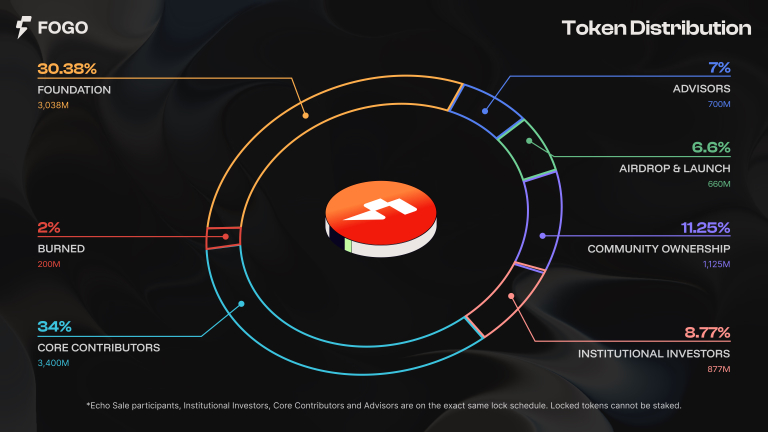
$FOGO is designed to align long-term network growth with community participation rather than short-term speculation. Unlike many Layer 1s, Fogo adopted a community-first distribution approach.
Token Utility
- Network Gas: $FOGO is used for transaction fees, with support for gas sponsorship to improve UX.
- Staking: Validators and delegators earn yield for securing the network.
- Ecosystem Flywheel: The Foundation supports core applications through grants and investments, with revenue-sharing agreements that redirect value back to the network.
Distribution Overview
A significant portion of supply is allocated to community ownership, core contributors, and the Foundation, with long-term vesting schedules designed to align incentives over multiple years. At launch, the majority of tokens remain locked, reducing early sell pressure while funding ecosystem development.
Why Fogo?
Most new chains talk about speed. Fogo talks about execution reality.
The reason Fogo stands out is not because it claims to be fast, but because it is built around where latency actually comes from in crypto markets. In most blockchains, speed bottlenecks are blamed on consensus alone. Fogo challenges that assumption by redesigning how execution, networking, and validator coordination work together.
Fogo’s architecture reflects a simple but rare insight: markets do not care about theoretical TPS; they care about deterministic execution and predictable latency.
By combining:
- SVM-based parallel execution,
- Firedancer-grade performance principles,
- And a geographically optimized, multi-local consensus approach,
Fogo positions itself as an execution layer that can support real trading activity, not just benchmarks.
This makes Fogo especially relevant for:
- On-chain derivatives
- High-frequency DeFi strategies
- Orderbook-based DEXs
- Real-time financial applications
In short, Fogo is not trying to replace Solana’s ecosystem or Ethereum’s settlement role. It is carving out a niche as a market-first execution chain, where performance is not a marketing metric but a design constraint.
How to Buy $FOGO
$FOGO is Now Live on MEXC (0% Fees)
For traders looking to get early exposure to the high-performance Fogo ecosystem, $FOGO is now officially available for trading on MEXC. By choosing MEXC, you can take advantage of the industry’s lowest costs with a 0% fee standard, ensuring you keep more of your profits while navigating the fast-moving markets of this SVM-based Layer 1. MEXC provides the deep liquidity and technical stability required to handle Fogo’s sub-second finality and real-time execution.
Haven’t signed up yet? Click Here !

FOGO vs Competitors
Fogo enters a crowded field of high-performance blockchains, but its positioning is notably different.
Versus Solana: Solana optimized for global throughput and ecosystem scale. Fogo optimizes for local execution determinism. Where Solana shines in composability at scale, Fogo focuses on reducing latency variability, a key requirement for professional trading systems.
Versus Monad: Monad emphasizes EVM compatibility with parallel execution. Fogo takes a different route by leveraging the SVM and targeting execution-heavy applications rather than Ethereum migration paths.
Versus Sei: Sei positions itself as a trading-focused chain, but largely through application-layer optimizations. Fogo pushes these optimizations deeper into the core execution and networking layers, which may offer longer-term structural advantages.
Versus Hyperliquid-style architectures: Hyperliquid proved that specialized execution environments can outperform generalized chains. Fogo applies this lesson at the base layer, aiming to give multiple applications access to similar performance characteristics.
Rather than competing head-on, Fogo complements this landscape by serving as a precision execution layer for markets that demand consistency over raw scale.
Investment Outlook:
From an investment perspective, $FOGO should not be evaluated like a generic L1 token.
Its long-term value is more closely tied to:
- Adoption by execution-sensitive applications
- Sustained on-chain trading volume
- Developer traction in performance-critical use cases
If Fogo succeeds in becoming the preferred chain for:
- Advanced DeFi protocols
- On-chain market makers
- Latency-sensitive financial products
then $FOGO accrues value not just through speculation, but through structural demand for block space and execution priority.
That said, risks remain. Fogo is early in its ecosystem lifecycle, and execution-focused chains must prove that developers and liquidity are willing to move for marginal performance gains. Competition from well-capitalized incumbents is also real.
For investors, $FOGO fits better as a thematic infrastructure bet rather than a short-term momentum trade.
Conclusion
Fogo represents a shift in how blockchains think about performance. Instead of chasing higher TPS numbers or broader generalization, Fogo narrows its focus to a single question: What does real financial execution actually require on-chain?
By designing around latency determinism, parallel execution, and market-native workloads, Fogo positions itself as a serious contender in the next phase of blockchain infrastructure, where execution quality matters more than slogans. $FOGO, as the network’s native asset, is directly tied to this vision. Its success will depend not on hype cycles, but on whether builders and traders recognize the value of an execution-first chain.
If crypto continues its trajectory toward professional-grade, on-chain financial markets, Fogo is building exactly for that future.
Disclaimer: This article is educational and does not constitute financial or investment advice. Personal circumstances vary. Consider speaking with a licensed financial advisor before making major financial decisions. Always confirm platform details and regulatory status with official sources.
Enjoy Most Trending Tokens, Everyday Airdrops, Xtremely Low Fees and Comprehensive Liquidity!
Sign Up App Store
 Google Play
 Android APK