


Exchange-traded funds (ETFs) have evolved into one of the most powerful tools in modern finance. From tracking U.S. stocks and bonds to accessing gold and Bitcoin, ETFs offer a gateway to global markets.
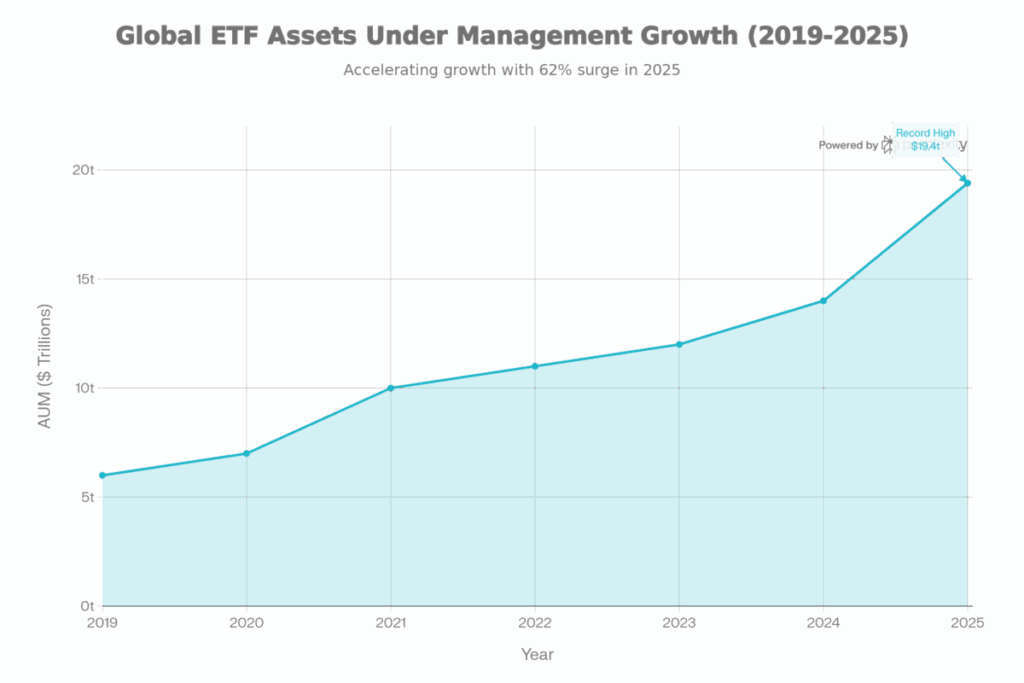
As of late 2025, ETFs globally manage well over 19,44 trillion USD and continue to grow rapidly. Their popularity stems from a simple promise: providing the diversification of a mutual fund with the trading flexibility of a stock.
Key Takeaways:
- Definition: ETFs are baskets of securities that trade on an exchange like a stock.
- Cost: Generally lower fees (expense ratios) than mutual funds.
- Variety: Ranges from S&P 500 index funds to niche Crypto and AI themes.
- Liquidity: Buy and sell instantly during market hours.
Table of Contents
What Is an Exchange-Traded Fund (ETF)?
An exchange-traded fund (ETF) is a pooled investment security that holds a basket of assets, such as stocks, bonds, or commodities, and trades on a stock exchange throughout the day. When you buy one ETF share, you instantly gain diversified exposure to dozens or even hundreds of underlying securities.
Definition and Core Concept
At its core, an ETF is a “wrapper” for a basket of investments.
- Most ETFs track a specific index, such as the S&P 500, Nasdaq-100, or a customized bond index, aiming to mirror its performance.
- Instead of purchasing 500 individual stocks like Apple (AAPL), Microsoft (MSFT), or Amazon (AMZNX) separately, you can buy one share of an S&P 500 ETF (e.g., VOO or SPY) and own a slice of the entire market.
How ETFs Work
- Creation: Fund providers (like Vanguard, BlackRock/iShares) create the fund and hold the underlying assets.
- Trading: ETF shares represent fractional ownership of that basket and trade on exchanges via your brokerage account.
- Pricing: Market makers adjust supply and demand to ensure the ETF price stays close to its Net Asset Value (NAV).
ETF vs. Mutual Fund vs. Stocks
ETFs occupy a “sweet spot” for investors. They offer the diversification of mutual funds but with the intraday liquidity of single stocks.
| Feature | ETFs | Mutual Funds | Individual Stocks |
| Trading | Intraday (buy/sell anytime market open) | End-of-day only (NAV pricing) | Intraday (real-time pricing) |
| Diversification | High (basket of 100s of assets) | High (basket of assets) | Low (single company exposure) |
| Expense Ratio | Low (0.14%-0.48% avg. 2025) | Higher (0.60%-0.89%+ active funds) | None (just commissions) |
| Minimum Investment | 1 share (~$20-$100) | Often $1,000-$3,000 minimum | 1 share (varies by price) |
| Liquidity | High (exchange-traded volumes) | Lower (redemption processing) | High (market-driven) |
| Transparency | Daily holdings published | Quarterly reports | Full company filings |
In 2025, ETFs continued to offer lower average expense ratios compared to actively managed mutual funds, typically 0.14%–0.48% for index ETFs versus 0.60%–0.89% or higher for many mutual funds, making them the preferred choice for cost-conscious investors building long-term wealth.
Types of ETFs Every Investor Should Know

ETFs now cover nearly every corner of the global market—from stocks and bonds to crypto and commodities. Below are the primary categories you should consider for a diversified portfolio, updated for 2026 trends with fresh examples and data.
Index ETFs (Passive Management)
Direct Answer: Index ETFs track major benchmarks like the S&P 500, offering low-cost, broad market exposure that captured the largest share of $19.44T global ETF assets in 2025.
These funds replicate performance of indexes like the S&P 500 or MSCI World.
- Examples: Vanguard Total Stock Market ETF (VTI), SPDR S&P 500 ETF Trust (SPY), both managing tens of billions in AUM.
- Why invest: Equity index ETFs dominated 2025 inflows due to rock-bottom fees (~0.03%-0.10%) and instant diversification across 500+ top companies.
Sector and Thematic ETFs
Direct Answer: Target booming sectors like AI, clean energy, and semiconductors, letting you ride high-growth trends through companies like Nvidia without picking individual winners.
These funds zero in on specific industries or emerging megatrends.
- Popular themes: Artificial Intelligence (AI), Clean Energy, Semiconductors.
- Key holdings: Heavy allocations to leaders like Nvidia (NVDA/USDT), Tesla (TESLA/USDT), Advanced Micro Devices (AMDSTOCK/USDT).
- Why invest: Thematic ETFs saw massive 2025 inflows as investors bet on tech transformation, perfect for targeted growth without constant stock-picking.
Crypto ETFs (New & Trending)
Direct Answer: Spot Bitcoin and Ethereum ETFs exploded in 2025, giving regulated crypto exposure through familiar brokerage accounts, no wallets needed.
This category surged after U.S. Spot Bitcoin ETF approvals.
- Function: Track prices of Bitcoin (BTC) or Ethereum (ETH) directly.
- Examples: iShares Bitcoin Trust (IBIT), Fidelity Wise Origin Bitcoin Fund (FBTC), among 2025’s top performers by inflows.
- Benefit: Gain crypto upside via your regular broker, with institutional-grade security and liquidity.
Bond and Commodity ETFs
Direct Answer: Bond ETFs stabilize portfolios with steady income; commodity ETFs like gold provide inflation protection, essential for balanced 2026 strategies.
- Bond ETFs: Access Treasuries, corporate bonds, or high-yield options for reliable income streams.
- Commodity ETFs: Track Gold (GLD), silver, oil, popular hedges as gold ETFs saw strong 2025 flows.
- Why they shine: Mix these with equity ETFs for smoother returns across market cycles.
Inverse and Leveraged ETFs
Direct Answer: Advanced tools for active traders seeking 2x/3x daily index moves or inverse plays, ideal for tactical short-term strategies.
Built for experienced traders expressing precise market views.
- Leveraged: Deliver 2x or 3x an index’s daily return.
- Inverse: Profit when markets drop.
- Pro move: Pair with high-volume trading for maximum flexibility in volatile 2026 conditions.
Why Invest in ETFs? Key Benefits
The global ETF market has grown at an annualized rate of ~19% over the last five years. Here is why investors worldwide are switching to ETFs:
- Diversification and Risk Reduction: With a single “click,” you can spread your capital across thousands of companies. In 2023, a typical global equity ETF held over 1,000 stocks, significantly reducing the risk associated with holding individual company shares.
- Cost Efficiency: ETFs are famous for being budget-friendly.
- Expense Ratios: Index equity ETFs averaged 0.14%–0.48% in 2024, while active mutual funds often charged 0.60%–0.89%+.
- Impact: Over 20 years, saving 0.5% in fees can result in thousands of dollars in extra returns.
- Liquidity and Transparency
- Trade Anytime: Unlike mutual funds (which price once at market close), ETFs trade all day.
- Transparency: Most ETFs publish their full holdings daily, so you always know exactly what you own.
- Dividend Income: Many ETFs pass through dividends from underlying stocks. Investors can choose to take the cash or set up DRIP (Dividend Reinvestment Plans) to compound their growth automatically.
Risks of ETF Investing and How to Manage Them
While ETFs are accessible, they are not risk-free.
- Market Risk: If the S&P 500 drops 20%, an S&P 500 ETF will also drop ~20%.
- Tracking Error: The slight deviation between the ETF’s performance and the index it tracks. For liquid funds, this is negligible (basis points).
- Liquidity in Niche Funds: While flagship ETFs trade billions daily, smaller niche ETFs may have wider bid-ask spreads, making them costlier to trade.
Pro Tip: Stick to large, liquid ETFs with high Assets Under Management (AUM) to minimize liquidity risks.
How to Invest in ETFs: A 5-Step Guide for 2026
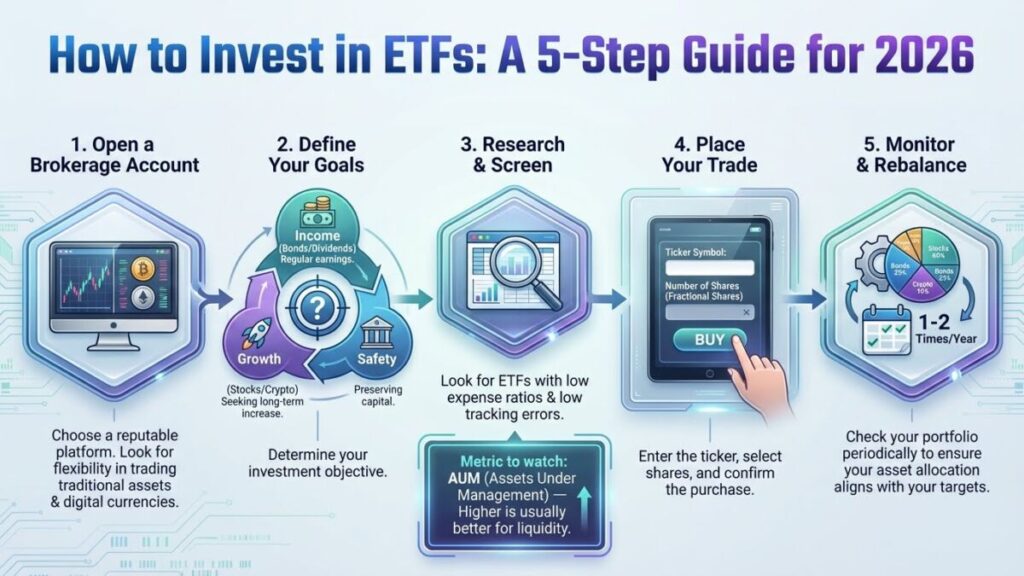
Getting started is straightforward. Follow this checklist:
- Open a Brokerage Account: Choose a reputable platform. For flexibility, modern investors often look for platforms that allow trading both traditional assets and digital currencies.
- Define Your Goals: Are you seeking growth (Stocks/Crypto), income (Bonds/Dividends), or safety?
- Research & Screen: Look for ETFs with low expense ratios and low tracking errors.
- Metric to watch: AUM (Assets Under Management)—higher is usually better for liquidity.
- Place Your Trade: Enter the ticker symbol, select the number of shares (or fractional shares), and click buy.
- Monitor & Rebalance: Check your portfolio 1-2 times a year to ensure your asset allocation aligns with your targets.
Conclusion
ETFs provide a modern, flexible, and cost-effective way to access global markets. Whether you are building a retirement nest egg with broad index funds or tactically trading Crypto and AI themes, ETFs offer the tools to design a portfolio that fits your lifestyle.
However, for those who want to trade the underlying heavyweights like Tesla, Apple, or Coinbase directly with high efficiency, modern platforms offer even more flexibility.
Ready to take control? If you want to trade top U.S. Stocks and Stock Futures using USDT with deep liquidity and low fees, explore Spot xStocks and Stock Futures on MEXC today. Diversify your portfolio beyond just crypto on one single, powerful platform.
Frequently Asked Questions (FAQ)
- Are ETFs good for beginners?
Yes. ETFs are ideal for beginners because they provide instant diversification. Buying one broad market ETF is safer and easier than trying to pick winning individual stocks.
- How many ETFs exist today?
By 2023, there were over 10,300 ETFs worldwide. This number continues to rise in 2024-2026 as new strategies, including Crypto and ESG funds, enter the market.
- How much does it cost to invest in ETFs?
You can start with the price of a single share (or less with fractional shares). Most brokers charge $0 commission, so your main cost is the annual expense ratio, often under 0.10% for index funds.
- How do ETFs make money for investors?
Investors earn money through capital appreciation (price goes up) and dividend distributions (payouts from the underlying companies).
- Are ETFs popular only in the U.S.?
No. While the U.S. is the largest market (over $9 Trillion AUM), Europe and Asia-Pacific are seeing record inflows and rapid adoption of ETF investing.