Market sentiment shifts to neutral amid post‑crash stabilization
The crypto market’s principal sentiment gauge has moved into “neutral” territory, registering a reading of 40 for the first time since October. The shift marks a material improvement from the “extreme fear” environment that dominated late 2025, and signals that investors are growing more cautious but less panic‑driven as the new year begins.
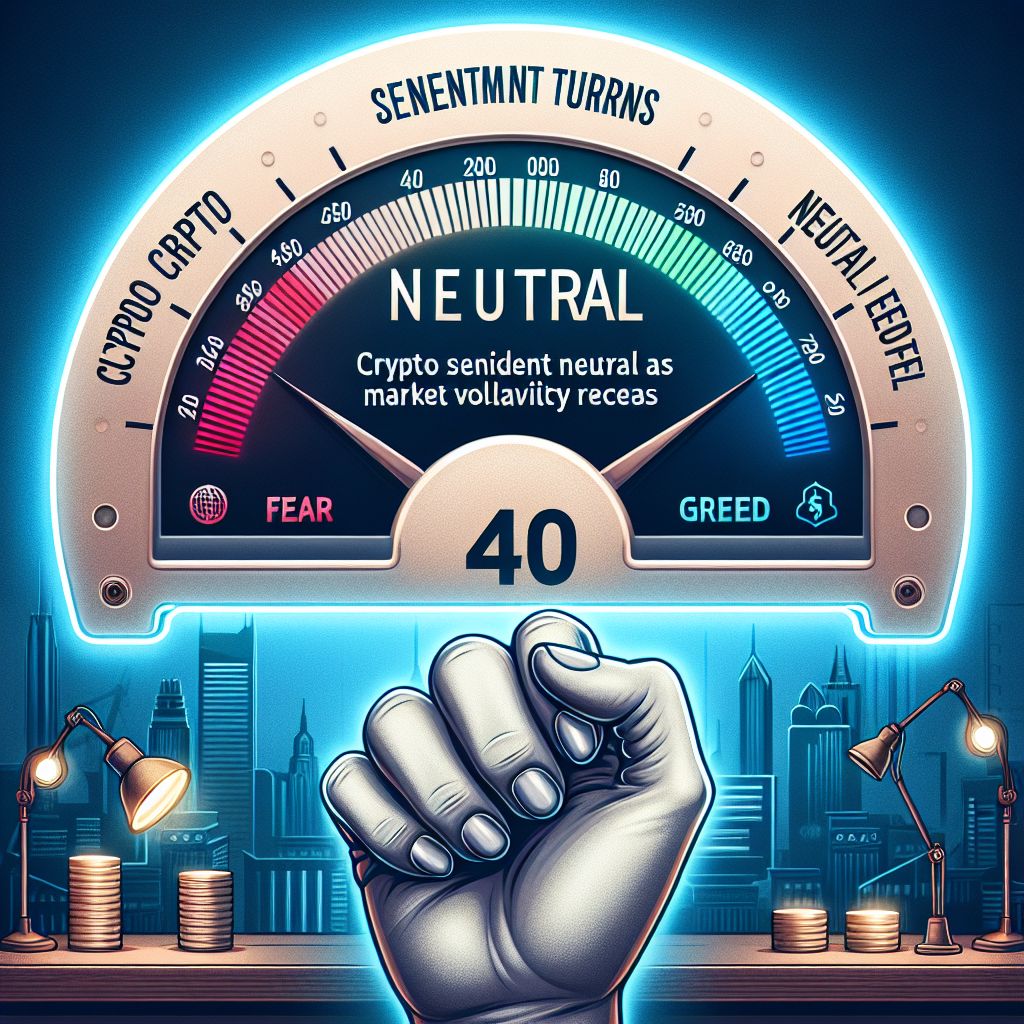
For MEXC users and market participants, the change in sentiment comes after a turbulent period that saw sharp price swings across major cryptocurrencies and broad declines in altcoin valuations. The neutral reading does not imply bullish conviction, but it does reflect reduced downside panic and a more balanced risk posture among investors.
How the index reflects investor psychology
The Fear & Greed measure aggregates multiple data points — including volatility, market momentum, social media trends, and trading volume — to estimate crowd sentiment. Readings below 25 typically indicate fear; values under 10 denote “extreme fear.” Conversely, readings above 70 signal greed or overenthusiasm.
A reading of 40 indicates neither acute worry nor exuberance. Market participants tend to interpret this state as one of consolidation, where upside rallies must be earned and downside risk is perceived as contained compared with the shock months preceding it.
2025 in review: from all‑time highs to a swift correction
Understanding the sentiment shift requires reviewing last year’s market dynamics. In October 2025, the crypto market experienced a dramatic peak and subsequent collapse:
- Bitcoin rallied to a reported all‑time high above $125,000 in the run‑up to the sell‑off.
- Within days, the market retraced sharply — Bitcoin fell to roughly $80,000, a decline on the order of 35% from the peak.
- Altcoins were disproportionately affected; many tokens lost a majority of their value in a short window, and the altcoin market capitalization (excluding the two largest tokens) declined by approximately one third in a single day.
- Investor sentiment bottomed in November 2025 with an index reading close to 10 — a level classified as “extreme fear.”
The October–November cycle exposed leverage, liquidity gaps, and the sensitivity of speculative flows to sudden market moves. That environment produced heightened volatility and forced many investors to reassess risk allocation heading into 2026.
Geopolitical events and market resilience
Early January saw renewed geopolitical headlines following a major military operation involving the United States and Venezuela. Media coverage and official statements drove elevated uncertainty across asset classes.
Notably, Bitcoin exhibited relative resilience in the immediate aftermath of the operation. While traditional risk‑on assets often sell off quickly during geopolitical shocks, major cryptocurrencies held up better than some market watchers expected. Analysts remain divided about the durability of this behavior:
- Some market participants argue crypto’s limited direct correlation with short‑term macro moves has supported stability.
- Others caution that liquidity and risk appetite can shift rapidly once global markets reopen and macro desks reassess positions.
The coming weeks will be important to see whether this resilience holds as global equity markets price in the geopolitical fallout and central bank guidance for 2026 becomes clearer.
Why crypto reacted differently
Several factors may explain why the crypto market showed relative stability:
- Lower retail leverage after the 2025 correction reduced the likelihood of forced liquidations.
- Institutional allocation frameworks adjusted in late 2025 — with many investors favoring longer‑term exposures and hedging strategies.
- On‑chain metrics, such as declining exchange inflows and rising long‑term holder concentration, suggested a base of retained demand.
Drivers behind the sentiment improvement
The move from “extreme fear” to “neutral” reflects several concurrent trends that have influenced market psychology:
- Price stabilization across major tokens after the violent retracement in October.
- Reduced leverage usage in spot and derivatives markets, limiting cascade risk.
- Gradual recovery in trading volumes, especially in higher‑quality large‑cap assets.
- An increase in narrative clarity around market structure following the shock events of late 2025.
These dynamics have created an environment where investors are more willing to hold positions through short‑term volatility, but not yet prepared to aggressively bid up risk assets without clearer macro or on‑chain confirmation.
Headwinds to watch in 2026
Despite the improvement in sentiment, several notable risks could weigh on the market through 2026:
- Geopolitical tensions remain elevated and unpredictable, with potential to trigger rapid risk repricing.
- Retail engagement — a key driver of speculative altcoin rallies — has been muted compared with prior cycles, limiting short‑term demand impulses.
- Macro policy decisions and interest rate trajectories in major economies will continue to influence risk asset correlations.
- Event risk remains elevated around large token unlocks, regulatory announcements, and concentrated liquidity points in DeFi and CeFi sectors.
Traders and portfolio managers should treat the neutral sentiment reading as a pause rather than a clear green light for aggressive positioning.
Opportunities and indicators to monitor
For market participants seeking to navigate 2026, the following indicators can help inform positioning:
- On‑chain flows: exchange inflows/outflows, active addresses, and long‑term holder accumulation.
- Derivatives metrics: funding rates, open interest, and the balance between perpetual and futures markets.
- Market breadth: altcoin market cap trends, dominance shifts, and token-specific volume recovery.
- Macro calendar: central bank decisions, inflation prints, and employment reports that shift global liquidity conditions.
- Geopolitical developments: any escalation in global hotspots that could prompt risk‑off moves.
Combining these on‑chain and macro indicators can provide a more robust signal set than relying on sentiment gauges alone.
Practical guidance for MEXC users
As a marketplace, MEXC emphasizes disciplined risk management and diversified exposure during phases of market transition. Key considerations include:
- Position sizing: align trade size with risk tolerance and the potential for renewed volatility.
- Use of hedges: consider options or inverse products where appropriate to protect concentrated exposures.
- Research‑driven allocation: prioritize assets with clear on‑chain fundamentals and liquidity profiles.
- Stay updated: follow macro developments and on‑chain metrics to adapt quickly to changing conditions.
These steps help preserve capital while maintaining optionality to participate in recoveries or new trends that emerge throughout 2026.
Outlook: cautious optimism with emphasis on risk control
The shift to a neutral sentiment reading is a constructive development for crypto markets, indicating that panic has subsided since the late‑2025 lows. However, neutral sentiment is not synonymous with renewed bullishness — it represents a market in recalibration.
For the remainder of 2026, expect episodic volatility driven by macro and geopolitical catalysts. The path to a sustained bullish phase will likely require:
- Renewed and broad‑based demand from both retail and institutional participants.
- Improving liquidity and volume across mid‑ and small‑cap tokens.
- Clearer macro signals that support risk‑asset allocation from global investors.
MEXC will continue monitoring sentiment indicators, on‑chain flows, and macro developments to provide timely market insights and tools that support informed trading and investing decisions.
Key takeaways
- The Fear & Greed reading has moved to neutral (40) for the first time since October, signaling reduced panic after the 2025 crash.
- Late‑2025 volatility featured a peak above $125,000 for Bitcoin followed by a 35% drawdown and severe altcoin losses.
- Geopolitical events in early 2026 produced uncertainty, but crypto showed relative resilience in initial reactions.
- Investors should balance cautious optimism with active risk management and track on‑chain and macro indicators closely.
Stay informed with MEXC’s market coverage as conditions evolve and new data emerge throughout 2026.
Disclaimer: This post is a compilation of publicly available information.
MEXC does not verify or guarantee the accuracy of third-party content.
Readers should conduct their own research before making any investment or participation decisions.
Join MEXC and Get up to $10,000 Bonus!
Sign Up