

How much control crypto traders are ready to give AI

Key Takeaways
- 84.8% of surveyed crypto users have used AI for research or trading. While 58.3% report improved market research, 46% also report better trade execution, though 54% have yet to see improvement at the execution stage.
- Interest in AI agents is already significant: half of respondents are interested in AI agents but have not tried them.
- 65.9% of AI users act on its advice at least sometimes; only 20% have tried execution without approving each trade.
- 54% would let AI trade with some funds, but no more than 20% of their account; only 6.5% would authorize more than half.
- Half of users with automated execution experience worry they could fail to detect or stop problems in time.
- Willingness to use automated trading grows from 55% under the baseline scenario to 71.8% when limits on funds, positions, leverage and losses are added.
- 95.5% support at least one mandatory protective measure, even as many want control over their own settings.
Most participants in MEXC’s survey already use AI. Few would trust it with most of their money. Of the 3,708 people surveyed, 84.8% had used AI to research or trade crypto in the previous six months. Yet only 6.5% would let it trade more than half of their account assets, even with transfers and withdrawals disabled and the option to stop it at any time.
Users’ answers suggest that interest in automation comes with quite specific expectations about how much money it can touch. With notifications and revocable access, 55% were ready to let AI trade automatically, while with added limits on funds and risk, their readiness rose to 71.8%. These preferences help explain why an audience that uses AI widely can remain cautious about handing over control.
Blockchain security firm Hacken contributed security analysis examining how trading agents can be manipulated and what safeguards can limit the consequences.
85% Use AI, With Stronger Reported Benefits in Research Than Trade Execution
For most AI users, the work begins well before they place an order. The most common uses include summarising news, analysing markets, and finding trading opportunities. When asked about their most recent AI-enabled trade, 68.9% of AI users said AI had its biggest impact before trading, in research, opportunity discovery, strategy, and risk management.

Widespread use has not meant better results for everyone. While 58.3% of AI users said it improved their market research, fewer than half reported better trade execution: 30.9% saw no difference, and 23.1% said results had worsened. AI has become part of many traders’ routines, but users were less likely to report execution than research improvements.
Despite mixed results, 65.9% of users said they act on AI recommendations at least sometimes, placing orders or adjusting trading positions. However, only 20% had tried execution without confirming each trade. For 57.6%, their own judgment with AI assistance worked best.
63% Want AI Built Into Exchange They Use
Traders often turn to ChatGPT or Claude for help, but most would prefer to access AI where they already trade. General-purpose tools had been used by 76.6% of AI users, well ahead of exchange chat assistants at 38.7%, exchange strategies or bots at 34.6%, and external agents connected to accounts at 17.1%. Yet when all respondents were asked which interface they would prefer, 62.6% chose AI built into an exchange. Many respondents would like to access it where they already trade.

That preference points to demand for a more integrated trading experience. Getting an answer from a chatbot is only part of the job: a trader still has to check it against current market conditions, account balances and open positions before proceeding with an operation. An assistant inside the exchange could reduce that back-and-forth. Respondents’ answers suggest demand for tools that fit more easily into their existing trading routine, but do not necessarily imply a desire to give AI more control.
For exchanges, there is an opportunity here. AI already has an audience, but connecting it to a useful trading routine remains difficult for some users. More than half of respondents (53.1%) used AI at least weekly. Among the 563 who had not used it (15.2% of the sample), difficulty getting started or high entry barriers was a more common obstacle than distrust of its judgments, cited by 46.7% and 32.7%, respectively. These findings suggest that simpler onboarding and clearer AI workflows could help lower the barrier to adoption. Putting a chat window inside an app would make it easier to find, while making it useful would require a clearer path from a question to a result the user can check.
The experience gap offers another clue. AI adoption reached 88.4% among respondents with one to two years of trading experience, compared with 74.7% among those with less than a year. Traders who already understand orders, positions and market analysis have more specific tasks to delegate and a better basis for judging the output. Younger respondents were also more likely to have tried AI: adoption reached 88.5% among those aged 18–34, compared with 69.9% among those aged 45 and above.
These differences suggest that making tools readily available will not be enough for every audience. A beginner asking what to buy and an experienced trader advancing their trading strategy may use the same assistant. Still, they need different guidance, and neither necessarily wants it to take control of the account.
Half Are Interested in AI Agents, but Only 13% Have Tried One
An AI agent can connect to an exchange account to check positions, analyze markets or execute trades within the permissions granted by the user, with actions either requiring user confirmation or running automatically within preset limits.
AI agents are only beginning to gain recognition, and despite their sophistication and autonomy in performing a wide range of operations, many users remain cautious about using them. While 84.8% of all respondents used AI to research or trade crypto in the previous six months, only 13% reported trying an agent connected to an exchange account.

While asking a chatbot to explain a market move has become familiar, connecting software to an account still raises questions about setup and access. Interest is already there: 50.1% of respondents were interested in agents but had not used one, with 30.6% of the full sample interested but deterred by configuration or difficulty getting started.
Among all respondents, 9.6% had tried an agent and wanted to continue, while 3.4% found the experience unsatisfactory. A trader might want an assistant to review existing positions and identify potential opportunities while still deciding personally whether to place an order.
This caution also shows up in respondents’ priorities for the next 12 months. Analyzing trading opportunities attracted 42.1%, processing market information 38.2%, and checking assets and positions 28.1%. Automatic position adjustments or take-profit and stop-loss orders within preset limits drew 17%.
72% of Users Would Try Automated Trading With Risk Limits
Users’ hesitation softened when they could decide in advance how much freedom AI might have. With notifications and the option to pause trading or revoke access, 55% were willing to have automatic execution. Adding limits on funds, positions, leverage and losses, with trading stopped automatically at the loss threshold, brought willingness to 71.8%. That is a gain of 16.8 percentage points, or 30.5% relative to the initial figure.
More than half of those initially unwilling or uncertain (53.6%) changed their mind under the additional safeguards. The strongest response came from traders who had already let AI execute orders after their approval: 65.7% of users had some experience delegating execution, while retaining the final decision on each trade. Their answers suggest that preset limits could make removing that approval step more acceptable. With those limits in place, their willingness reached 77.8%, close to the 78.9% recorded among respondents who had already tried automatic execution.
The responses also help explain why mixed assessments of AI’s performance can coexist with interest in automation. A trader can remain doubtful about its decisions and still be ready to try it with limited budget and risks. That willingness is conditional, however: 13.3% of those initially willing became hesitant in the second scenario.

Willingness to try automation did not translate into willingness to pledge the majority of the funds. With transfers and withdrawals prohibited and trading stoppable at any time, 54% would allow AI to use some funds, but no more than 20% of their account balance. Another 18.3% would authorize none, and only 6.5% would authorize more than half.

Execution Experience Brings Greater Focus on Risk and Control
Respondents with AI execution experience showed greater awareness of its risks than those who used it only for information or advice. Half rated a threat of failing to detect or stop a problem in time at 4 or 5 out of 5, compared with 41% of respondents who used AI for advice only.
This caution extended across every risk measured, from misunderstood instructions to attacks on accounts and connected tools. Respondents with automatic execution experience gave each risk a higher average rating than users who requested advice only.
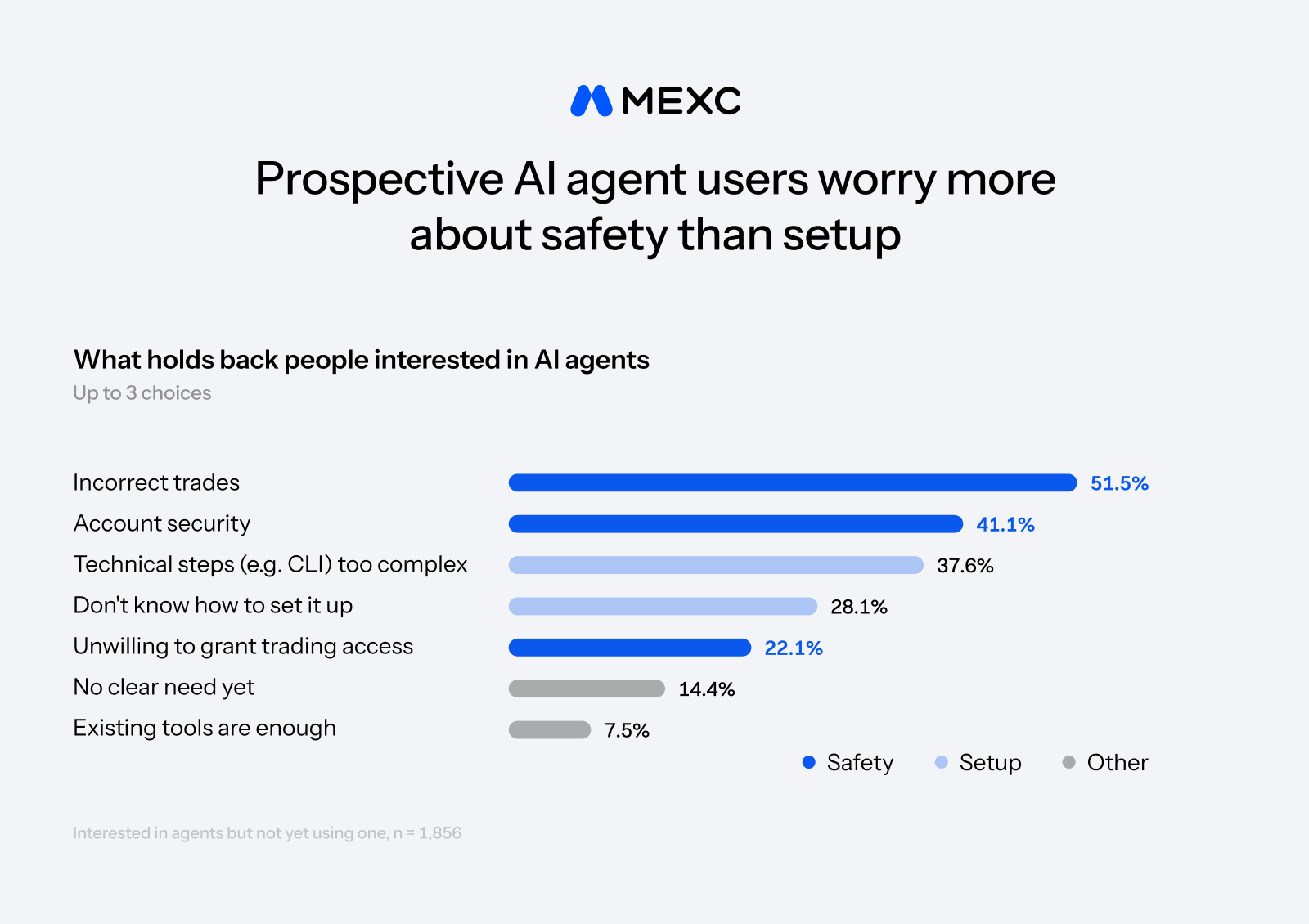
Among prospective users, the bigger obstacles also concerned what might happen after setup. Of the 1,856 respondents interested in agents but yet to try them, 51.5% worried about incorrect trades and 41.1% about account security. Both exceeded concerns about technical complexity. Relatively few in this interested group said they had no clear need for an agent or that their existing tools were sufficient.

Users Prioritize Capital and Permission Controls, While Expecting Industry Safeguards
When asked which protections mattered most, 52.5% of respondents favoured limits on capital and loss with automatic stopping, while 47.3% and 30.2% prioritized permission restrictions and approval for high-risk operations, respectively. The control aspect carried more weight among people who already tried automatic execution. They were more likely than advice-only users to prioritize permission restrictions and tools for pausing trading or revoking access. Human approval, meanwhile, attracted similar support across the three experience groups, while activity logs ranked last.

Who should decide which protections apply? The largest group (46.2%) wanted exchanges to provide safety settings and let users choose whether to enable them. Another 25.7% favored minimum measures for every AI trading tool. Support for optional settings was particularly strong among users with confirmed trading experience (53.6%), compared with 50.2% among users with automatic execution and 43.4% among users with AI advice experience only.
That preference for choice came with an important qualification. Among respondents who favored optional settings and answered the separate question about industry standards, 97.8% supported at least one mandatory safeguard. Across all 3,464 valid responses to the standards question, support reached 95.5%; just 4.5% selected none. The answers suggest that users may want discretion over an agent’s day-to-day activity while still expecting its provider to undergo audits, investigate failures or check that customers understand the risks.

Testing users’ understanding before first use received the most support. Respondents with execution experience also placed greater weight on scrutiny of the providers themselves. Support for independent audits rose from 33.4% among advice-only users to 45.2% among confirmed-execution users and 51.3% among automatic-execution users. Incident investigation and disclosure followed a similar pattern: 28%, 41.4% and 51%. For these users, the relationship with a provider appears to extend beyond connecting an account and setting limits. They also want evidence that the system has been checked — and a process for finding out what happened if it fails.
Why Trading Permissions Need to Be Paired With Exposure Controls
Security analysis contributed by Hacken.
The restrictions users want address different risks. Disabling withdrawals prevents an agent from withdrawing funds, but it can still lose money through trading. In a scenario described by Hacken, an attacker could manipulate an agent into buying a low-volume token at an inflated price from the attacker’s sell orders. The user would receive tokens worth less than they paid, while the attacker collected the profit. The transaction would use the agent’s existing trading permissions.
This helps explain the importance of combining permission restrictions with limits on funds and exposure, the two settings respondents favored most. A user can restrict withdrawals and still limit how much the agent may spend and which assets it may buy. Hacken also recommends checking order prices against an independent reference to prevent purchases or sales far outside the allowed limits.
Some risks begin with the information an agent uses. Hacken described a lab test in which an instruction embedded in a software changelog caused an agent to execute a script without explicit approval. Although the test did not involve trading, it demonstrated how external material could influence an agent’s actions. News pages and token descriptions could present similar risks when an agent uses them to research potential trades.
The consequences depend partly on what happens between the agent proposing an action and the platform executing it. Hacken recommends setting trading limits through a separate system that the agent cannot override. Checking individual orders alone is insufficient: several purchases below a $10,000 order limit could still create a position larger than the user intended. Controls therefore need to cover total exposure as well as individual transactions, with additional authorization required to grant more access.
Testing should establish whether those controls work under the conditions they are intended to address. Hacken’s approach includes attempts to bypass limits by splitting orders, influence decisions through misleading inputs and check whether an emergency stop blocks new orders and cancels outstanding ones. Following an attempted manipulation through to execution shows whether a weakness in the agent can result in an unexpected trade.
The survey findings also point to a role for protective measures that users may not prioritize themselves. Activity logs ranked last among their preferred protections, yet 51% of respondents with automatic execution experience supported incident investigation and disclosure. Records of the information behind a decision, the proposed action, and the checks applied before execution can help explain how an unexpected trade occurred. For providers, keeping that history supports the explanations users expect when something goes wrong.
What This Means for Exchanges
Crypto traders have already adopted AI, but their trust is conditional. Most want it close to their trading routine, and few are ready to give it significant control. Willingness grows when limits on funds, exposure and losses are in place, and almost all respondents expect some basic protective measures from the industry and trading platforms. Hacken’s analysis confirms that these expectations matter: permissions alone do not prevent losses, and controls must work independently of the agent and cover total exposure. Wider AI adoption is inevitable, but it should come with reasonable risk limits, multiple tests, and records of agents’ operations.
Methods and Supporting Data
Hacken contributed technical analysis and a description of its lab testing. These contributions provide security context; they are separate from the survey findings and do not constitute an audit of MEXC’s trading infrastructure.
The survey covered 3,708 valid respondents, including 3,145 who used AI for crypto research or trading in the previous six months and 563 who did not. Respondents are predominantly male and active spot and futures traders. The survey was conducted online from September 14 to 20, 2026, with respondents recruited through MEXC’s digital channels, including social media, the MEXC app and website.
Each percentage uses the valid responses for its question and group. Task, tool, non-use and agent-concern questions allowed up to three selections; safeguard priorities allowed two and industry requirements allowed four. The preferred interface and exchange-oversight questions were single-choice. Totals may differ from 100% because of rounding or multiple selections.
For group comparisons, respondents with any automated execution experience are assigned to the automated group. Those with confirmed execution experience but no automated execution experience form the confirmed group. Other AI users form the information-or-advice group. These groups do not overlap, unlike the individual execution options in the original multiple-response question.
Scenario responses stated willingness rather than actual use or allocations. Performance assessments are subjective, and differences between groups do not show cause and effect.
