

1. Executive Summary: The Genesis Airdrop
The Stable Network Genesis Airdrop is live and the clock is running. The claim portal opened on December 8, 2025 and closes permanently on March 2, 2026, at 12:00 UTC. Any unclaimed $STABLE tokens after this deadline will be returned to the treasury; there are no extensions and no late claims.
This is not a speculative points campaign. The $STABLE Genesis Distribution is a completed, on-chain allocation of tokens to verified early participants. If your wallet meets the eligibility criteria, your tokens are already assigned and waiting. The only action required is claiming them through the one official portal at app.merkl.xyz/users/ before the window closes.
Stable Network is the project’s own term for what it has built: the world’s first “stablechain”; a Layer-1 blockchain where USDT functions as the native gas token, eliminating the volatility-driven cost uncertainty that plagues every other major blockchain. The project launched its mainnet on December 8, 2025, backed by a $28 million seed round co-led by Bitfinex and Hack VC, with participation from Tether, Franklin Templeton, PayPal Ventures, and Castle Island Ventures; one of the most credentialed institutional rosters for a Layer-1 launch in recent memory.
2. What Is Stable Network? The World’s First Stablechain Explained

2.1 The Problem with Every Other Blockchain’s Gas Model
Every major blockchain from Ethereum, Solana, BNB Chain, Avalanche shares a structural problem for payment and settlement use cases: gas fees are paid in volatile native tokens. When ETH doubles in price, the dollar cost of every Ethereum transaction doubles with it. When network congestion spikes, gas prices surge unpredictably. For a business trying to process payroll, cross-border remittances, or institutional settlements on-chain, this cost volatility is a fundamental operational barrier.
Tron found significant traction for USDT transfers by offering low fees, but it remains a general-purpose blockchain with all the architectural compromises that implies. No blockchain had been purpose-built from the ground up with one specific goal: making USDT transactions fast, cheap, predictable, and settlement-grade until Stable.
2.2 The Stablechain Concept
Stable Network describes itself and its technology — as the first “stablechain.” This is not a marketing term but an architectural description: a Layer-1 blockchain where stablecoins are the native currency for all network operations, including gas fees. Users on StableChain transact entirely in USDT. They do not need ETH, SOL, BNB, or any other volatile token to pay for transactions. Gas fees, protocol interactions, and settlements are all denominated in USDT creating a completely predictable, dollar-denominated cost environment.
For retail users, this means a remittance app built on Stable operates identically to a dollar bank wire in terms of cost predictability. For institutions, it means guaranteed, enterprise-grade fee structures that can be budgeted and audited in dollar terms with no currency risk.
2.3 Institutional Backing: A $28M Seed Round of Unusual Depth
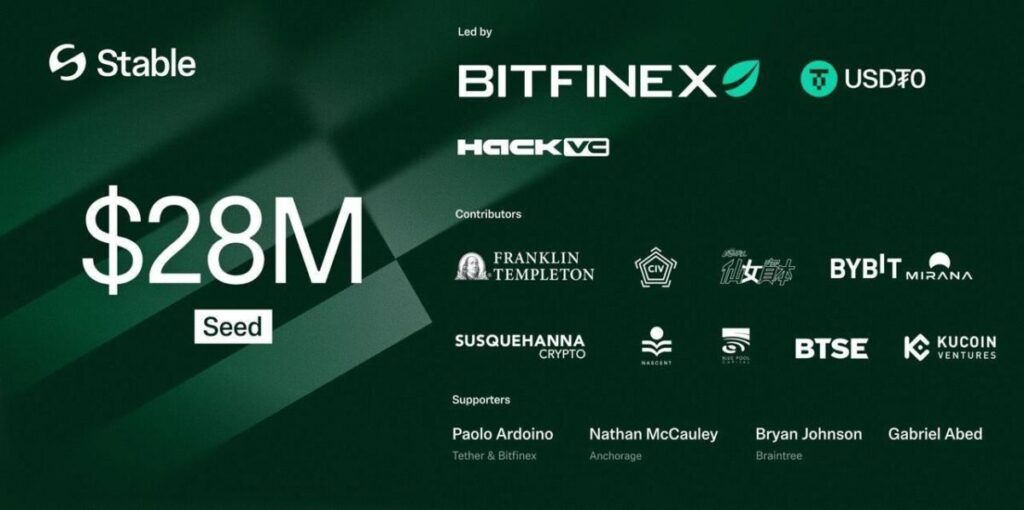
Stable’s $28 million seed round, completed July 31, 2025, tells an unusually credible story for a new Layer-1. The co-leads — Bitfinex (one of the oldest and highest-volume crypto exchanges) and Hack VC (a leading Web3 infrastructure fund) are joined by Tether itself (the issuer of USDT, the world’s largest stablecoin by market cap), Franklin Templeton (a $1.5 trillion traditional asset manager actively deploying in blockchain), PayPal Ventures (PayPal’s corporate venture arm, which has its own stablecoin PYUSD), and Castle Island Ventures (a specialist crypto fund focused on infrastructure investments).
The presence of Franklin Templeton and PayPal Ventures; two organizations with massive traditional finance distribution networks at the seed round of a stablecoin-focused L1 is a strong signal of where institutional capital expects stablecoin settlement infrastructure to go. These are not momentum investors chasing a narrative; they are infrastructure investors with direct operational interest in the future of dollar-denominated on-chain settlement.
2.4 The Leadership Team
Stable is led by CEO Brian Mehler, formerly a co-manager of a $1 billion blockchain fund at Block.one the organization behind the EOS blockchain bringing deep institutional capital allocation experience to the project. The founding vision came from Joshua Harding, who previously served as Founder and CEO. The technical foundation is anchored by CTO Sam Kazemian, the founder of the Frax stablecoin protocol one of the most technically sophisticated stablecoin systems deployed on Ethereum. Kazemian’s involvement ensures the core architecture benefits from first-hand expertise in the practical mechanics of stablecoin economic design at scale.
3. The Technology: How StableChain Makes USDT the Native Gas Token

3.1 USDT0: The Omnichain Native Gas Asset
Following the v1.2.0 mainnet upgrade on February 4, 2026, StableChain’s native gas token is now USDT0; the omnichain USDT standard developed using LayerZero’s cross-chain messaging protocol. USDT0 enables USDT to move seamlessly between blockchain networks at lower cost and with greater interoperability than standard bridged USDT. On StableChain, USDT0 is the network’s native unit of account, meaning users fund their wallets with USDT0 and pay all fees in the same asset with no wrapping, conversion, or secondary token required.
Important update: Earlier guides referenced gUSDT (wrapped USDT0) as the gas token. This has been deprecated by the v1.2.0 upgrade. The current gas mechanism uses USDT0 directly, with an account abstraction layer that handles conversion automatically in most wallet setups. The claim guide below reflects these current network parameters.
Additionally, peer-to-peer USDT0 transfers are protocol-level gas-exempt; meaning standard wallet-to-wallet USDT sends on StableChain are entirely free at the base protocol layer.
3.2 StableBFT Consensus: Sub-Second Finality
StableChain uses StableBFT, a customized delegated Proof-of-Stake consensus mechanism engineered for high-throughput settlement. The network achieves sub-second block finality; transactions are confirmed and irreversible in under one second. This performance tier rivals traditional payment rail throughput, making StableChain technically viable for real-time point-of-sale retail payments and high-frequency institutional settlement flows that existing blockchains cannot support at comparable cost efficiency.
The network’s 2026 roadmap includes a transition to Autobahn, a DAG-based consensus architecture targeting 10,000+ TPS; eliminating single-proposer bottlenecks and positioning the network for enterprise-grade volume.
3.3 EVM Compatibility and Account Abstraction
StableChain is fully EVM-compatible, meaning any smart contract written in Solidity for Ethereum can be deployed on StableChain without modification. This dramatically lowers the barrier for developers to build payment applications and DeFi protocols on the network.
The protocol also supports EIP-7702 account abstraction, allowing standard EOA wallets to temporarily gain smart contract-like logic for enhanced payment flows. This is the mechanism that enables the account abstraction layer to handle USDT0 gas conversions automatically users experience gasless-feeling interactions even when micro-fees are occurring under the hood.
3.4 Enterprise-Grade Infrastructure: Guaranteed Blockspace and Confidential Transfers
Two features specifically target institutional adoption. Guaranteed Blockspace allows enterprise users to reserve dedicated transaction throughput, ensuring predictable execution even during peak network demand — a critical requirement for payment processors and treasury operations running high-volume workflows. Confidential Transfers enable transaction privacy while remaining compatible with regulatory compliance frameworks, protecting business-sensitive settlement data without sacrificing auditability for authorized parties.
4. $STABLE Token Economics: Tokenomics, Allocation, and Staking Rewards
4.1 Fixed Supply, Zero Inflation
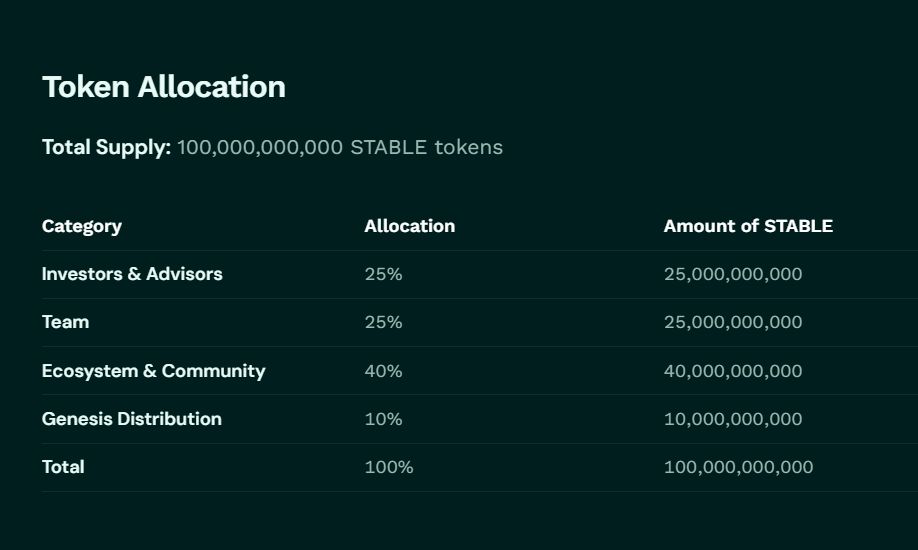
$STABLE has a hard-capped total supply of 100 billion tokens with no inflationary emissions ever planned. No new $STABLE can be minted after genesis. This is a deliberate design choice that aligns with the network’s core thesis: the economic value of the network should accrue through real usage and fee revenue, not through token issuance.
4.2 Token Distribution Breakdown
| Allocation | Percentage | Tokens | Notes |
| Ecosystem & Community | 40% | 40B STABLE | Developer grants, user incentives, integrations; 8% unlocked at launch, remaining 32% vests over 3 year |
| Team | 25% | 25B STABLE | 1-year cliff, 4-year vesting |
| Investors & Advisors | 25% | 25B STABLE | 1-year cliff, 4-year vesting |
| Genesis Distribution | 10% | 10B STABLE | Fully unlocked at mainnet launch — the source of the current airdrop |
The Genesis Distribution (10%) is the allocation from which the current airdrop is being distributed. It was released in full at mainnet launch, enabling the Merkl claim campaign and the Binance Alpha distribution program that followed.
Investor and team tokens are locked until late 2026 under the one-year cliff vesting schedule meaning there is no insider sell pressure until at least December 2026. This is a meaningful protection for early airdrop recipients and market participants in the near-term window following the claim period.
4.3 Staking Rewards: Denominated in USDT, Not $STABLE
One of $STABLE’s most architecturally unusual and strategically significant features is its staking reward mechanism. Because all network fees are collected in USDT, validators and delegated stakers earn their rewards in USDT not in inflationary token emissions. This means staking $STABLE generates dollar-denominated yield, driven by real network usage and transaction fee revenue, rather than the dilutive token-printing that powers most Proof-of-Stake reward systems.
As network transaction volume grows driven by payment applications, institutional settlement flows, and DeFi protocol usage the USDT flowing into the validator vault grows with it. Stakers participate in this revenue proportionally to their delegated stake.
4.4 $STABLE Utility Summary
$STABLE serves three core functions within the StableChain ecosystem. It secures the network through delegated staking to validators under the StableBFT consensus mechanism. It governs the protocol, holders vote on protocol upgrades, validator elections, fee parameters, and broader ecosystem decisions through the Stable Foundation. And it generates USDT-denominated staking yield proportional to network transaction fee revenue.
5. Eligibility Check: Who Qualifies for the Genesis Airdrop?
The Genesis Airdrop targets two specific categories of early ecosystem participants, both of which involve on-chain activity during StableChain’s pre-mainnet phases. Eligibility is determined entirely by verifiable on-chain activity; there are no subjective or team-discretionary criteria.
5.1 Pre-Deposit Phase Participants (Vault Receipt Holders)
Users who deposited assets into Stable’s pre-deposit program and held vault receipts during either of the two Pre-Deposit phases are eligible. Phase 1 filled its $825 million cap in just 22 minutes a signal of the extraordinary demand from early ecosystem participants. Phase 2 added per-wallet KYC limits to broaden participation beyond concentrated whale wallets.
If you deposited assets and received vault receipt tokens during either phase, you are in this eligibility category.
5.2 DeFi Vault Deployers (Morpho, Pendle, Uniswap)
Users who took the additional step of deploying their vault receipts into integrated DeFi protocols; specifically Morpho, Pendle, or Uniswap qualify under the second eligibility category. This tier rewards deeper ecosystem engagement: rather than simply holding vault receipts passively, these participants actively contributed liquidity to the integrated DeFi infrastructure surrounding StableChain.
5.3 Cumulative Allocations
Participants who qualify under multiple criteria; for example, a user who held vault receipts during both Pre-Deposit phases AND deployed them on Morpho receive cumulative allocations reflecting all qualifying activities. There is no cap on combined eligibility categories.
5.4 How to Check Your Eligibility
Navigate to app.merkl.xyz/users/ and connect the wallet you used during pre-deposit and DeFi vault activities. If eligible, your allocation amount will populate automatically. If the portal shows no allocation, your wallet does not qualify under the current Genesis Distribution criteria.
There is no action required for ineligible wallets; no funds are at risk and no transaction is needed.
6. Step-by-Step $STABLE Claim Guide
Claiming $STABLE requires your wallet to be connected to the StableChain network and hold a small amount of USDT0 to cover the gas cost of the claim transaction. The entire process typically takes 10–15 minutes. Follow each step carefully and use only the official URLs listed below; verified against Stable’s official X account (@stable) and official blog at blog.stable.xyz.
Step 1: Add StableChain to Your EVM Wallet
Open your EVM wallet (MetaMask, Rabby, or any compatible alternative) and add StableChain as a custom network using the following parameters:
- Network Name: Stable
- RPC Endpoint: https://rpc.stable.xyz
- Chain ID: 988
- Currency Symbol: USDT0
- Block Explorer: https://explorer.stable.xyz
Once added, switch your wallet’s active network to Stable before proceeding.
Note on currency symbol: The v1.2.0 upgrade (February 4, 2026) deprecated gUSDT as the gas token. The current network uses USDT0 directly. Some older wallet configurations may still display gUSDT; the network currency symbol in the parameters above reflects the current post-upgrade state.
Step 2: Bridge USDT to StableChain for Gas
You need a small amount of USDT0 on the StableChain network to cover the gas cost of the claim transaction — typically a fraction of a cent. Use one of the two official bridging options:
Option A — Stargate Finance (Recommended) Navigate to Stargate Finance and bridge USDT from Ethereum mainnet or Arbitrum to the Stable network. Stargate is the primary official bridge for StableChain and the most reliable option.
Option B — Jumper Exchange Jumper.exchange aggregates multiple bridging routes and may offer marginally better rates or shorter confirmation times depending on current network conditions.
Once the bridge transaction confirms, USDT0 will appear in your wallet on the Stable network. The account abstraction layer will handle gas fee deductions automatically from your USDT0 balance — you do not need to manage a separate gas token.
If you bridged previously and see USDT0 already in your wallet: The v1.2.0 upgrade may have automatically migrated your balance. Check your Stable network wallet balance before bridging additional funds to avoid over-bridging.
Minimum bridge amount: A few cents of USDT is sufficient to cover claim gas. Bridge no more than necessary; excess USDT0 remains in your wallet and can be used for future StableChain interactions.
Step 3: Claim Your $STABLE via Merkl
Navigate to the only official claim portal: app.merkl.xyz/users/
- Connect the wallet that held vault receipts or deployed on Morpho/Pendle/Uniswap during the pre-deposit phases. Ensure your wallet is switched to the Stable network (Chain ID: 988) before connecting.
- Once connected, the portal will automatically check your wallet address against the Genesis Distribution merkle tree. If eligible, your $STABLE allocation amount will populate on screen.
- Click Claim and approve the transaction in your wallet. The gas fee will be deducted from your USDT0 balance.
- Once the transaction confirms (typically within seconds given StableChain’s sub-second finality), your $STABLE tokens will appear in your connected wallet on the Stable network.
7. Why Stable Network Deserves Attention: Investment Value Analysis
7.1 The Institutional Roster Is the Signal
The specific combination of investors in Stable’s $28 million seed round is not accidental. Franklin Templeton manages $1.5 trillion in assets and has been one of the most active traditional financial institutions in blockchain; their participation signals that Stable’s stablecoin settlement thesis has cleared serious institutional due diligence. PayPal Ventures has direct operational interest in dollar-denominated on-chain payments through its own PYUSD stablecoin. Tether itself is building on the infrastructure of its own largest use case. These are not financial speculators; they are strategic investors with direct distribution value for the network they are backing.
7.2 USDT-Denominated Staking Yield Creates Genuine Token Utility
Most governance tokens derive value from speculative demand alone; there is no cash flow backing the token price. $STABLE is structurally different: staking it generates real USDT yield proportional to actual network transaction fee revenue. As StableChain’s usage grows; driven by payment apps, DeFi protocols, and institutional settlement flows; the USDT flowing to stakers grows with it. This creates a direct, verifiable link between network adoption and token holder returns that most Layer-1 governance tokens lack entirely.
7.3 The Stablecoin Payment Infrastructure Market Is Enormous
The global stablecoin market exceeded $200 billion in total supply by late 2025, with USDT representing the single largest share. Cross-border payment flows through stablecoins, remittances, B2B settlements, payroll, treasury operations are growing rapidly as businesses discover that dollar-denominated blockchain rails outperform traditional correspondent banking on cost, speed, and auditability. Stable is building the optimized infrastructure layer for precisely this use case at a moment when enterprise and institutional demand is structurally accelerating.
7.4 No Inflation, No Insider Sell Pressure Until Late 2026
The combination of a hard-capped supply and a one-year cliff on team and investor tokens (vesting begins no earlier than December 2026) creates a relatively clean near-term supply environment for airdrop recipients. The absence of inflationary staking emissions replaced by USDT fee-sharing removes the constant downward price pressure that plagues most Proof-of-Stake token economics in their early phases.
7.5 Technical Roadmap Has Clear Institutional Milestones
Stable’s development roadmap is oriented toward measurable, enterprise-grade milestones rather than abstract feature announcements: the USDT0 gas upgrade (completed February 2026), guaranteed blockspace for institutions (active), StablePay consumer wallet (in development), and the Autobahn DAG consensus upgrade targeting 10,000+ TPS. Each milestone directly addresses a concrete institutional adoption barrier, creating a clear narrative of sequential technical de-risking ahead of mainstream enterprise integration.
8 Stable Network Airdrop FAQ
What is the exact deadline to claim $STABLE? The claim portal closes permanently on March 2, 2026, at 12:00 UTC. There are no extensions. Unclaimed tokens after this deadline are returned to the Stable treasury and will not be redistributable to late claimants. Check your eligibility and claim before this date.
Is there any advantage to claiming earlier rather than later? No. The Stable team has officially confirmed that claiming early versus claiming late within the window provides no advantage. Your allocation is fixed. Take the time to verify all URLs carefully before proceeding.
Which wallets are eligible for the Genesis Airdrop? Eligibility is limited to two groups: wallets that held vault receipts during Pre-Deposit Phase 1 or Phase 2, and wallets that deployed those vault receipts into integrated vaults on Morpho, Pendle, or Uniswap. Wallets that meet multiple criteria receive cumulative allocations.
What happened to gUSDT? The v1.2.0 mainnet upgrade on February 4, 2026 deprecated gUSDT (wrapped USDT0) in favor of direct USDT0 as the native gas token. The current network uses USDT0 for all gas and settlement, with the account abstraction layer handling conversions automatically. The claim guide above reflects the current post-upgrade network parameters.
How much USDT do I need to bridge for the claim gas fee? A few cents; typically $0.01 to $0.05 worth of USDT is more than sufficient to cover the claim transaction gas cost. Bridge only what you need.
What is the total $STABLE supply and is inflation possible? Total supply is fixed at 100 billion $STABLE. No new tokens can ever be minted. There are no inflationary emissions — staking rewards are paid from real USDT network fee revenue rather than from token issuance.
What do staking rewards look like in practice? Stakers delegate $STABLE to validators and receive a share of the USDT fees collected by those validators from network transactions. The yield is denominated in USDT; not in $STABLE and scales with network transaction volume. As more payment and DeFi applications use StableChain, the USDT flowing to stakers increases proportionally.
When do team and investor tokens unlock? Both the team (25%) and investor/advisor (25%) allocations are subject to a one-year cliff and four-year vesting schedule. No tokens from these allocations will begin unlocking until approximately December 2026 at the earliest providing a near-term period of reduced insider supply pressure.
Is the $STABLE token currently tradeable? Yes. $STABLE is currently trading on centralized exchanges following its December 2025 mainnet launch. Always verify listing information through Stable’s official channels.
Disclaimer: This article is provided for informational purposes only and does not constitute financial or investment advice. Cryptocurrency and airdrop participation carries inherent risk. Always conduct independent research and consult a qualified professional before making any investment decisions. Airdrop allocations are not guaranteed and depend on final protocol tokenomics and distribution rules set by the Project team.
