

Despite Bitcoin trading at $69,334 today and an ecosystem now worth trillions, the ghost in the machine remains just that: a ghost.
As we move deeper into 2026, the hunt for Satoshi Nakamoto—the pseudonymous creator of Bitcoin—has shifted from internet sleuthing to high-stakes courtroom dramas and controversial documentary reveals. Yet, nearly 18 years after the publication of the whitepaper, the identity of the person (or group) who gifted the world decentralized finance remains the modern era’s greatest unsolved mystery.
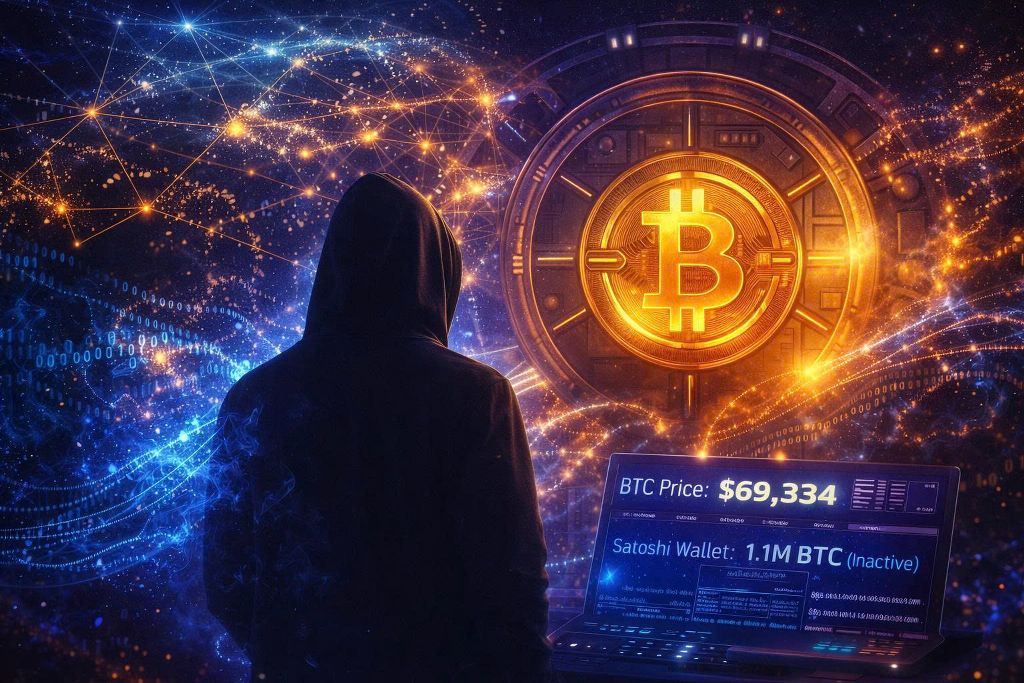
Table of Contents
The “Satoshi Era” Awakens
The crypto market has been on edge following a series of on-chain anomalies. On February 7, 2026, a cryptic transfer of 2.565 BTC was sent directly to Bitcoin’s Genesis wallet—the very first address mined by Nakamoto. While the transfer effectively “burned” over $175,000 (since the Genesis keys are presumed lost or deliberately discarded), it reignited a fervor of speculation. Was this a signal? A mistake? Or a billionaire’s tribute?
This follows a more significant event in late 2025, when dormant wallets from 2010—the “Satoshi Era”—suddenly activated, moving over 2,000 BTC (approx. $138 million at current prices). While forensic analysis suggests these belong to early miners rather than Nakamoto himself, the movement of such ancient coins always sends tremors through the market.
The HBO Fallout and the “Peter Todd” Theory
The search for Satoshi took a chaotic turn following the late 2024 release of the HBO documentary Money Electric: The Bitcoin Mystery. The film controversially pointed the finger at core developer Peter Todd, a claim that was met with widespread skepticism from the cryptographic community.
The aftermath was far from cinematic for Todd, who was forced into hiding due to safety concerns and an onslaught of harassment. The incident served as a grim reminder of why Nakamoto likely chose anonymity in the first place: the creator of a stateless currency is a target for every state, criminal, and fanatic on earth.
The End of the “Faketoshi” Saga
While new theories emerge, old imposters have finally been silenced. Dr. Craig Wright, who spent years aggressively suing developers and claiming to be Satoshi, faced a definitive legal reckoning in 2025. Following a devastating loss in the UK High Court—where a judge ruled his evidence was forged on a “grand scale”—Wright was later found in contempt of court and received a suspended prison sentence.
The legal dismantling of Wright’s claims has been a victory for the open-source community, officially closing the chapter on the “Faketoshi” distraction.
The Leading Theories in 2026
With Wright out of the picture and the Peter Todd theory largely dismissed, the community has circled back to the “usual suspects,” though with a new lens:
- Len Sassaman: The late privacy advocate and cryptographer is currently the favored candidate for many researchers. His death in 2011 oddly coincides with Satoshi’s final communication (“I’ve moved on to other things”).
- Hal Finney: The recipient of the first Bitcoin transaction remains the sentimental favorite. His battle with ALS and passing in 2014 aligns with the dormancy of the Satoshi wallets.
- Nick Szabo & Adam Back: Both men, whose pre-Bitcoin work (Bit Gold and Hashcash) is cited in the whitepaper, remain active in the space but steadfastly deny being the creator.
The Billion-Dollar Silence
Today, Bitcoin’s price hovers around $69,300, down slightly (-0.06%) in the last 24 hours but maintaining a massive market presence. Nakamoto’s estimated hoard of 1.1 million BTC is now valued at roughly $76 billion.
That this fortune remains untouched is the strongest evidence of all. In a world where every digital footprint is tracked, the discipline to leave $76 billion on the table suggests that Satoshi Nakamoto is either deceased or possesses a level of ideological conviction that is virtually alien to the modern financial world.
As 2026 unfolds, the mystery endures. And perhaps, for Bitcoin to truly function as a decentralized currency, it is better that its creator remains a myth rather than a man.
Disclaimer: This post is a compilation of publicly available information. MEXC does not verify or guarantee the accuracy of third-party content. Readers should conduct their own research before making any investment or participation decisions.
