

Key Takeaways
- The “Fortress” Thesis: While AI startups face volatility, Microsoft (MSFT) offers stability with a $3.42T market cap and a $460 price tag backed by real enterprise cash flow.
- Azure is Eating the World: Currently holding 24-25% of the cloud market, Azure is growing at 33-40%, significantly outpacing AWS thanks to AI infrastructure demand.
- Financial Health: A massive $45.1B net cash from operations (FY26 Q1) creates a safety net that few competitors can match.
- The Real Risks: It’s not all sunshine. Investors must watch antitrust scrutiny in the EU and soaring AI CAPEX that could compress short-term margins.
Volatility is usually the price of admission for the AI sector. But Microsoft (MSFT) is proving to be the exception.
While the rest of the market scrambles to bet on the “next big thing,” Microsoft has quietly cemented itself as the inevitable infrastructure of the modern economy. Trading around $460 as of mid-January 2026, MSFT isn’t a lottery ticket, it’s a compounder.
Let’s strip away the hype and look at the raw data to understand why MSFT remains a core holding for investors who value sleep over adrenaline.
Table of Contents
The Monetization Reality: Turning AI Hype into Enterprise Revenue
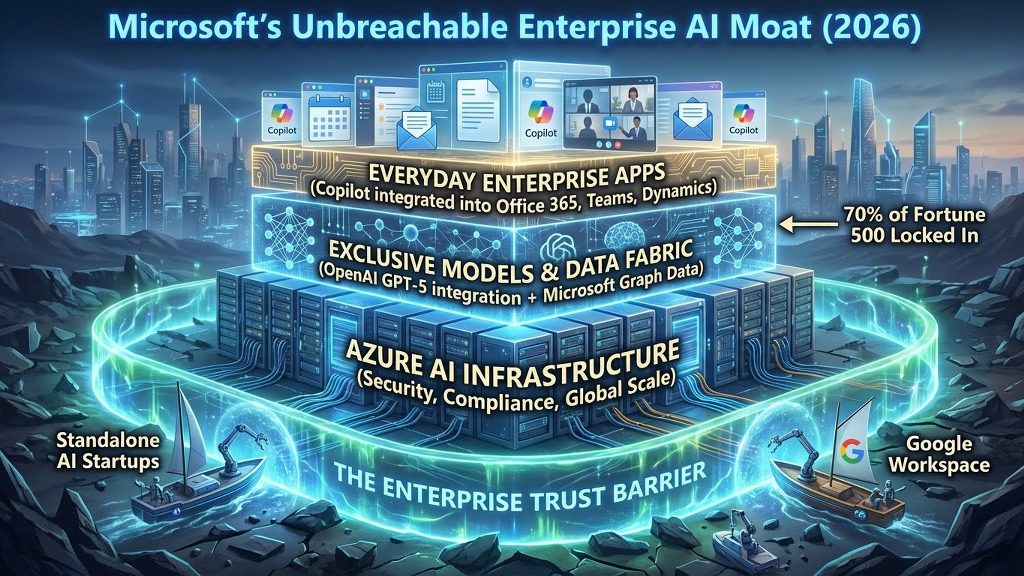
Most AI companies are still selling promises. Microsoft is selling invoices.
The narrative for 2026 isn’t just about “innovation”; it’s about adoption. Microsoft’s early $13 billion bet on OpenAI (now a stake valued around $203 billion) was a masterstroke, but the real story is how they’ve operationalized that tech.
- Copilot is the New Office Standard: It’s no longer an experiment. With over 300,000 employees internally and 70% of Fortune 500 companies adopting Copilot, Microsoft has successfully raised the average revenue per user (ARPU) for its commercial seats.
- The Revenue Proof: FY26 Q1 revenue hit $77.7 billion (up 18% YoY). This isn’t theoretical growth; it’s enterprise budgets shifting specifically to Microsoft’s ecosystem.
Analyst Note: The integration of ChatGPT tech into Bing and Office 365 creates a “moat” that is incredibly difficult for Google or standalone AI startups to breach in the enterprise space.
Azure vs. AWS: The Cloud War Has Shifted
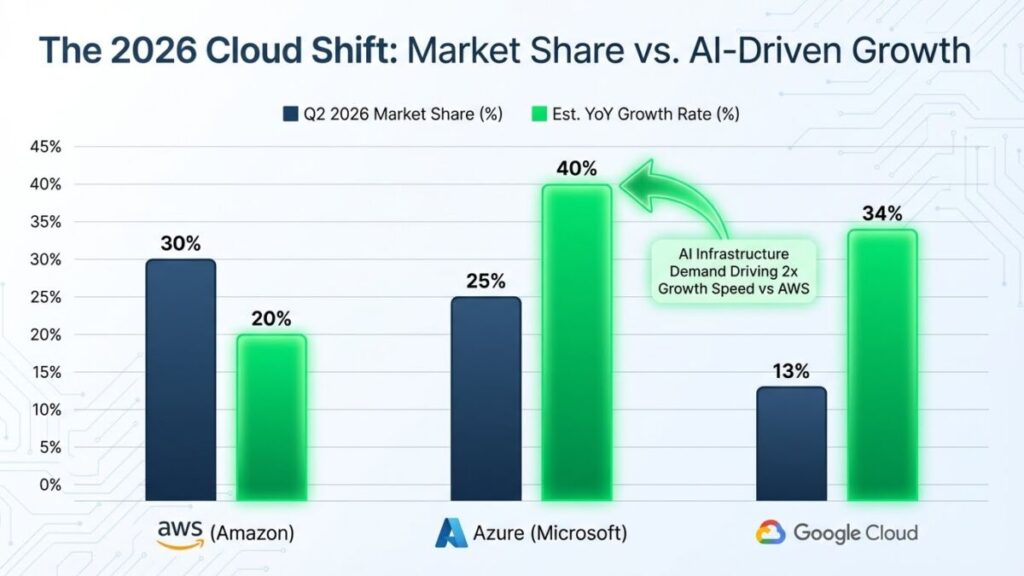
For a long time, Amazon Web Services (AWS) was the untouchable leader. That gap is closing fast.
In the AI era, compute is the new oil, and Azure is arguably the better refinery. Azure is capturing the lion’s share of AI-related cloud workloads because of its exclusive infrastructure optimization for OpenAI models.
Cloud Market Snapshot (Q2 2025/2026 Data):
| Cloud Provider | Market Share | Est. YoY Growth | Primary Driver |
| AWS (Amazon) | 30% | 17-20% | Legacy Infrastructure |
| Azure (Microsoft) | 24-25% | 33-40% | AI & Generative Models |
| Google Cloud | 13% | 32-34% | Data Analytics/TPU |
Why this matters for your portfolio: Azure’s annual run rate for AI alone has hit $13 billion. When the #2 player is growing nearly twice as fast as the #1 player, a “flippening” in market leadership isn’t just possible, it’s becoming probable within the decade.
Financial Fortress: The “Sleep Well” Metrics
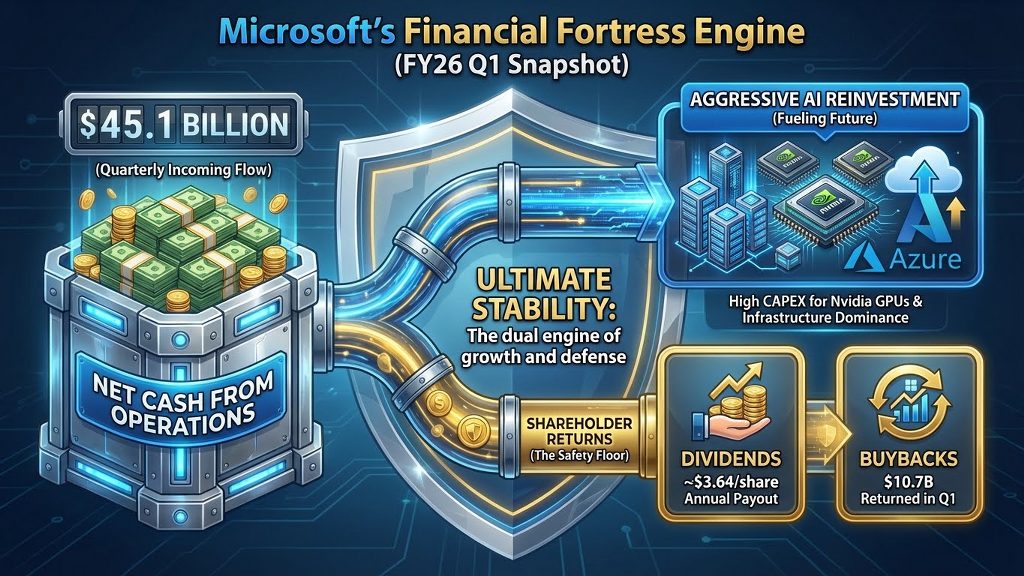
Tech stocks usually come with fragile balance sheets. Microsoft operates more like a sovereign wealth fund.
The “Sleep Well at Night” factor comes down to one word: Liquidity. In FY26 Q1 alone, Microsoft generated $45.1 billion in net cash from operations. They are sitting on roughly $28.8 billion in cash equivalents.
The Shareholder Return Engine
Even as they pour billions into data centers, they prioritize paying you:
- Dividend Yield: 0.79% (Annual payout ~$3.64/share). It sounds small, but with a 10%+ growth rate, your yield-on-cost compounds significantly over time.
- Buybacks: $10.7 billion returned to shareholders in just one quarter.
This dual engine, aggressive reinvestment in AI plus massive capital returns, is rare. It provides a floor for the stock price during market corrections.
Valuation: Is $460 Too Expensive?
Let’s talk numbers. A stock price of $460 implies a trailing P/E of ~32.7, dropping to a forward P/E of 27.65. If you are new to valuation metrics, understanding what is P/E ratio is crucial to interpreting whether this price point represents good value.
Is that rich? Historically, yes. In the context of AI, no. With a PEG ratio (Price/Earnings-to-Growth) of 2.05, the market is pricing MSFT fairly for its 15-20% expected growth rate. You are paying a premium for quality, similar to buying a bond that also happens to grow double-digits.
Key Strategic Considerations for Investors
While Microsoft’s trajectory is overwhelmingly positive, sophisticated investors should keep an eye on a few dynamic factors that could influence short-term performance:
- Elevated AI Capital Expenditure Microsoft is aggressively investing in next-generation infrastructure, including Nvidia GPUs and data centers, to secure its leadership position. While this high “investment intensity” is necessary for long-term dominance, it may temporarily impact profit margins. Investors should view this not as a cost, but as the fuel required to power future growth engines.
- Navigating the Regulatory Landscape As a global technology leader, Microsoft naturally operates under the microscope of regulators like the FTC and the European Commission. While scrutiny regarding partnerships (such as with OpenAI) creates headlines, Microsoft has a long history of successfully managing complex legal environments and adapting its business model to comply with evolving global standards.
- The Open Source Dynamic The rise of open-source models (like Meta’s Llama) offers developers alternatives to proprietary AI. However, this creates a segmented market rather than a zero-sum game. While open source serves specific needs, large enterprises continue to prioritize Azure’s security, compliance, and integrated support—areas where “free” models cannot compete. Microsoft’s ability to offer a premium, enterprise-grade environment remains its distinct advantage.
Trade MSFT Your Way on MEXC
Ready to act on this analysis? Whether you align with the “buy and hold” thesis or prefer active trading, MEXC has the right tool for you.
Use MEXC Spot x Stocks to add MSFT to your long-term portfolio, or leverage Stock Futures to capitalize on short-term volatility by going Long or Short. Access the world’s top assets directly with USDT, seamlessly bridging your crypto and stock strategies in one platform.
Verdict: The Cornerstone of a 2026 Portfolio
Microsoft manages to be two things at once: a defensive shield and an offensive weapon.
It protects your portfolio with a fortress balance sheet and dividends, while simultaneously exposing you to the highest upside in the AI revolution via Azure. At $460, it is not “cheap,” but quality rarely is.
The Strategy: Treat MSFT as a core holding. Ignore the daily noise, reinvest the dividends, and let the cloud compounding take care of the rest.
Frequently Asked Questions (FAQ)
- Is MSFT stock a Buy, Sell, or Hold in early 2026?
For long-term investors, it is a Buy/Hold. The valuation is fair (PEG 2.05) relative to its dominant position in AI and Cloud. Short-term traders should be wary of volatility around earnings reports due to high CAPEX expectations.
- How safe is Microsoft’s dividend?
Extremely safe. With over $45B in quarterly operating cash flow and a low payout ratio, Microsoft has ample room to increase dividends even if a recession hits.
- What is the biggest threat to Microsoft in 2026?
Regulatory intervention. Antitrust actions regarding their cloud dominance or OpenAI partnership pose the most significant structural risk to their business model.
- Can Azure overtake AWS?
Yes. Azure is currently growing significantly faster (33-40%) than AWS (17-20%). If this trend continues, Azure could become the market leader by revenue within the next 3-5 years.
Disclaimer: This article is for informational purposes only and does not constitute financial advice. Please conduct your own research (DYOR) and assess your risk tolerance before trading. MEXC does not accept liability for any investment decisions made based on the information provided herein.
