

Key Takeaway
- Financial Maturity: Robinhood (NASDAQ: HOOD) has successfully transitioned from a high-growth startup to a profitable powerhouse, projecting $1.99 EPS for FY2025.
- Strategic Positioning: With nearly $333 billion in Assets Under Custody (AUC), HOOD is capturing significant market share from legacy brokers through retirement and subscription products.
- The Crypto Catalyst: Crypto remains a high-octane growth engine, contributing ~35% of revenue, making HOOD a key beneficiary of the 2026 digital asset bull run.
- Trader’s Insight: For crypto-native investors, HOOD serves as both a long-term hold and a volatility play, with derivative markets offering strategic hedging opportunities.
Table of Contents
HOOD Stock Profile: Latest Market Data
Before analyzing the fundamentals, let’s establish the current market context for Robinhood Markets as of mid-January 2026.
| Metric | Data (Jan 19, 2026) | Signal |
| Current Price | ~$108.74 | Consolidation |
| Market Cap | $94.99 Billion | Large Cap |
| P/E Ratio (Forward) | ~44x | Growth Priced |
| EPS (FY2025 Est) | $1.99 | High Growth (+82%) |
| Beta (5Y) | 1.65 | High Volatility |
Company Overview: The “Super App” Evolution
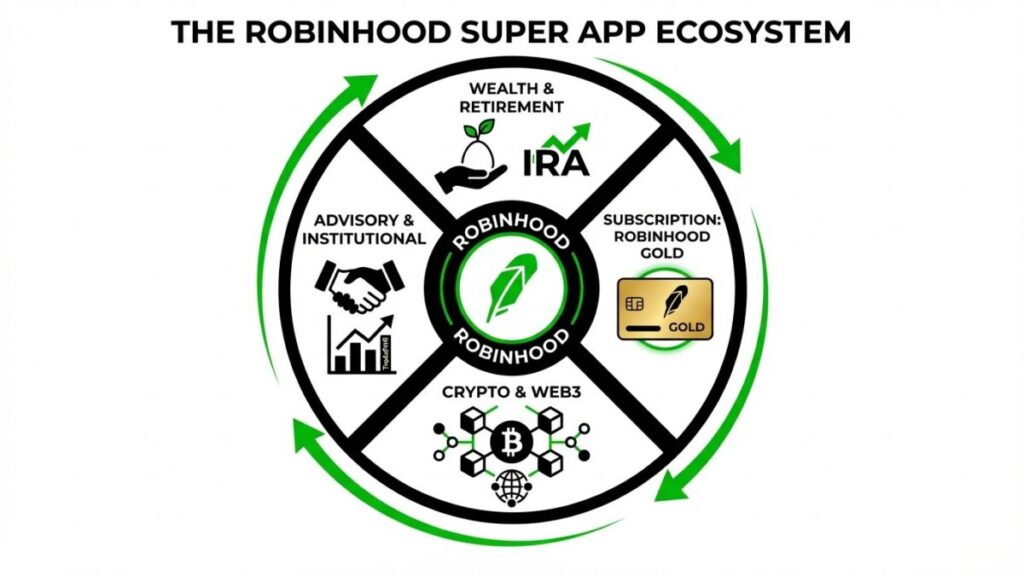
By 2026, the narrative around Robinhood has shifted. No longer defined solely by the retail trading frenzy of 2021, Robinhood has built a sticky, comprehensive financial ecosystem.
deepening the “Share of Wallet”
The company is aggressively expanding beyond simple stock trading into holistic wealth management:
- Robinhood Gold: This subscription layer has become a massive recurring revenue moat. With ARPU (Average Revenue Per User) climbing to $191 (+82% YoY), Gold members are not just trading; they are banking, saving, and researching on the platform.
- The Retirement Lock-in: The 1-3% IRA match program was a strategic masterstroke. By securing $10 billion in retirement assets, Robinhood has effectively reduced user churn. Investors are far less likely to switch platforms when their long-term pension funds are locked in.
- Global & Institutional Steps: The acquisition of TradePMR allows Robinhood to enter the RIA (Registered Investment Advisor) space, targeting wealthier, older demographics, while EU expansion continues to diversify its geographic footprint.
Financial Performance: Operational Leverage in Action
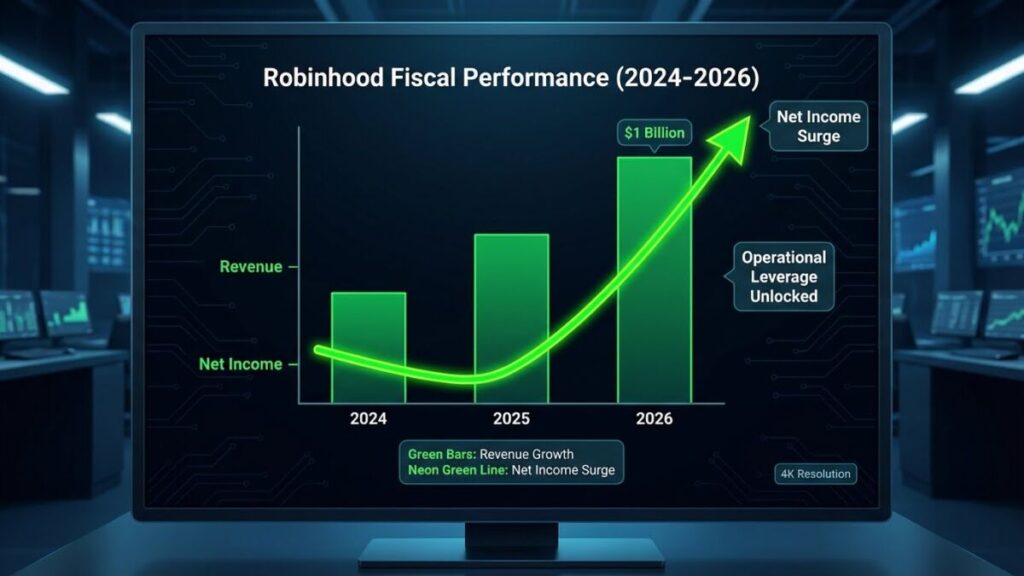
The most compelling bullish argument for HOOD in 2026 is Operational Leverage. The company has maintained a disciplined cost structure even as revenue accelerates, allowing profit margins to expand significantly.
Key Performance Indicators (KPIs):
- Revenue Acceleration: Q3 2025 revenue reached $989 million (+45% YoY), driven by a resurgence in retail engagement. Q4 is forecasted to breach the psychological $1 billion quarterly milestone.
- Profitability Unlocked: Unlike many fintech peers, HOOD delivers real GAAP profitability. Net income surged 271% to $556 million in Q3.
- Clean Balance Sheet: With $8.07 billion in corporate cash and investments versus manageable debt, Robinhood is insulated against high-interest rate environments and retains the dry powder for strategic acquisitions.
Analyst Note: The projected EPS growth from $0.61 (Q3) to a full-year forecast of $2.40 in 2026 suggests the stock’s premium valuation is supported by tangible earnings power, not just hype.
The Crypto Factor: Strength & Correlation
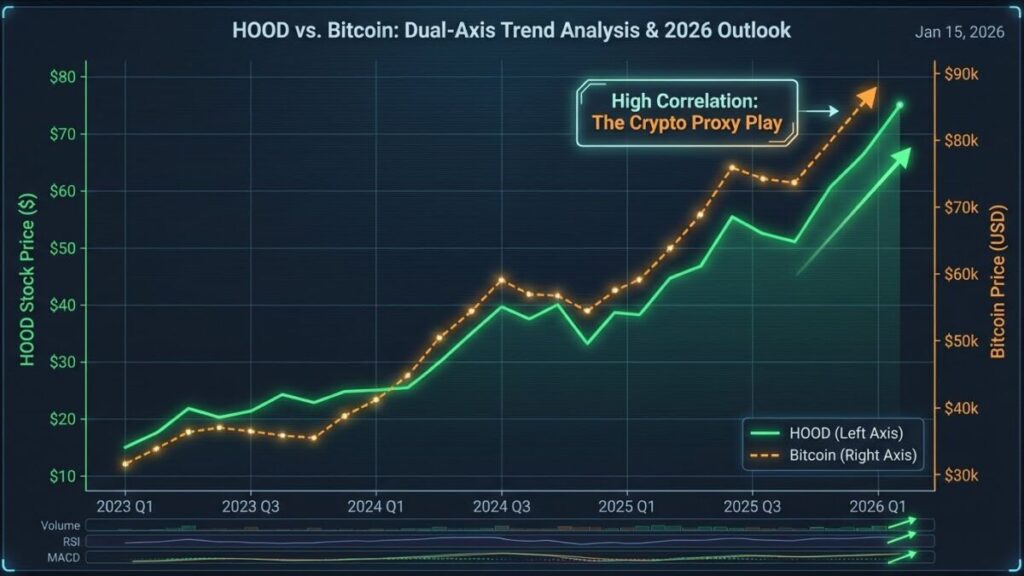
Is HOOD a fintech stock or a crypto proxy? The data suggests it is a hybrid with a high correlation to the digital asset market.
- Revenue Driver: In Q3, crypto transaction revenue reached $268 million (approx. 21% of total revenue). With the crypto market rally in Q4, this segment is expected to expand further.
- Prediction Markets: The launch of prediction markets has seen rapid adoption, with 2.3 billion contracts traded in Q3 alone, adding a new layer of engagement beyond standard token trading.
For investors, this means HOOD often acts as a “leveraged beta” play on Bitcoin—rising fast when crypto rallies, but facing headwinds during digital asset corrections.
Risks & Considerations
While the growth trajectory is impressive, smart investors must weigh the potential headwinds:
- Valuation Premium: At ~44x Forward Earnings, HOOD is priced for perfection. Any miss in the upcoming Q4 earnings or 2026 guidance could lead to multiple compression.
- Regulatory Environment: The crypto and fintech sectors remain under regulatory scrutiny. Changes to market structure rules or staking services could impact future margins.
- Revenue Concentration: While diversifying, a significant portion of growth is still tied to market sentiment and trading volumes, which can be cyclical.
Smart Alternative: Trade HOOD Stock Futures on MEXC
While holding shares is ideal for long-term growth, active traders often face limitations with traditional brokers (settlement times, no weekend trading). This is where crypto-native platforms bridge the gap.
Why consider MEXC Stock Futures?
- Capital Efficiency: Trade HOOD/USDT contracts with leverage, freeing up capital for other opportunities.
- Hedging: Easily Short HOOD to hedge your portfolio against tech or crypto market downturns.
- Speed: Deposit USDT and start trading instantly, no settlement delays.
Conclusion
Robinhood has silenced the skeptics. With $1.27 billion in quarterly revenue and a clear path to $2.40 EPS by 2026, it has evolved into a profitable fintech leader. For long-term investors, it offers unique exposure to the intersection of traditional finance and crypto.
However, given the stock’s volatility (Beta 1.65) and premium valuation, active traders may find better utility in derivative markets like MEXC Stock Futures, where they can manage risk and capitalize on price swings more dynamically.
Frequently Asked Questions (FAQ)
Q1: Is HOOD stock overvalued at $108?
Not necessarily. While a 44x P/E is high, it is justified by the massive 82% earnings growth rate. The “PEG ratio” suggests it is still fairly priced for growth.
Q2: Can I trade HOOD stock on weekends?
Traditional brokers are closed on weekends. However, some crypto-backed stock futures platforms may offer extended hours or pre-market trading options depending on liquidity.
Q3: How does Robinhood make money?
Three main pillars: Transaction-based revenues (Crypto/Options), Net Interest Income (Cash/Margin), and Subscriptions (Robinhood Gold).
Q4: Why trade Stock Futures on MEXC instead of buying shares?
MEXC allows you to trade with Leverage (using less capital to control a larger position) and offers the ability to Short Sell instantly to profit from market drops, all using USDT.
Disclaimer: This article is for informational purposes only and does not constitute financial advice. Please conduct your own research (DYOR) and assess your risk tolerance before trading. MEXC does not accept liability for any investment decisions made based on the information provided herein.
