


Stablecoins are becoming the financial infrastructure of crypto markets, connecting trading, liquidity, and blockchain settlement systems.
Stablecoins were supposed to be simple.
Digital dollars on the blockchain.
Fast. Borderless. Stable.
But in 2026, stablecoins are no longer just a convenience for traders. They are a $300+ billion market and processed more than $34 trillion in transaction volume last year (Visa Onchain Analytics, 2025). Governments are regulating them. Banks are launching them. Exchanges depend on them.
And yet, most traders still treat all stablecoins the same.
That’s a mistake.
Because not all stablecoins work the same way, and the differences matter.
If you trade crypto, hold USDT on an exchange, farm yield, or move funds between platforms, understanding how stablecoins actually work is now part of risk management.
1. What Is a Stablecoin (Really)?
At its core, a stablecoin is a digital asset designed to maintain a stable value, usually pegged to the US dollar.
But “designed to” does not mean “guaranteed to.”
According to the Wharton Blockchain and Digital Asset Project’s 2026 Stablecoin Toolkit, stablecoins are:
Publicly available, non-central bank issued digital assets aiming to serve as a stable unit of account through economic mechanisms.
That definition matters.
They are not issued by central banks.
They rely on economic design, not government authority.
Stability is the goal, but it’s never guaranteed.
And how that stability is achieved is where things get interesting.
2. The Four Main Types of Stablecoins (And Why Traders Should Care)

Different stablecoin designs rely on different economic mechanisms to maintain their dollar peg.
There are four major models in today’s market. Each carries different risks.
1st. Fully Collateralized Stablecoins (The “Traditional” Model)
Examples: USDT, USDC
This is what most people imagine.
For every token issued, the company holds reserves, usually cash, US Treasury bills, or short-term government securities.
If 1 billion tokens exist, the issuer claims to hold $1 billion (or equivalent assets) in custody.
Why traders like it:
- Easy to understand
- Widely accepted
- Deep liquidity on exchanges
The real risk: You are trusting a centralized entity to:
- Actually hold the reserves
- Manage them safely
- Remain solvent
- Avoid regulatory shutdown
This model depends entirely on trust and compliance.
For exchange traders, this is generally the lowest-friction stablecoin, but not risk-free.
2nd. Overcollateralized On-Chain Stablecoins (DeFi Model)
Example: DAI
This model removes traditional custodians.
Users lock crypto (like ETH) into smart contracts. They mint stablecoins worth less than their collateral — usually 150% or more.
If collateral value drops too much, the system automatically liquidates positions.
Why traders like it:
- Transparent on-chain collateral
- No centralized bank custody
- DeFi integration
The real risk:
- Crypto collateral is volatile
- Market crashes trigger liquidations
- Capital inefficient (requires excess collateral)
This model trades efficiency for decentralization.
3rd. Algorithmic Stablecoins (Supply-Based Model)
This model tries to maintain price stability by expanding and contracting token supply instead of backing with collateral.
- When price rises above $1 → mint more tokens.
- When price drops below $1 → reduce supply.
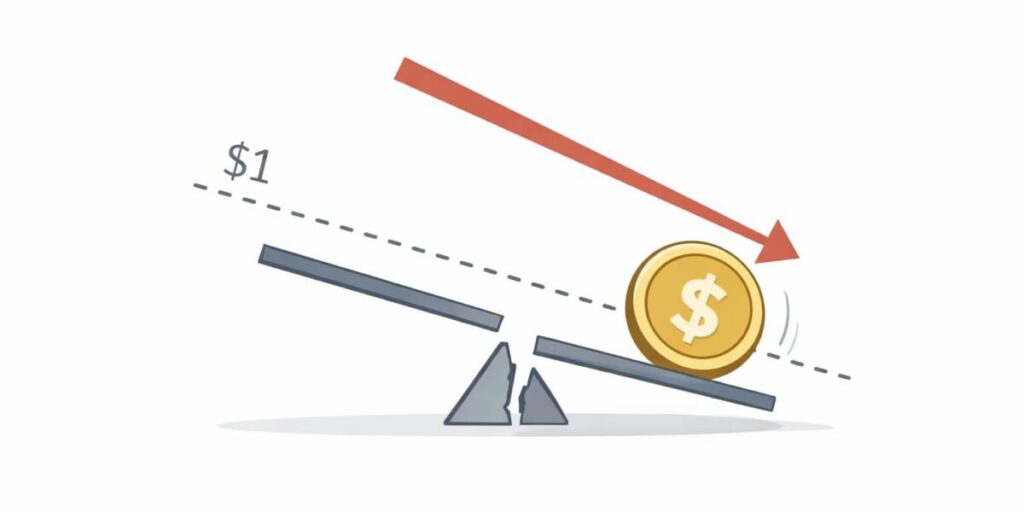
Some stablecoins designs can lose their peg during market stress, creating systemic risk for traders and exchanges.
In theory, it works like a self-adjusting monetary policy.
In reality, history says otherwise.
In May 2022, traders watched TerraUSD collapse in real time. Within days, what was once considered a stable digital dollar lost its peg entirely, wiping out more than $40 billion in value and sending shockwaves across the entire crypto market.
The peg broke. Confidence vanished. The algorithm failed.
Because stability without real backing depends entirely on market psychology.
Today, major regulatory frameworks exclude pure algorithmic stablecoins.
For traders: extremely high structural risk.
4th. Synthetic or Hedged Stablecoins (The New Innovation)
This newer model uses crypto collateral combined with derivatives hedging.
In simple terms:
- Hold crypto assets
- Open short positions in futures markets
- Stay “delta neutral” so price changes cancel out
The strategy aims to keep value stable while earning yield from staking rewards and funding rates.
Why traders find it interesting:
- Generates yield
- Capital efficient
- Rapid growth in derivatives ecosystems
The risk:
- Depends on derivatives market liquidity
- Funding rates can flip negative
- Extreme volatility could stress hedging systems
This model is innovative, but complexity increases systemic exposure.
3. Why Stablecoin Structure Matters for Exchanges and Traders:
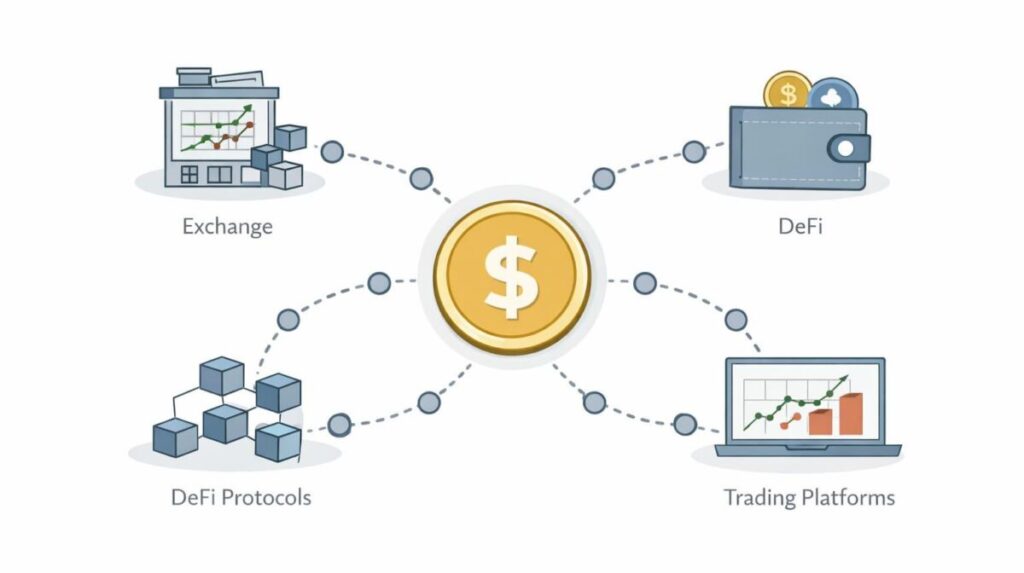
Stablecoins act as the liquidity backbone connecting exchanges, trading platforms, and decentralized finance systems.
On platforms or other major exchanges, stablecoins are the base layer of trading.
They are:
- Margin collateral
- Settlement currency
- Liquidity pairs
- Treasury storage
If a stablecoin depegs even temporarily:
- Liquidations spike
- Order books thin
- Arbitrage volatility increases
- Trust declines
For traders, stablecoins are not just “parking money.” They are infrastructure.
And infrastructure risk is often invisible until it fails.
4. Are Stablecoins Actually Used for Payments?
Here’s something surprising.
Visa reported $34 trillion in stablecoin transaction volume in 2025. But after removing bot activity and high-frequency trading, roughly 80% disappears. And about 99% of remaining volume is tied to digital asset trading, not consumer payments.
So despite headlines about “crypto replacing banks,” stablecoins today are primarily trading tools, not retail payment systems.
That could change.
But for now, they are deeply embedded in crypto markets rather than everyday commerce.
5. Regulation Is Catching Up:
In 2025, the United States introduced federal stablecoin legislation. The European Union, Japan, Singapore, Hong Kong, and the UAE also established regulatory frameworks.
Governments are focusing primarily on:
- Reserve transparency
- Liquidity requirements
- Redemption rights
- Consumer protection
Why?
Because stablecoins resemble money market funds more than they resemble cryptocurrencies.
If reserves are mismanaged or redemption fails during panic, financial contagion could spread quickly.
Regulation is not anti-crypto here. It is system protection.
For exchanges and institutional traders, regulatory clarity is bullish long-term, even if it reduces yield or increases compliance cost.
6. What Traders Should Actually Do:
Instead of blindly holding stablecoins, consider:
I. Diversify Exposure:
Don’t keep all capital in one stablecoin. Structural risk differs.
II. Understand the Backing:
Is it Treasury-backed? Crypto-backed? Derivatives-hedged?
Each has different stress scenarios.
III. Monitor Depeg Events:
Even “safe” stablecoins can temporarily trade at $0.97 or $1.03 during market panic. Liquidity spreads matter during volatility.
IV. Treat Yield Carefully:
If a stablecoin offers high yield, ask:
- Where does it come from?
- Is it sustainable?
- Is it dependent on derivatives funding rates?
Yield is never free.
7. The Bigger Picture: Stablecoins as Financial Infrastructure
Stablecoins are no longer experimental.
They now sit between:
- Traditional banking
- Crypto exchanges
- DeFi protocols
- AI trading agents
- Cross-border settlement systems
They are competing with:
- Bank deposits
- Money market funds
- Central Bank Digital Currencies (CBDCs)
The future of money may not be Bitcoin replacing the dollar.
It may be programmable dollars running on blockchain infrastructure.
That shift is quieter, but potentially more powerful.
8. Final Thought: Stability Is an Engineering Problem

Stablecoins could become the programmable financial layer connecting Blockchain infrastructure with global economic systems.
Stablecoins are not magical.
They are financial engineering systems attempting to replicate trust, liquidity, and stability without traditional banking structures.
Some rely on custody. Some rely on overcollateralization. Some rely on algorithms. Some rely on derivatives markets.
Each approach has trade-offs.
For traders and crypto platforms, the key is not to chase hype, but to understand structure.
Because when volatility hits, structure determines survival.
And in crypto, survival is everything.
Source & References:
- Visa Onchain Analytics Report (2025 Stablecoin Volume Data)
- Wharton Blockchain and Digital Asset Project – The Stablecoin Toolkit (2026)
- CoinMarketCap Historical Data – TerraUSD (UST) Collapse (May 2022)
- Public regulatory frameworks: EU MiCA Regulation (2023 implementation phase), U.S. Stablecoin Legislative Developments (2025)
Disclaimer: This content is for educational and reference purposes only and does not constitute any investment advice. Digital asset investments carry high risk. Please evaluate carefully and assume full responsibility for your own decisions.
